Science is full of strange, wonderful facts. And what better way to learn them than through a puzzle? These science riddles with answers turn hard facts into fun little mysteries. Solve them alone, or challenge your friends, kids, or classroom.
Below you’ll find 165 riddles, sorted by topic. Every riddle has a clear, bolded answer right underneath. No flipping to the back of the book. No guessing games. Just quick, satisfying “aha!” moments, one after another.
Table of Contents
Physics and Force Riddles With Answers
Physics explains how the world moves, bends, and glows. These physics riddles cover light, energy, sound, and the invisible forces that shape everyday life.
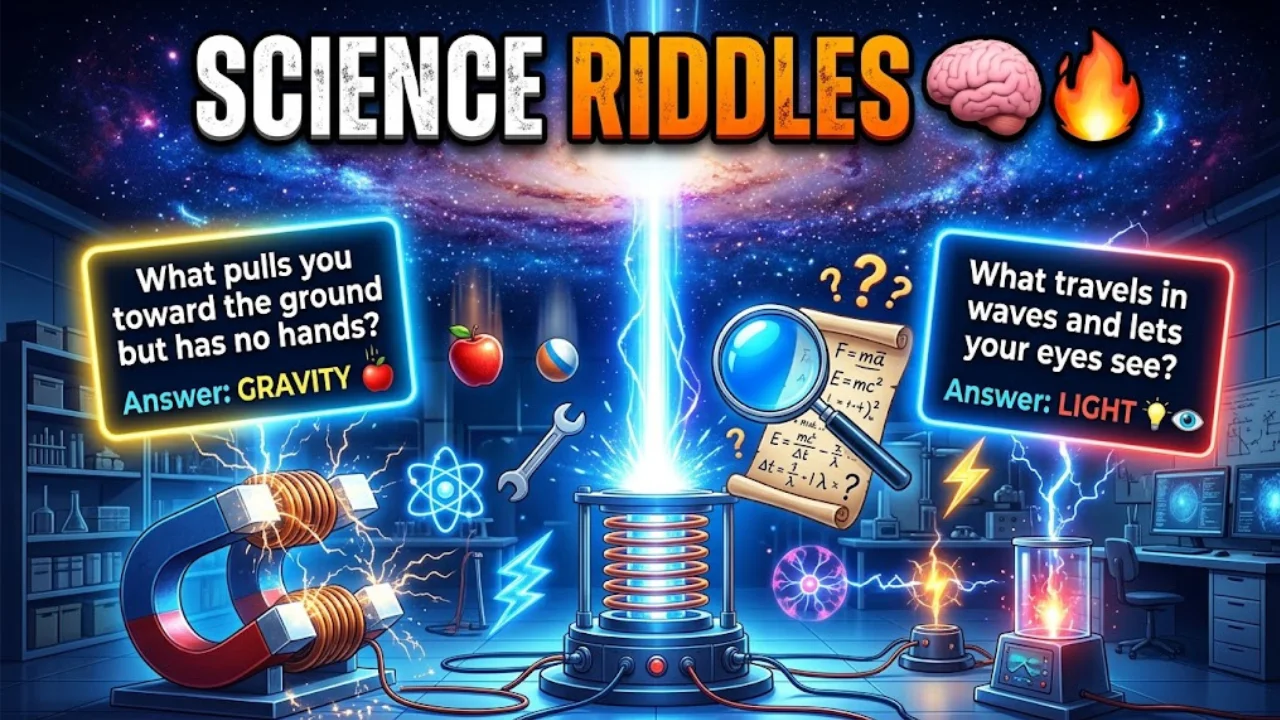
- What travels in waves, bounces off mirrors, and lets your eyes see the world? Answer: Light
- What pulls you toward the ground but has no hands to grab you? Answer: Gravity
- What has a north end and a south end, and can push or pull metal without touching it? Answer: A magnet
- What can’t be seen, but bends trees and lifts kites into the sky? Answer: Wind
- What force makes your bike slow down when you stop pedaling? Answer: Friction
- What keeps you leaning back when a car speeds up fast? Answer: Inertia
- What repeats your voice back to you across a canyon? Answer: An echo
- What kind of energy is stored in a stretched rubber band? Answer: Potential energy
- What kind of energy does a rolling skateboard have? Answer: Kinetic energy
- What flows through wires to power your lights and phone charger? Answer: Electricity
- What simple machine is a flat ramp used to lift heavy objects with less effort? Answer: An inclined plane
- What simple machine helps you open a door using a small push near the edge? Answer: A lever
- What round object lets a wagon roll instead of drag? Answer: A wheel
- What tool uses a rope and a wheel to lift heavy loads, like a flag on a pole? Answer: A pulley
- What happens to a rubber duck in water because it’s less dense than the water around it? Answer: It floats (buoyancy)
- What invisible force pushes down on you from the air, all day, every day? Answer: Air pressure
- What splits sunlight into a rainbow when light passes through it? Answer: A prism
- What arc of color appears in the sky after it rains? Answer: A rainbow
- What dark shape follows you around on a sunny day? Answer: A shadow
- What bends when a straight pencil looks broken inside a glass of water? Answer: Light (refraction)
- What bounces off a smooth surface to show you your own face? Answer: A reflection
- What tool tells you the temperature outside, hot or cold? Answer: A thermometer
- What word means “how much matter” is packed inside an object? Answer: Mass
- What word describes how heavy something feels because of gravity’s pull? Answer: Weight
- What do scientists call a push or a pull on an object? Answer: Force
- What word describes speeding up or slowing down? Answer: Acceleration
- What curved path does a satellite follow around the Earth? Answer: An orbit
- What has no matter at all, yet light can still travel through it? Answer: A vacuum
- What word describes a fast back-and-forth shake, like a guitar string? Answer: Vibration
- What tiny particle carries an electric charge through a wire? Answer: An electron
- What law says every action has an equal and opposite reaction? Answer: Newton’s Third Law
- What happens to sound when it can’t travel because there’s no air, like in space? Answer: It can’t be heard (sound needs air or matter to travel)
- What word describes the highness or lowness of a sound? Answer: Pitch
Chemistry and Element Riddles With Answers
Chemistry is the study of what things are made of and how they change. These riddles cover atoms, reactions, and everyday materials you already use.
- What needs oxygen to burn, but water puts it right out? Answer: Fire
- What can be solid ice, liquid water, or steamy gas, all at once at the right temperature? Answer: Water
- What starts black, glows red when burned, and turns gray as ash? Answer: Charcoal
- What is the tiniest building block of matter, too small for your eyes to see? Answer: An atom
- What forms when two or more atoms bond together, like two hydrogen and one oxygen? Answer: A molecule (water)
- What word describes a pure substance found on the periodic table, like gold or oxygen? Answer: An element
- What gas do you breathe in that keeps you and every fire alive? Answer: Oxygen
- What is the lightest and most common element in the entire universe? Answer: Hydrogen
- What element makes up both the graphite in your pencil and a sparkling diamond? Answer: Carbon
- What shiny yellow metal is used in rings, coins, and trophies? Answer: Gold
- What reddish coating forms on iron after it meets water and air? Answer: Rust
- What white crystal makes your fries taste better but can raise blood pressure in large amounts? Answer: Salt
- What sweet crystal dissolves in your tea or lemonade? Answer: Sugar
- What kind of substance tastes sour and turns blue litmus paper red? Answer: An acid
- What kind of substance feels slippery and turns red litmus paper blue? Answer: A base
- What number scale, from 0 to 14, tells you how acidic or basic something is? Answer: The pH scale
- What forms when you stir sand into water, but the two never chemically combine? Answer: A mixture
- What happens to water when it heats up and turns into invisible vapor? Answer: Evaporation
- What happens when water vapor cools and turns back into liquid drops, like on a cold glass? Answer: Condensation
- What gas do you breathe out, and what do plants breathe in? Answer: Carbon dioxide
- What gas makes up about 78% of the air you breathe, though you rarely think about it? Answer: Nitrogen
- What layer high in the sky blocks harmful rays from the Sun? Answer: The ozone layer
- What kitchen powder fizzes and bubbles the moment it meets vinegar? Answer: Baking soda
- What is the hardest natural substance on Earth, formed from carbon under extreme pressure? Answer: A diamond
- What soft, gray form of carbon is used inside your pencil? Answer: Graphite
- What silvery liquid metal shares its name with both a Roman god and a planet? Answer: Mercury
- What word describes what happens when two chemicals combine to make something brand new? Answer: A chemical reaction
- What speeds up a chemical reaction without being used up itself? Answer: A catalyst
- What state of matter has no fixed shape and can fill any container, like air? Answer: A gas
- What state of matter takes the shape of its container but keeps the same volume? Answer: A liquid
- What state of matter holds its own shape and size, like a rock or a block of wood? Answer: A solid
- What process turns wood and oxygen into fire, heat, and smoke? Answer: Combustion
- What soft metal reacts violently and can even spark when it touches water? Answer: Sodium
Must Visit: 160+ Ultimate Christmas Riddles With Answers to Challenge Your Brain & Spark Holiday Fun in 2026
Biology and Human Body Riddles With Answers
Your body is a walking science lab. These biology riddles cover organs, cells, and the tiny systems working inside you right now.
- What organ pumps blood through your body about 100,000 times every single day? Answer: The heart
- What two organs fill up with air every time you take a breath? Answer: The lungs
- What organ controls your thoughts, memories, and movements from inside your skull? Answer: The brain
- What 206 hard parts give your body its shape and protect your organs? Answer: Bones (the skeleton)
- What is the largest organ in the human body, covering you from head to toe? Answer: Skin
- What red liquid carries oxygen to every part of your body? Answer: Blood
- What twisted molecule inside your cells carries the instructions that make you, you? Answer: DNA
- What thread-like structures, 23 from each parent, carry your genetic code? Answer: Chromosomes
- What is the smallest living unit that makes up every plant and animal? Answer: A cell
- What 32 hard structures help you bite and chew your food? Answer: Teeth
- What muscle in your mouth tastes sweet, salty, sour, and bitter? Answer: The tongue
- What two round organs let you see color, light, and shape? Answer: Your eyes
- What organs let you hear music, voices, and everyday sound? Answer: Your ears
- What organ uses acid to break down the food you just ate? Answer: The stomach
- What two bean-shaped organs filter waste out of your blood? Answer: Kidneys
- What bony column runs down your back and protects your nerves? Answer: The spine
- What automatic, lightning-fast reaction pulls your hand off a hot stove before you even think? Answer: A reflex
- What can everyone hold for a short time, but nobody can hold forever? Answer: Your breath
- What sudden, loud burst clears dust or germs out of your nose? Answer: A sneeze
- What action makes your mouth stretch wide open when you’re tired, and can spread to others nearby? Answer: A yawn
- What sudden muscle twitch in your chest makes a “hic” sound? Answer: A hiccup
- What pattern on your fingertip is completely unique to you, and no one else on Earth? Answer: A fingerprint
- What keeps growing from your head, though the strands themselves have no living cells? Answer: Hair
- What salty liquid cools your skin down on a hot day? Answer: Sweat
- What liquid in your mouth helps soften food before you swallow? Answer: Saliva
- What tiny germ, far too small to see, can make you sick and spread from person to person? Answer: A virus
- What system inside your body fights off germs and keeps you healthy? Answer: The immune system
- What short piece of DNA passes traits, like eye color, from parent to child? Answer: A gene
- What process lets plants turn sunlight, water, and air into their own food? Answer: Photosynthesis
- What green pigment inside leaves captures sunlight for energy? Answer: Chlorophyll
- What word describes a seed’s first sprout as it breaks through the soil? Answer: Germination
- What tough tissue connects your muscles to your bones? Answer: A tendon
- What round part of your eye sits in a socket and can never bounce or be thrown? Answer: Your eyeball
Space and Astronomy Riddles With Answers
Space is bigger than the mind can fully picture. These astronomy riddles cover planets, stars, and the mysteries far beyond Earth’s atmosphere.
- What giant, glowing star gives Earth its light and warmth? Answer: The Sun
- What planet has layers like an onion, but you’d never call it a ball or a cake? Answer: Earth
- What planet sits closest to the Sun and is named after a speedy Roman god? Answer: Mercury
- What planet is the hottest in the solar system, even hotter than Mercury, because of its thick clouds? Answer: Venus
- What planet is known as the “Red Planet” because of its rusty, iron-rich soil? Answer: Mars
- What is the largest planet in the solar system, famous for its giant red storm? Answer: Jupiter
- What planet is famous for the bright, icy rings that circle it? Answer: Saturn
- What planet spins on its side, almost like it’s rolling instead of spinning? Answer: Uranus
- What deep blue planet has the fastest winds recorded anywhere in the solar system? Answer: Neptune
- What was once called the ninth planet, but is now known as a dwarf planet? Answer: Pluto
- What object in the night sky changes shape from full to crescent, but never actually changes size? Answer: The Moon
- What tiny points of light appear at night, but vanish by day without anyone stealing them? Answer: Stars
- What pattern of stars forms shapes in the sky, like a bear or a hunter? Answer: A constellation
- What giant swirl of stars, gas, and dust is Earth’s cosmic home? Answer: A galaxy (the Milky Way)
- What object is so dense that not even light can escape its pull? Answer: A black hole
- What icy space object grows a glowing tail as it nears the Sun? Answer: A comet
- What rocky object orbits the Sun but is too small to be called a planet? Answer: An asteroid
- What bright streak lights up the sky when space debris burns up in Earth’s atmosphere? Answer: A meteor
- What tool helps astronomers see distant planets, moons, and stars up close? Answer: A telescope
- What person wears a special suit to survive and work outside Earth’s atmosphere? Answer: An astronaut
- What powerful vehicle launches astronauts and satellites into space? Answer: A rocket
- What curved path does a planet follow as it circles the Sun? Answer: An orbit
- What object orbits Earth and sends signals to your phone’s map app? Answer: A satellite
- What event happens when the Moon blocks the Sun and turns day into darkness? Answer: A solar eclipse
- What event happens when Earth’s shadow falls across the Moon, turning it reddish? Answer: A lunar eclipse
- What term describes the floating feeling astronauts experience in space? Answer: Zero gravity (weightlessness)
- What ocean movement rises and falls twice a day because of the Moon’s pull? Answer: A tide
- What colorful light show appears near the North Pole when charged particles hit the atmosphere? Answer: The Aurora (Northern Lights)
- What unit measures distance in space based on how far light travels in one year? Answer: A light-year
- What word describes everything that exists: every star, planet, and speck of space? Answer: The universe
- What theory explains the explosive moment the universe began? Answer: The Big Bang
- What glowing cloud of gas and dust is often called a “star nursery” because new stars form there? Answer: A nebula
- What massive explosion happens at the end of a dying star’s life? Answer: A supernova
Earth, Weather, and Technology Riddles With Answers
Earth science covers weather, land, and the tools humans built to understand it all. These riddles blend natural phenomena with modern technology.
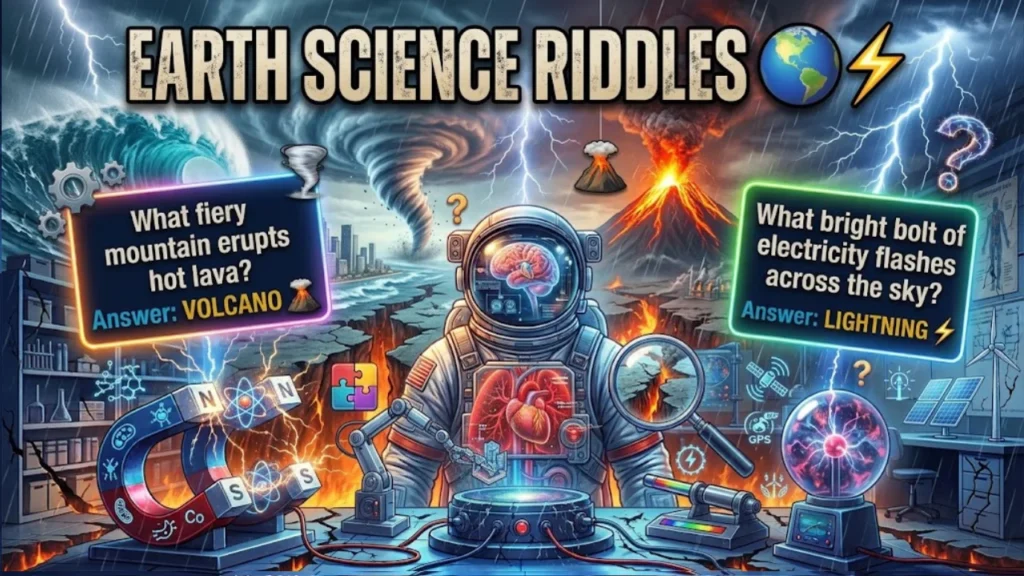
- What fiery mountain erupts hot lava from deep inside the Earth? Answer: A volcano
- What sudden shake of the ground can knock down buildings in seconds? Answer: An earthquake
- What giant ocean wave is caused by an underwater earthquake? Answer: A tsunami
- What hard material, formed over millions of years, makes up mountains and cliffs? Answer: Rock
- What preserved trace of an ancient creature is found buried in stone? Answer: A fossil
- What giant reptile walked the Earth millions of years before humans existed? Answer: A dinosaur
- What slow-moving river of solid ice can carve out entire valleys? Answer: A glacier
- What massive chunk of floating ice hides most of its bulk underwater? Answer: An iceberg
- What covers about 71% of Earth’s surface and holds nearly all of its water? Answer: The ocean
- What natural waterway flows from mountains down toward the sea? Answer: A river
- What dry, sandy region gets very little rainfall each year? Answer: A desert
- What thick, green forest gets so much rain that it’s home to more species than anywhere else on land? Answer: A rainforest
- What word describes a community of living things working together with their environment? Answer: An ecosystem
- What term describes who eats whom, starting from a plant and ending with a predator? Answer: A food chain
- What white, fluffy shape floats in the sky and can turn dark before a storm? Answer: A cloud
- What falls from clouds and fills rivers, lakes, and gardens? Answer: Rain
- What loud rumble follows a flash of lightning in a storm? Answer: Thunder
- What bright, fast bolt of electricity flashes across the sky during a storm? Answer: Lightning
- What cold, white flakes fall in winter and blanket the ground? Answer: Snow
- What spinning storm forms over warm ocean water and has a calm “eye” at its center? Answer: A hurricane
- What fast, spinning funnel of wind can drop from a storm cloud and touch the ground? Answer: A tornado
- What small tool always points north and helps explorers find their way? Answer: A compass
- What system uses satellites in space to guide your phone or car to the right address? Answer: GPS
- What machine stores your photos, plays your games, and processes information in seconds? Answer: A computer
- What programmed machine can move, sense, and complete tasks on its own? Answer: A robot
- What global network connects computers so people can share messages and information instantly? Answer: The internet
- What tool lets scientists study cells and bacteria far too small to see with the naked eye? Answer: A microscope
- What flat device on rooftops turns sunlight directly into electricity? Answer: A solar panel
- What tall, spinning machine turns wind into usable electric power? Answer: A wind turbine
- What natural process traps heat near Earth’s surface, keeping the planet warm enough for life? Answer: The greenhouse effect
- What fuel, formed from ancient plants and animals, is burned for energy today? Answer: Fossil fuel
- What process turns used bottles, cans, and paper into brand-new products? Answer: Recycling
- What changes four times a year because of Earth’s tilt as it orbits the Sun? Answer: A season
FAQs
What are some science riddles?
Science riddles are short puzzles that describe a fact, object, or process from physics, chemistry, biology, or astronomy, using clues instead of naming the answer directly. A simple example: “What pulls you toward the ground but has no hands to grab you?” The answer, gravity, is one of the most tested forces on Earth. According to the International Astronomical Union, gravity is the reason planets stay in orbit around the Sun at all.
What are 10 scientific questions?
Here are 10 quick examples pulled from the full list above: What travels in waves and lets you see? (Light) What organ pumps your blood? (The heart) What gas do plants breathe in? (Carbon dioxide) What is the closest planet to the Sun? (Mercury) What causes rust on iron? (Water and oxygen) What process makes plants their own food? (Photosynthesis) What has rings made of ice? (Saturn) What tool magnifies tiny cells? (A microscope) What force slows a rolling ball? (Friction) What natural event turns the Moon red? (A lunar eclipse)
What’s the hardest riddle ever?
There’s no single “official” hardest riddle, since difficulty depends on the solver’s age and knowledge. Riddles that force you to think in an unexpected direction, rather than recall a fact, tend to feel hardest. In science, riddle 59 above is a good example: it blends chemistry, mythology, and astronomy into one single answer, Mercury, since the word names an element, a Roman god, and a planet all at once.
What are some fun science quiz questions?
Fun science quiz questions mix trivia with a light challenge, perfect for a classroom or family game night. A few favorites: Which planet is closest to the Sun? (Mercury) What gas do humans need to survive? (Oxygen) What do you call a space rock that lands on Earth? (A meteorite) What is the largest organ in the human body? (Skin) The National Human Genome Research Institute notes that every human has roughly 20,000 genes, which makes questions about DNA and genetics endlessly fun to explore.
Conclusion
Science riddles turn hard facts into fun little challenges. They work for classrooms, road trips, or a quiet night at home. Pick a category, read the clue out loud, and see who guesses the answer first. With 165 riddles above, you won’t run out of brain teasers anytime soon.

Amelia Singh is a content strategist and digital writer specializing in curated web directories, cultural quote archives, and instructional content. She is dedicated to creating clear, engaging, and reliable digital resources for readers worldwide.