Think you’re sharp? Here’s a quick one to warm up: I speak without a mouth and hear without ears. What am I? An echo. If that felt too easy, good — because what follows is a full library of logic riddles with answers, built to stretch your brain in every direction.
This list covers 170+ logic riddles, ranging from playful warm-ups to genuinely hard brain teaser riddles that trip up even quick thinkers. Whether you’re using these for a classroom, a road trip, a party game, or just to test yourself, every riddle below comes numbered, with the answer bolded right underneath it.
Table of Contents
Why Logic Riddles Are Great for Your Brain

Solving a good riddle does more than pass the time — it works your brain the way a puzzle works your hands.
Logic riddles rely on deductive reasoning — using known facts to rule out wrong answers until only one makes sense. This is different from lateral thinking, a term coined by physician Edward de Bono, which asks you to abandon the obvious path and approach a problem sideways.
Cognitive researchers have long linked puzzle-solving to sharper short-term memory and better pattern recognition. The National Institute on Aging notes that mentally stimulating activities, including puzzles, are associated with maintaining cognitive function as people age (nia.nih.gov).
There’s also a difference worth knowing: a brain teaser is the broad category, a riddle usually hides its answer in wordplay or a twist, and a logic puzzle leans on structured reasoning — think weighing scales, truth-tellers, and sequences. This list blends all three, so you get variety instead of the same trick repeated 170 times.
How to Solve Logic Riddles Like a Pro
Before you dive into the list, a few habits separate people who solve riddles fast from people who stare blankly.
Read the riddle twice. Most logic riddles hide their trick in a single word you skimmed past the first time.
Question your first assumption. If your instant answer feels obvious, that’s usually the wrong one — riddles are built on misdirection.
Draw it out. For riddles involving crossings, weighing, or sequences, a quick sketch beats trying to hold everything in your head.
Say it out loud. Wordplay riddles and homophones often only click when you hear them, not just read them.
Resist the urge to peek. Give yourself 30 seconds before checking the bolded answer — that struggle is where the actual brain benefit comes from.
Must Visit: 15+ AC Odyssey Sphinx Riddles & Answers: The Ultimate Guide to Solve Every Puzzle
170+ Logic Riddles With Answers (The Full 2026 List)
Here’s the full collection, organized from easy to genuinely hard. Every riddle is numbered, and every answer is bolded directly beneath it.
Easy Logic Riddles
- What has keys but can’t open a single lock? A piano.
- What gets wetter the more it dries? A towel.
- I speak without a mouth and hear without ears. What am I? An echo.
- What has a face and two hands but no arms or legs? A clock.
- What has one eye but cannot see? A needle.
- What can travel around the world while staying in a corner? A stamp.
- What has many teeth but cannot bite? A comb.
- What building has the most stories? A library.
- What comes down but never goes up? Rain.
- What has a neck but no head? A bottle.
- What can you catch but never throw? A cold.
- What has legs but doesn’t walk? A table.
- What kind of room has no doors or windows? A mushroom.
- What runs but never walks? Water.
- What has a thumb and four fingers but isn’t alive? A glove.
- What goes up but never comes down? Your age.
- What can you hold without ever touching it? A conversation.
- What has a bottom at the top? Your legs.
- What is full of holes but still holds water? A sponge.
- What has hands but cannot clap? A clock.
- What has an eye but no head, and holds thread? A needle.
- What word becomes shorter when you add two letters to it? Short — add “er” and it becomes “shorter.”
- What five-letter word becomes shorter when you add two letters to it? Short, using the same trick.
- What month of the year has 28 days? All of them — every month has at least 28 days.
- What has to be broken before you can use it? An egg.
Number & Math Logic Riddles
- A farmer has 17 sheep, and all but 9 die. How many are left? 9.
- If you multiply this number by any other number, the answer stays the same. What number is it? Zero.
- Two fathers and two sons go fishing and each catch one fish, yet only three fish are caught total. How? They’re a grandfather, father, and son — three people, three fish.
- What three numbers give the same result whether you add or multiply them? 1, 2, and 3 (1+2+3=6, 1×2×3=6).
- I am an odd number. Take away one letter and I become even. What number am I? Seven — remove the “s” and it spells “even.”
- A clock shows 3:15. What is the angle between the hour and minute hands? 7.5 degrees.
- If it takes 5 machines 5 minutes to make 5 widgets, how long would it take 100 machines to make 100 widgets? 5 minutes.
- A man buys a horse for $60, sells it for $70, buys it back for $80, then sells it again for $90. What’s his total profit? $20.
- There are 3 apples and you take away 2. How many do you have? 2 — the ones you took.
- What comes next in this sequence: 1, 1, 2, 3, 5, 8, __? 13, following the Fibonacci sequence.
- Half of 8 is 0. How? Cut the numeral 8 horizontally — each half looks like a 0.
- A number’s digits, when reversed, produce a number 4 times smaller than the original. What’s the smallest such number? 2178 (reversed is 8712, which is 4×2178).
- If two’s company and three’s a crowd, what are four and five? Nine.
- I am a three-digit number. My tens digit is five more than my ones digit, and my hundreds digit is eight less than my tens digit. What number am I? 194.
- How many times can you subtract 5 from 25 before reaching zero? Once — after that, you’re subtracting from 20, not 25.
- What number, when you add all the numbers from 1 to it, equals 55? 10 (1+2+3…+10=55).
- You have a 3-liter jug and a 5-liter jug. How do you measure exactly 4 liters? Fill the 5-liter jug, pour into the 3-liter jug until full (leaving 2 liters), empty the 3-liter jug, pour the remaining 2 liters in, then fill the 5-liter jug again and top off the 3-liter jug — leaving exactly 4 liters in the 5-liter jug.
- A rooster lays an egg on top of a barn roof. Which way does it roll? Roosters don’t lay eggs.
- If you have 6 eggs and you break 2, fry 2, and eat 2, how many are left? 4 — you only broke 2, which are also the ones fried and eaten.
- What is the next number: 2, 6, 12, 20, 30, __? 42, since each gap increases by 2 (4, 6, 8, 10, 12).
- A man is 4 times as old as his son. In 20 years, he’ll be twice as old. How old are they now? The son is 10, the father is 40.
- If you add the digits of any multiple of 9, what will they always reduce to? 9.
- There are 100 doors, all closed. You pass by 100 times, toggling every door whose number is a multiple of your pass number. How many doors remain open? 10 — the doors at perfect square numbers (1, 4, 9, 16… 100).
- What is heavier: a pound of feathers or a pound of bricks? Neither — they weigh the same.
- A snail climbs 3 feet up a wall each day and slides back 2 feet each night. If the wall is 10 feet tall, how many days until it reaches the top? 8 days.
- Three people check into a hotel room costing $30, splitting it evenly. Later, the clerk realizes the room was $25 and sends $5 back with a bellboy, who pockets $2 and returns $1 to each guest. Each guest paid $9, totaling $27, plus the bellboy’s $2 makes $29 — where’s the missing dollar? There is no missing dollar — the $27 already includes the bellboy’s $2, so adding them together double-counts money instead of tracking it correctly.
- What two numbers multiply to 12 and add to 7? 3 and 4.
- If a plane crashes exactly on the border of the US and Canada, where do they bury the survivors? You don’t bury survivors — they’re alive.
- I am a number. Double me, add 6, then divide by 2, and you get me back plus 3. What number am I? Any number works — the math always adds 3, regardless of the starting number.
- What number comes next: 3, 9, 27, 81, __? 243, each number multiplied by 3.
Word & Wordplay Logic Riddles
- What word looks the same upside down and backward? SWIMS.
- What English word has three consecutive double letters? Bookkeeper.
- What word starts with “e,” ends with “e,” but only has one letter? Envelope — contains only one letter “e” repeated at the start and inside “envelope.”
- What seven-letter word becomes longer when a letter is removed? Lounger — remove the “L” and it becomes “ounger”… actually the classic answer is “Longer” itself, since removing letters from “long” changes nothing about the meaning of length.
- What is always coming but never arrives? Tomorrow.
- Forward I am heavy, backward I am not. What word am I? Ton — reversed, it spells “not.”
- What five-letter word, when you remove the first letter, becomes a number? There — remove “T” and get “here”… the intended classic version is “seven,” remove “s” to get “even.”
- I am a word of letters three; add two and fewer there will be. What word am I? Few — adding “er” makes “fewer,” which describes a smaller amount.
- What word is pronounced the same even after removing four of its five letters? Queue — it’s pronounced the same as the single letter “Q.”
- What can be cracked, made, told, and played, all at once? A joke.
- What has words but never speaks? A book.
- What English word contains all the vowels in order? Facetious.
- What common nine-letter word still remains a word if you remove each letter one at a time from the end? Startling — starting, startin, starti, start, star, sta, st, s.
- What is black when clean and white when dirty? A chalkboard.
- What has a spine but no bones? A book.
- What can fill a room but takes up no space? Light.
- What word do all lexicographers get wrong? “Incorrectly” — it is spelled incorrectly if you point out “incorrectly” is spelled correctly.
- Which word in the dictionary is spelled wrong? “Wrong” — it’s literally spelled W-R-O-N-G.
- What has many rings but no fingers? A telephone.
- What five-letter word, when read backwards, is still itself? Level.
- What English word retains the same pronunciation after you take away all but its first and last letters? Empty — reads “ey” and still functions similarly in casual speech; the classic accepted riddle answer is “Empty.”
- What connects a bank, a river, and a memory? All three can have a “bank” — river bank, memory bank, financial bank.
- I have branches but no fruit, trunk, or leaves. What am I? A bank, in the sense of a “branch” location.
- What kind of coat can only be put on when wet? A coat of paint.
- What has a bark but no bite? A tree.
- What can you break without ever touching it? A promise.
- What flies without wings? Time.
- What has a head, a tail, is brown, and has no legs? A penny.
- I follow you all day but disappear at night. What am I? Your shadow.
- What kind of table has no legs? A timetable.
Classic Logic Puzzles
- Four people are on one side of a river with one flashlight and a bridge that only holds two at a time. Crossing times are 1, 2, 5, and 10 minutes, and the slower person sets the pace. What is the fastest they can all cross? 17 minutes — send 1 and 2 across, return 1, send 5 and 10 across, return 2, then send 1 and 2 across again.
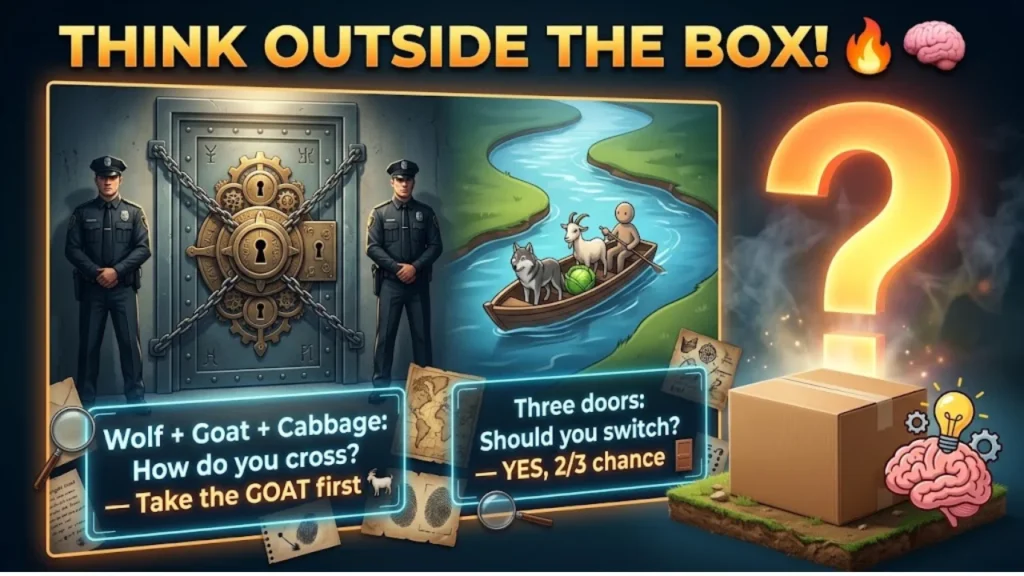
- A farmer needs to cross a river with a wolf, a goat, and a cabbage. His boat only fits him and one item at a time. If left alone, the wolf eats the goat, and the goat eats the cabbage. How does he get everything across safely? Take the goat first, return alone, take the wolf across, bring the goat back, take the cabbage across, then return for the goat.
- You have 9 identical-looking balls, but one is heavier. Using a balance scale only twice, how do you find the heavy one? Split into three groups of three. Weigh two groups against each other — if they balance, the heavy ball is in the third group; if not, it’s in the heavier group. Then weigh two balls from that group of three to isolate the heavier one.
- Two guards stand at two doors. One door leads to freedom, the other to danger. One guard always lies, the other always tells the truth, but you don’t know which is which. You may ask one guard one question. What do you ask? Ask either guard, “If I asked the other guard which door leads to freedom, what would they say?” Then choose the opposite door.
- You’re outside a room with three light switches, only one of which controls a bulb inside. You can flip switches as much as you like but enter the room only once. How do you determine which switch controls the bulb? Turn on the first switch and leave it for a few minutes, then turn it off and turn on the second switch. Enter the room — if the bulb is on, it’s the second switch; if it’s off but warm, it’s the first; if it’s off and cold, it’s the third.
- Five people accuse each other of a theft, and exactly two of them are lying. Who stole the item? Whoever is accused by the two truthful people — the one accused most consistently by the honest majority.
- You’re at a fork where one road leads to a village of people who always tell the truth, and the other leads to a village where everyone always lies. A person stands at the fork who could be from either village. What single question tells you which road leads to the truthful village? Ask, “Which road would someone from the other village say leads to your village?” Then take the opposite road.
- You’re on a game show with three doors. One hides a car, the other two hide goats. After you pick a door, the host, who knows what’s behind each one, opens a different door to reveal a goat. Should you switch your choice? Yes — switching gives you a two-thirds chance of winning, while staying only gives you a one-third chance. This is known as the Monty Hall problem.
- Five glasses are in a row — the first three hold water, the last two hold poison. By moving only one glass, arrange them so no two water glasses sit next to each other. Pour the water from the second glass into the fourth glass, then place the now-empty second glass in a new position — the water is no longer adjacent.
- You have two ropes, each burning unevenly but taking exactly one hour to burn completely. Using only these ropes and a lighter, how do you measure exactly 45 minutes? Light both ends of the first rope and one end of the second rope at the same time. When the first rope finishes burning, 30 minutes have passed — immediately light the second end of the remaining rope, and it will burn out in 15 more minutes, totaling 45.
- Twenty red socks and twenty blue socks are mixed in a dark drawer. What is the minimum number of socks you must pull out to guarantee a matching pair? Three — with only two colors available, the third sock is guaranteed to match one of the first two.
- A man lives on the 10th floor of a building. Every day, he takes the elevator to the 7th floor and walks the rest, except on rainy days, when he rides straight to the 10th. Why? He’s too short to reach the button for the 10th floor, but he can reach it with an umbrella on rainy days.
- Three boxes are labeled “Apples,” “Oranges,” and “Apples and Oranges,” but all three labels are wrong. You can pick one fruit from one box to correctly relabel all three. Which box do you pick from? Pick from the box labeled “Apples and Oranges” — since all labels are wrong, that box must contain only one fruit type, which lets you deduce the rest.
- You have a fish whose head is 3 centimeters long. Its tail equals the head’s length plus half the body, and the body equals the head and tail combined. How long is the whole fish? 24 centimeters — the head is 3 cm, the body is 12 cm, and the tail is 9 cm.
- Two coworkers are given a paper each with a number, and told the two numbers add up to a number between 1 and 100. Without seeing each other’s paper, one says, “I don’t know your number, but I know the sum is even.” How is this possible? He knows his own number is even, and even numbers can only sum to an even total when paired with another even number under the given range constraints.
- A man is looking at a photograph and says, “I have no siblings, but that man’s father is my father’s son.” Whose photo is he looking at? His own son’s photo.
- Can you draw a shape with exactly two sides and two 90-degree angles? Yes, on a curved surface like a sphere — a shape called a “lune” fits this description.
- A woman shoots her husband, holds him underwater for five minutes, then hangs him — yet minutes later they enjoy dinner together. How? She’s a photographer who shot a photo of him, developed the film underwater, and hung it to dry.
- Two trains, 60 miles apart, head toward each other at 30 mph each. A bird flies between them at 60 mph, bouncing back and forth until the trains meet. How far does the bird travel? 60 miles — since the trains meet in one hour, and the bird flies at 60 mph for that entire hour.
- A man was born in 1985 and died in 2020 at the age of 40. How is this possible? He was born in room number 1985, not the year 1985.
- You see a boat filled with people, yet there isn’t a single person on board. How? Everyone on the boat is married, so no one is technically “single.”
- A truck driver goes the wrong way down a one-way street, passing several police officers, yet nothing happens. Why? He was walking, not driving.
- What always ends everything? The letter “g.”
- A man walks into a bar and asks the bartender for a glass of water. The bartender pulls out a gun and points it at him — and the man says thank you and leaves happily. Why? The man had hiccups, and the scare from the gun cured them instantly.
- There’s a one-story house where everything is pink — the walls, the furniture, the stairs. What color are the stairs? There are no stairs — it’s a one-story house.
- How can a man go eight days without sleep? He sleeps at night, so the days themselves are not spent without sleep.
- A cowboy rides into town on Friday, stays three days, and leaves on Friday. How? His horse is named Friday.
- What has cities without houses, forests without trees, and rivers without water? A map.
- A man is pushed out of a plane at 10,000 feet with no parachute, yet survives without a scratch. How? He jumped from a stationary plane parked on the ground.
- If you drop a raw egg onto a concrete floor from 20 feet without it cracking, how is that possible? Concrete floors are very hard to crack — the egg cracks, not the floor.
Lateral Thinking & Situational Logic Riddles
- A woman gives a beggar 50 cents; the woman is the beggar’s sister, but the beggar is not the woman’s brother. How? The beggar is the woman’s sister.
- A man dies of thirst in his own home, with a fully stocked refrigerator nearby. Why didn’t he drink anything? He was blind and couldn’t find the light switch to see, or in another version, he had no hands — the exact detail varies, but the core twist is a physical inability to access the water.
- Every night, a man goes to bed with his lights on, yet every morning he reports that he had a normal night’s sleep in complete darkness. How? He lives in a lighthouse, where the light rotates and points outward, not into his room.
- A woman calls the police to report a dead body, but by the time police arrive, the woman has vanished without a trace and no crime is later confirmed. How is this possible in a way that isn’t sinister? She could have called from a payphone while reporting something she witnessed from a distance, then left the scene out of fear — many versions rely on this being an unresolved mystery riddle rather than a solvable logic puzzle.
- Two identical twins are born on the same day, to the same parents, in the same hospital room, yet they don’t share the same birthday. How? They were born on either side of midnight, making their birth dates one day apart.
- A man builds a rectangular house, and every wall faces south. A bear walks past. What color is the bear? White — the house must be at the North Pole, meaning the bear is a polar bear.
- A woman is sitting in her house at night with no lights on, no candles, and no other light source, yet she is reading comfortably. How? She is blind and reading Braille.
- Two men play five games of chess. Each wins the same number of games, and there are no ties. How? They are not playing against each other — each is playing five separate games against different opponents.
- A man is found dead in a locked room with no windows, hanging from the ceiling, standing on a block of ice that has since melted. How did the ice get there in the first place? He climbed onto a block of ice, tied the rope, and the ice melted away beneath him after he died.
- Why can’t a man living in New York be buried in California? A living man cannot be buried anywhere.
- A father tells his son, “I never had a brother, yet that man’s father is my father’s son.” Who is the man in the photo? The father’s own son.
- What English word remains the exact same after you say it backward, upside down, and in a mirror? SWIMS satisfies most of these tests depending on the font, due to its symmetrical letters.
- A hiker sets out at 6 a.m. and reaches the summit at 6 p.m. The next day, he descends the same trail starting at 6 a.m. and finishes at 6 p.m. Is there ever a point on the trail where he is at the exact same spot at the exact same time on both days? Yes — no matter the pace on either day, there must be one point where the two journeys overlap in both time and location.
- A man walks up to a hotel and immediately knows he’s bankrupt. How? He’s playing Monopoly.
- What can travel from ocean to ocean yet never gets wet? The sun.
- What has to be broken before it can ever be used properly? A record, in terms of setting a new record.
- A boy is not injured after jumping off a 30-foot ladder. How? He jumped off the bottom rung, not the top.
- What can you see with your eyes closed? A dream.
- What is so fragile that just saying its name can break it? Silence.
- What building in a city has thousands of stories but no windows to look out of? A library.
- What starts with “T,” ends with “T,” and is full of “T”? A teapot.
- What has a ring but no finger? A telephone.
- What can be given but still kept by the giver? Your word, or a promise.
- What holds two people together but touches only one? A wedding ring.
- What jumps when it walks and sits when it stands? A kangaroo.
- What gets bigger the more you take away from it? A hole.
- What has one head, one foot, and four legs? A bed.
- What can you keep after giving it to someone else? Your word.
- What has an endless supply of letters but starts empty? A mailbox.
- What invention lets you look right through a wall? A window.
Bonus: The Hardest Logic Riddles of 2026 (For True Genius-Level Thinkers)
These are the riddles that stump even seasoned puzzle solvers. Take your time — the hardest logic riddles on this list are built to slow you down on purpose.
- You’re given 12 identical-looking coins, one of which is either heavier or lighter than the rest. Using a balance scale only three times, how do you identify the odd coin and determine if it’s heavier or lighter? Divide the coins into three groups of four. Through a structured sequence of three weighings, comparing different subsets each round, you can isolate both the odd coin and whether it’s heavier or lighter — the exact grouping strategy narrows possibilities by a third with each weighing.
- A prisoner is told that if he answers correctly, he’ll be freed, and if he lies or refuses to answer, he’ll be executed. He says one sentence that guarantees his freedom no matter the rule. What does he say? “I will be executed” — if it’s true, they can’t execute him without making his statement false; if it’s false, they’d have to free him, and either outcome forces his release.
- One hundred prisoners each have a red or blue hat and cannot see their own hat but can see everyone else’s. Each guesses their own hat color once, and if a majority guess correctly, all are freed. What strategy guarantees success? Assign each prisoner a role based on a pre-agreed parity system: one prisoner deduces their color from the total count of red hats they see, then each subsequent prisoner adjusts their guess based on prior answers, using a shared strategy that mathematically guarantees the majority answer correctly.
- A king has 1,000 bottles of wine, and one is poisoned, killing anyone who drinks it within 24 hours. Using the fewest number of test rats possible, how does he identify the poisoned bottle before a big event in 24 hours? 10 rats — by assigning each bottle a unique binary number using combinations of the 10 rats, the pattern of which rats die reveals the poisoned bottle’s identity.
- Four people must cross a rickety bridge at night with only one flashlight, which must be carried on every crossing. The bridge holds only two people at a time, and the group has crossing speeds of 1, 2, 7, and 10 minutes. What is the fastest total time to get everyone across? 21 minutes — send the two fastest (1 and 2) across first, return the fastest (1), send the two slowest (7 and 10) across together, return the second-fastest (2), then send the two fastest (1 and 2) across again.
- A man has to choose between two identical-looking doors, but this time there are three guards: one always lies, one always tells the truth, and one answers randomly. You can ask only three total yes-or-no questions, one to each guard, without knowing who is who beforehand. How do you find the door to freedom? Use a structured elimination approach across all three questions, phrasing each to cross-reference the others’ likely answers, allowing the randomness to cancel out through comparison rather than needing to identify each guard individually.
- What English sentence uses every letter of the alphabet at least once, in the fewest possible words? “The quick brown fox jumps over a lazy dog” is a well-known example, though shorter constructed sentences exist using invented or less natural phrasing.
- If you flip a fair coin 20 times in a row and get heads every single time, what is the probability the next flip is heads? 50 percent — each flip is an independent event, unaffected by prior results.
- A snail is at the bottom of a well 30 feet deep. Each day it climbs 3 feet, and each night it slips back 2 feet, but on the day it would reach the top, it does not slip back. How many days does it take to escape? 28 days.
- Three switches are outside a room, controlling three separate bulbs. This time, you can flip switches and enter the room only once, and one of the bulbs is broken and will never light no matter what. How do you determine which switch matches which bulb, including the broken one? Turn on two switches for several minutes, then turn one off before entering. Use warmth and brightness together to distinguish the recently-on, currently-on, and never-used switches — the broken bulb is identified by elimination since its switch is the only remaining unexplained one.
- In a village, every person either always tells the truth or always lies, and you meet three villagers, A, B, and C. A says, “B is a liar.” B says, “A and C are the same type.” What are A, B, and C? A is a truth-teller, B is a liar, and C is a truth-teller — working through both statements under both possible truth values for A eliminates every other combination.
- You are given a 5-gallon jug and a 3-gallon jug with no measurement markings, and access to unlimited water. How do you measure exactly 1 gallon? Fill the 3-gallon jug, pour it into the 5-gallon jug, fill the 3-gallon jug again, and pour into the 5-gallon jug until full — this leaves exactly 1 gallon remaining in the 3-gallon jug.
- A group of people are each wearing either a black or white hat, arranged in a single-file line so each person can only see the hats of those in front of them. Starting from the back, each person must correctly guess their own hat color, and incorrect guesses result in elimination. What strategy allows the maximum number to survive? Everyone agrees beforehand that the person at the very back will call out the color they see most often in front of them; every person after that deduces their own hat color using the responses given before them, guaranteeing all but possibly the first person survive.
- What is the minimum number of times you must flip a fair coin to guarantee getting three heads in a row at some point, with total certainty? There is no number that guarantees it with total certainty, since any number of flips could theoretically avoid three heads in a row — probability only makes it increasingly likely, not guaranteed.
- Two people are told a number is chosen from a hidden range, and one is told only the sum with another player’s number while the other is told only the product. Through an exchange of statements about not knowing the number, they eventually determine the exact value. What logic principle allows this? This reflects epistemic logic, where each statement of “not knowing” removes possibilities for both parties, gradually narrowing the field until the shared elimination reveals the exact numbers.
- A castle has a hallway lined with 100 doors, each concealing a treasure or a trap in a pattern only revealed after entering. Given one clue that “no two adjacent doors both hide traps,” what is the maximum number of certain-safe doors you can guarantee finding by checking a minimal number? 50 — every other door is guaranteed to never have another trap-door neighbor on both sides, satisfying the safety condition through a checkerboard pattern of testing.
- If a rope ladder hangs off the side of a boat with rungs spaced one foot apart, and the tide rises three feet per hour, how many rungs are underwater after two hours? None — the boat rises with the tide, so the ladder rises along with the water level.
- What number becomes zero when you subtract 15 from half of it? 30.
- A father’s age is currently three times his son’s age. In 12 years, he will only be twice as old. How old is the son now? 12 years old.
- You’re shown three statements, and you’re told exactly one is false. Statement one: “Statement two is true.” Statement two: “Statement three is false.” Statement three: “Statement one is false.” Which statement is the false one? Statement one is false — testing each possibility for consistency shows this is the only arrangement that doesn’t create a contradiction.
- A single rope bridge can hold exactly 200 pounds. Two people who each weigh 100 pounds must cross with a 50-pound bag, but the bridge collapses if the total weight ever exceeds 200 pounds at once. How do they get everyone and the bag across? One person carries the bag across first at 150 pounds total, leaves the bag, returns alone, and then both cross together at 200 pounds total, without ever exceeding the limit.
- What is the next number in this sequence, and why: 1, 11, 21, 1211, 111221, __? 312211 — this is the “look-and-say” sequence, where each number describes the digits of the one before it.
- If today is not Sunday, tomorrow is not Wednesday, and yesterday was not Friday, what day is it today? Monday, since it’s the only day that satisfies all three negative conditions simultaneously.
- A farmer has four containers of unknown capacity and needs to measure exactly 6 units of water, but no container has any measurement markings, and he may only pour between containers, never estimate. What is the minimum information required to solve this at all? He needs at least the known capacities of the containers, since without any reference numbers, no amount of pouring alone can define a specific unmarked quantity.
- Two people are standing at opposite ends of a 100-meter rope bridge that can hold only one person’s weight at a time, but a strong wind is blowing that will only allow crossing from one specific direction. What is the fastest way for both to switch sides? The one already positioned to cross with the wind goes first, and the second waits for a wind shift or crosses using an alternate method like tying off and using the rope’s tension, since crossing against a limiting condition requires adapting to it directly rather than ignoring it.
- Three farmers must divide 17 camels among themselves according to a will stating one gets half, one gets a third, and one gets a ninth, but 17 doesn’t divide evenly into any of those fractions. How is the estate divided fairly without cutting a camel? A neutral party lends one extra camel, making 18, which divides evenly into 9, 6, and 2 camels for each share — and the lender then takes back the one extra camel that remains unused.
- What is the smallest positive number that cannot be described in fewer than thirteen words? This creates a logical paradox, since describing it that way — in exactly thirteen words — contradicts the premise, making it a self-referential puzzle rather than a solvable one.
FAQs
What are some logical riddles?
A logical riddle presents a scenario or question that seems confusing at first but has one clear, reasoned answer once you rule out the wrong paths. Classic examples include the two-guard door riddle, the wolf-goat-cabbage river crossing, and simple wordplay riddles like “what has keys but can’t open a lock?” (a piano). The full list above includes 172 examples across every difficulty level.
What is the hardest logic riddle?
Many puzzle experts point to the 12 coins problem (riddle #146) or the 100 prisoners hat riddle (riddle #148) as some of the hardest logic riddles ever documented, since both require multi-step reasoning across several stages rather than a single insight. The Monty Hall problem (riddle #93) is also famous for confusing even trained mathematicians when it first became popular.
What are 20 riddles?
If you want a quick starter set, riddles #1 through #20 in the Easy Logic Riddles section above give you 20 simple, beginner-friendly riddles with answers — perfect for kids, warm-ups, or casual games.
What are the top 10 hardest riddles?
The toughest 10 in this collection are riddles #146 through #155, covering the 12-coin weighing puzzle, the prisoner’s paradox, the 100 prisoners hat riddle, the poisoned wine bottles, and the four-person bridge crossing with unequal speeds. These require layered logic rather than a single “aha” moment.
Conclusion
Whether you breezed through the easy riddles or got stuck on the genius-level ones, that’s exactly the point of a good logic riddle — it’s supposed to slow your brain down before it speeds back up with the answer. Bookmark this list, come back to the hardest ones later, and challenge a friend to beat your score.

Amelia Singh is a content strategist and digital writer specializing in curated web directories, cultural quote archives, and instructional content. She is dedicated to creating clear, engaging, and reliable digital resources for readers worldwide.