Ready for a real brain workout? These visual riddles with answers aren’t the same tired ones you’ve seen a hundred times. Every image-based puzzle below is picked to test your logic, your eyes, and your patience — all at once.
Grab a coffee, silence your phone, and see how many of these 2026 visual brainteasers you can crack before peeking at the bolded answers.
Table of Contents
What Are Visual Riddles? (Meaning, Types & Why They’re Called That)
A visual riddle is a puzzle you solve mostly through a picture, symbol, or drawing instead of plain text. It’s also called a picture riddle, image riddle, or rebus puzzle, depending on who’s asking.
People search for this puzzle type under a few different names, and they’re all talking about the same thing:
- Picture riddles — the image itself holds the clue
- Image riddles — same idea, just a different phrase people type into Google
- Rebus puzzles — words, letters, or symbols arranged to spell out a hidden phrase
- Visual brainteasers — a broader term covering any puzzle that leans on sight over text
- IQ picture tests — visual riddles dressed up as intelligence tests
- Optical riddles — puzzles built around how your eyes trick your brain
This list covers several riddle types on purpose, because most brainteaser articles online only stick to one format. You’ll find rebus riddles, object-guessing riddles, logic-based visual puzzles, and a few classic optical tricks — all mixed into one place
20+ Mind-Blowing Visual Riddles With Answers (2026 Edition)

Here’s the main event. Each picture riddle below comes with its answer bolded right underneath, so you can test yourself first and confirm second.
1. A double-decker bus has no visible door in the picture. Which direction is it driving — left or right?
Answer: Right — because the driver’s door and seat placement (UK-style layout) only make sense if the bus is moving that way.
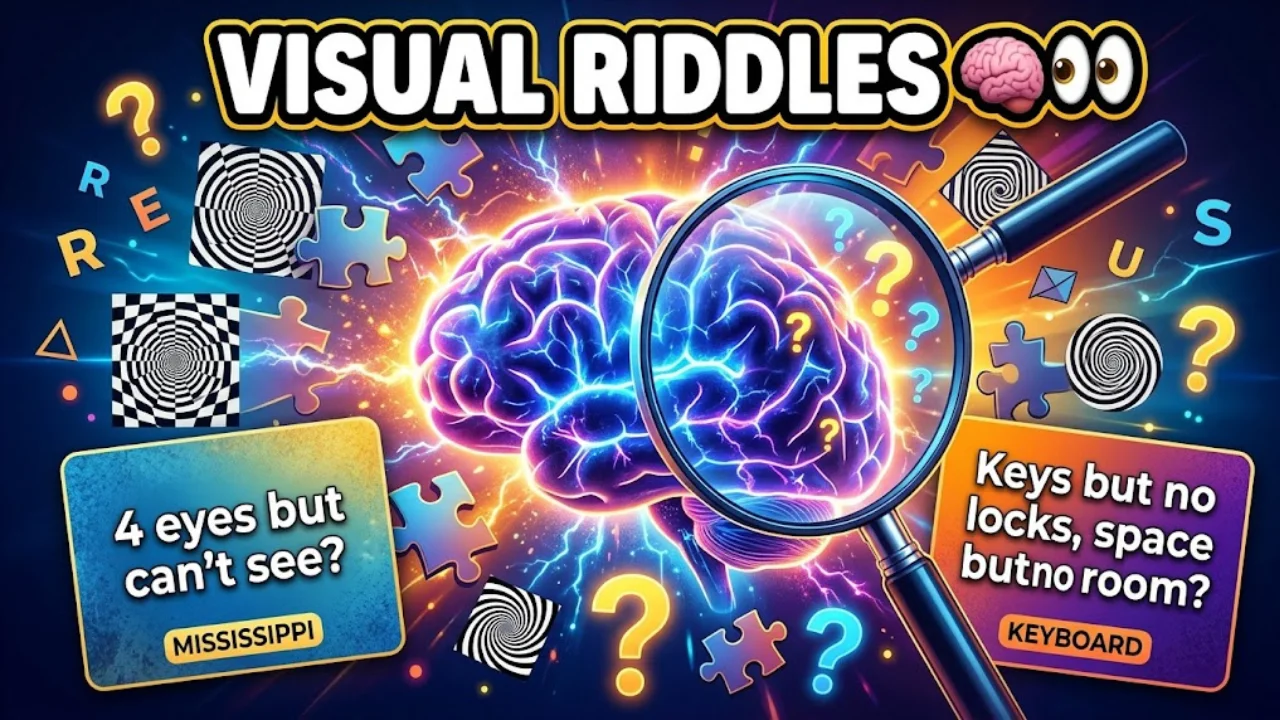
2. What has four eyes but can’t see a thing?
Answer: Mississippi — it has four letter “i’s” hiding in it.
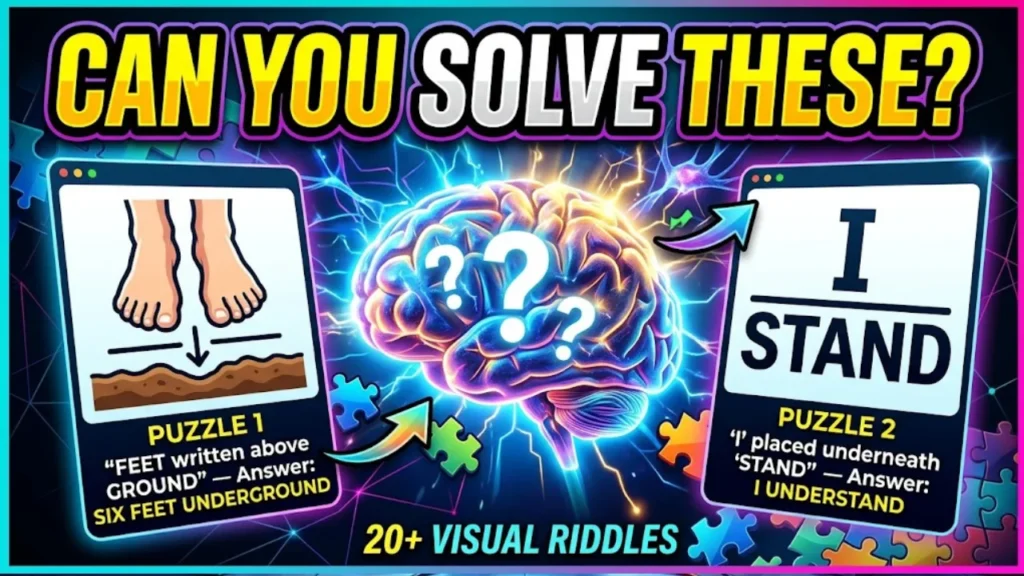
3. Rebus riddle: the word “GROUND” is written directly under the word “FEET.” What phrase does this picture spell out?
Answer: Six feet underground.
4. A parking lot is numbered from 16 to 87, except one space is left blank in the photo. What number belongs there?
Answer: 87 — flip the image upside down and the answer reveals itself.
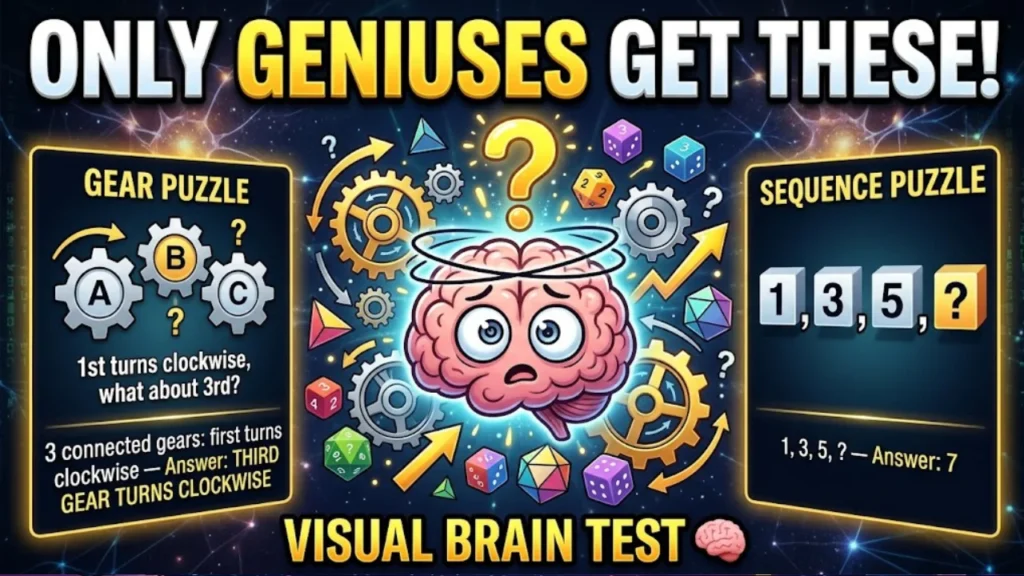
5. Three connected gears sit in a row. If the first gear spins clockwise, which way does the third gear turn?
Answer: Clockwise — every gear reverses the direction of the one next to it, so two reversals cancel out.
6. Rebus riddle: the letters “L E” sit on top of “V E L.” What word is hidden here?
Answer: Split level.
7. Five identical shadows sit under one object, but only one shadow actually matches it in size and shape. Which one is correct?
Answer: The shadow that matches the object’s exact proportions — the others are stretched, flipped, or shrunk just enough to fool a quick glance.
8. What common word gets shorter every time you add two letters to it?
Answer: Short — add “e” and “r,” and it becomes “shorter.”
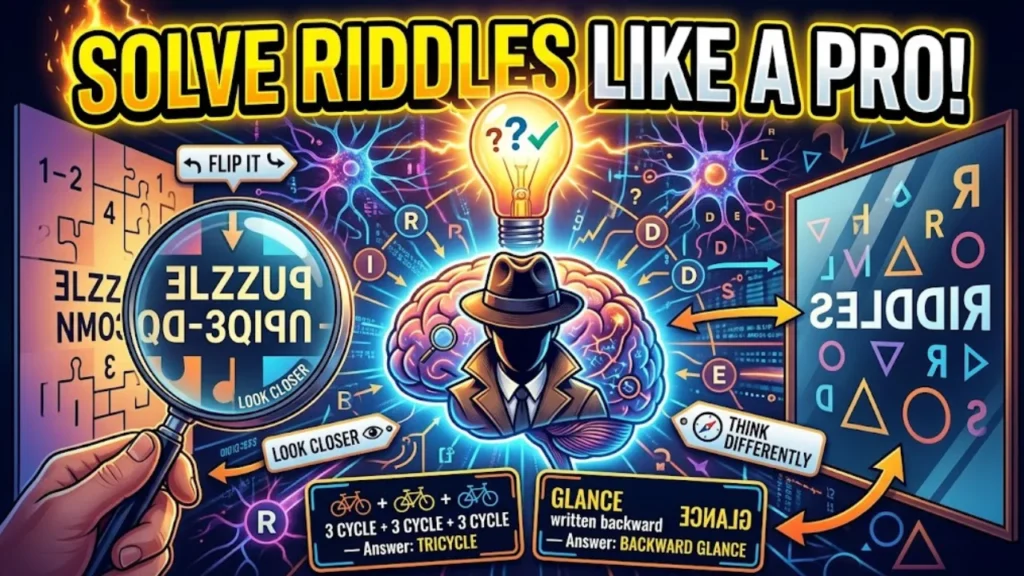
9. Rebus riddle: the word “CYCLE” is repeated three times in a stack. What word does this represent?
Answer: Tricycle — three cycles.
10. I have keys but open no locks. I have space but no room to walk in. What am I?
Answer: A keyboard.
11. A row of dice shows the numbers 1, 3, and 5 in sequence. What number should logically come next?
Answer: 7 — the pattern skips every other odd number.
12. Rebus riddle: the word “STAND” appears with a small “I” placed underneath it. What phrase is this?
Answer: I understand — “I” is literally under “stand.”
13. The more you take of me, the more you leave behind. What am I?
Answer: Footsteps.
14. A six-pointed star shape is drawn with several overlapping lines. How many triangles can you count total, including the smaller ones hidden inside?
Answer: 13 triangles.
15. Rebus riddle: the word “GLANCE” is written completely backward. What phrase does this represent?
Answer: Backward glance.
16. What kind of building has the most stories, yet no one has ever read them all?
Answer: A library.
17. A picture shows five zodiac symbols and one snake mixed in. Which item doesn’t belong, and why?
Answer: The snake — it isn’t one of the twelve official zodiac signs, even though it looks like it could fit.
18. Rebus riddle: the word “READING” is written with vertical lines slicing through each letter. What phrase does this spell out?
Answer: Reading between the lines.
19. I have a face and two hands, but no arms or legs. What am I?
Answer: A clock.
20. Five keys look almost identical in a photo, but only one matches the teeth pattern of a padlock shown beside them. Which key opens it?
Answer: Key number 5 — its ridges line up exactly with the lock’s internal pins.
21. (Bonus riddle) A wooden box, a long plank, and a single string are drawn together in one simple sketch. What object do these three pieces make when combined?
Answer: A guitar — the plank forms the neck, the string is the string, and the box becomes the body.
22. (Bonus riddle) Rebus riddle: the number “1” appears, followed by a large gap, then the word “DER.” What word is hidden in the space?
Answer: Wonder — “one” plus “der,” with the gap representing the missing letters.
That’s 22 total image riddles with answers — enough to keep a whole group busy for an evening.
Must Visit: 160+ Amazing Science Riddles With Answers That Will Put Your Knowledge to the Test
Why Visual Riddles Are Good for Your Brain (The Science-Backed Benefits)
Solving picture puzzles isn’t just a fun way to kill time. Research backs up real cognitive gains behind this hobby.
A 2024 study that tracked the lifestyle habits of more than 9,000 people found that board games and puzzles were among the strongest predictors of sharp reasoning skills, and ranked as a top predictor for memory and verbal ability, according to reporting from National Geographic.
Separate research covered by ScienceDaily found that people who regularly solve word and number puzzles show brain function equal to roughly ten years younger than their actual age on tests of grammatical reasoning, and about eight years younger on memory-based tests.
Here’s what a regular habit of solving visual brainteasers can sharpen over time:
- Nonverbal reasoning — spotting patterns without relying on words
- Visual-spatial processing — understanding how shapes and objects relate to each other
- Attention to detail — catching small differences others miss
- Working memory — holding multiple clues in your head at once
- Pattern recognition — noticing repeated shapes, sequences, or symbols quickly
None of this is a miracle cure for cognitive decline. But as a low-cost, screen-free mental habit, it’s a genuinely solid one.
How to Solve Visual Riddles Like a Pro (Tips & Tricks)
Some visual riddles with answers feel impossible until someone shows you the trick. Once you know the tricks, the next one gets easier.
- Look for hidden context clues. Position, size, and orientation almost always matter more than the obvious object in the picture.
- Think past the literal meaning. Most rebus puzzles rely on wordplay — say the letters or phrase out loud if you’re stuck.
- Break the image into pieces. Instead of judging the whole picture at once, isolate each part and ask what it represents on its own.
- Flip your perspective — literally. A surprising number of puzzles only make sense upside down or mirrored.
- Practice regularly. Pattern recognition is a trainable skill, not a fixed talent — the more riddles you solve, the faster your brain spots the trick.
FAQs
What are those visual riddles called?
They go by several names: picture riddles, image riddles, rebus puzzles, and visual brainteasers. All four terms describe the same basic idea — a puzzle solved mainly through an image rather than written text.
What is a riddle with an image?
A riddle with an image is any puzzle where a picture, drawing, or symbol holds the main clue instead of a written sentence. Solvers have to interpret what the image represents — whether that’s a hidden word, a spatial trick, or an object made from smaller pieces.
What is 4 eyes but can’t see?
The answer is Mississippi. The word contains four letter “i’s,” and each “i” is read as an “eye” in the riddle’s wordplay.
What are 20 riddles?
“20 riddles” usually refers to a themed collection — like this one — that bundles 20 or more brainteasers, picture puzzles, or logic questions together in a single list for group games, classroom activities, or personal brain training.
Conclusion
Twenty-two riddles, one clear goal: give your brain a real challenge without the usual filler. Whether you solved all of them on your first try or needed the bolded answers a few times, that’s exactly the point of a good visual riddle — it should make you think twice before it clicks. Save this list, share it with someone competitive, and see who cracks the toughest ones first.

Amelia Singh is a content strategist and digital writer specializing in curated web directories, cultural quote archives, and instructional content. She is dedicated to creating clear, engaging, and reliable digital resources for readers worldwide.