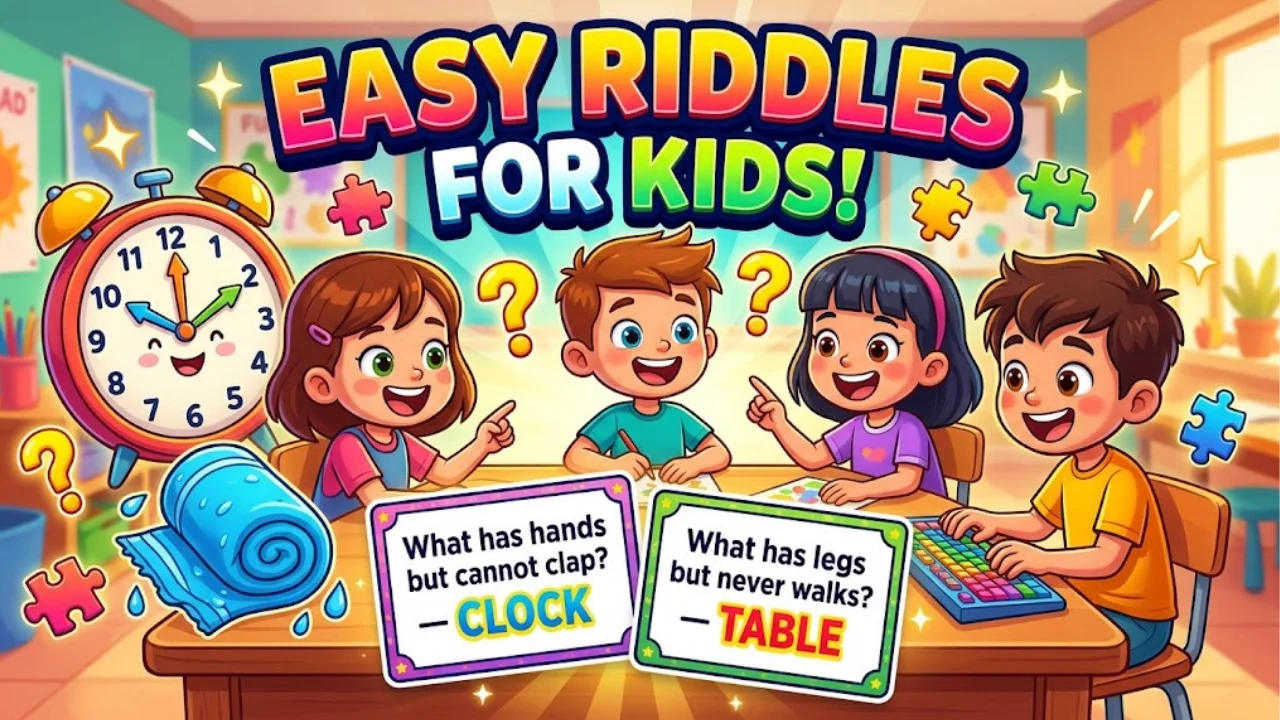
Looking for fun Easy riddles for kids that actually keep them thinking? You’ve found the right list. Below are 310+ easy kid riddles with answers, sorted from short warm-ups to tricky brain benders.
Every riddle is numbered, and every answer is bolded so you can quiz your child without any guesswork on your end. Use them for car rides, dinner table games, or a five-minute classroom brain break.
Table of Contents
What Are Fun Riddles for Kids? (And Why They’re Great for Young Minds)
Fun riddles for kids are short questions or statements with a clever, hidden answer. A good riddle uses wordplay, a surprise twist, or a bit of misdirection to make the reader stop and really think before blurting out a guess.
Riddles aren’t just entertainment. According to child-development research, activities that require pattern recognition and logical reasoning — like riddles — strengthen the same mental muscles kids use in reading comprehension and math. The American Academy of Pediatrics notes that unstructured, playful brain challenges support attention span and working memory in school-age kids.
Here’s what makes riddles genuinely useful:
- They build critical thinking by forcing kids to look past the obvious answer
- They grow vocabulary through unusual phrasing and double meanings
- They strengthen memory and focus during the “figuring it out” process
- They create bonding time since most riddles are best solved out loud, together
This list moves from short and easy riddles all the way to hard, tricky riddles, with animal riddles, food riddles, math riddles, word riddles, and mystery riddles mixed in along the way.
Must Visit:210+ Brilliant Clever Riddles for Adults With Answers That Will Seriously Challenge Your Brain
20 Short & Easy Riddles for Kids
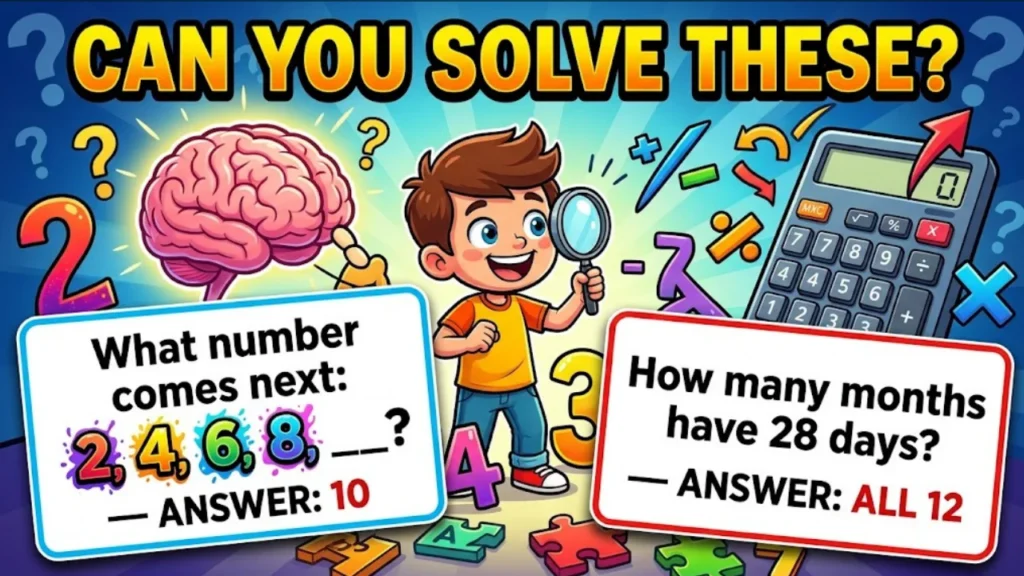
These Fun & Easy riddles for kids are the perfect warm-up. They’re quick, simple, and great for preschoolers through early elementary kids who are just learning how riddles work.
1. What has hands but cannot clap?
Answer: A clock.
2. What has a face but no eyes, and hands but no arms?
Answer: A clock.
3. What gets wetter the more it dries?
Answer: A towel.
4. What has legs but never walks?
Answer: A table.
5. What has keys but no locks, and space but no room?
Answer: A keyboard.
6. What can you catch but never throw?
Answer: A cold.
7. What has one eye but cannot see?
Answer: A needle.
8. What goes up but never comes back down?
Answer: Your age.
9. What has teeth but cannot chew?
Answer: A comb.
10. What runs but never walks?
Answer: Water.
11. What has a neck but no head?
Answer: A bottle.
12. What can travel the whole world while staying in one corner?
Answer: A stamp.
13. What belongs to you, but your friends use it more than you do?
Answer: Your name.
14. What comes down but never goes up?
Answer: Rain.
15. What has a head and a tail but no body?
Answer: A coin.
16. What can you keep even after giving it away?
Answer: Your word.
17. What has many keys but cannot open a single lock?
Answer: A piano.
18. What is full of holes yet still holds water?
Answer: A sponge.
19. What has a bark but no bite?
Answer: A tree.
20. What can fill a whole room without taking up any space?
Answer: Light.
Funny, Animal & Food Riddles for Kids
Ready to laugh a little? This section blends funny riddles, animal riddles, and food riddles — the three categories that get the biggest giggles at the dinner table.
21. Why did the banana visit the doctor?
Answer: Because it wasn’t peeling well.
22. What do you call cheese that isn’t yours?
Answer: Nacho cheese.
23. Why did the scarecrow get an award?
Answer: Because he was outstanding in his field.
24. Why don’t scientists trust atoms?
Answer: Because they make up everything.
25. Why did the math book look upset?
Answer: Because it had too many problems.
26. Why did the bicycle fall over?
Answer: Because it was two-tired.
27. What did zero say to eight?
Answer: Nice belt.
28. Why don’t eggs tell jokes?
Answer: Because they might crack up.
29. What do you call a fake noodle?
Answer: An impasta.
30. Why was the soccer stadium so cold?
Answer: Because it was full of fans.
31. Why did the golfer pack two pairs of pants?
Answer: In case he got a hole in one.
32. What did one plate whisper to the other?
Answer: Lunch is on me.
33. Why did the tomato turn red?
Answer: Because it saw the salad dressing.
34. What kind of tree fits in your hand?
Answer: A palm tree.
35. Why did the student eat his homework?
Answer: Because his teacher said it was a piece of cake.
36. What did the ocean say to the shore?
Answer: Nothing, it just waved.
37. Why can’t your nose be twelve inches long?
Answer: Because then it would be a foot.
38. What kind of band never plays music?
Answer: A rubber band.
39. What has 13 hearts but no other organs?
Answer: A deck of cards.
40. What did the ghost use to wash its hair?
Answer: Sham-boo.
41. Why don’t ants ever get sick?
Answer: Because they have tiny ant-bodies.
42. What do you call a bear caught in the rain?
Answer: A drizzly bear.
43. Why did the picture go to jail?
Answer: Because it was framed.
44. What can be cracked, made, told, and played?
Answer: A joke.
45. Why did the cookie visit the doctor?
Answer: Because it felt crummy.
46. What did one wall say to the other wall?
Answer: I’ll meet you at the corner.
47. Why did the broom arrive late?
Answer: It overswept.
48. What building has the most stories?
Answer: The library.
49. Why did the smartphone need glasses?
Answer: It lost all its contacts.
50. What do you call a snowman in July?
Answer: A puddle.
51. Why do bees have sticky hair?
Answer: Because they use honeycombs.
52. What has four wheels and flies?
Answer: A garbage truck.
53. Why was the belt arrested?
Answer: For holding up a pair of pants.
54. What did the janitor say when he jumped out of a closet?
Answer: Supplies!
55. Why did the clock get sent to the principal’s office?
Answer: For tocking too much.
56. What has ears but cannot hear a single word?
Answer: A cornfield.
57. Why did the coffee file a police report?
Answer: It got mugged.
58. What did the volcano say to the other volcano?
Answer: I lava you.
59. Why did the calendar seem stressed?
Answer: Its days were numbered.
60. What kind of shoes do spies wear?
Answer: Sneakers.
61. What do you call an elephant that doesn’t matter?
Answer: An irrelephant.
62. What do you get when you cross a cow with a duck?
Answer: Milk and quackers.
63. Why don’t elephants use computers?
Answer: Because they’re afraid of the mouse.
64. What do you call a bear with no teeth?
Answer: A gummy bear.
65. Why are fish so smart?
Answer: Because they swim in schools.
66. What do you call a sleeping bull?
Answer: A bulldozer.
67. Why did the cow become an astronaut?
Answer: To see the moo-n.
68. What has stripes but isn’t a barber?
Answer: A zebra.
69. What animal can jump higher than a house?
Answer: Any animal, since a house can’t jump at all.
70. Why don’t crabs ever donate to charity?
Answer: Because they’re shellfish.
71. What do you call a dog that does magic tricks?
Answer: A labracadabrador.
72. Why do seagulls avoid flying over the bay?
Answer: Because then they’d be bay-gulls.
73. What did the buffalo say to his son at college drop-off?
Answer: Bison.
74. Why did the owl throw a party?
Answer: Because he didn’t want to be owl by himself.
75. What do you call a pig who knows karate?
Answer: A pork chop.
76. What is the fastest land animal that still can’t climb a tree?
Answer: A cheetah.
77. What jumps when it walks and sits when it stands?
Answer: A kangaroo.
78. What animal has a thousand needles but never sews?
Answer: A porcupine.
79. What has a horn but never honks?
Answer: A rhinoceros.
80. What sounds like a parrot but is actually orange?
Answer: A carrot.
81. What has long ears, hops, and loves carrots?
Answer: A rabbit.
82. What lives in a bowl, swims, and has big eyes?
Answer: A goldfish.
83. What has a shell but is never mistaken for a car?
Answer: A turtle.
84. What can honk without any horn at all?
Answer: A goose.
85. What sleeps all day and flies at night with no feathers?
Answer: A bat.
86. What animal is famous for having nine lives?
Answer: A cat.
87. What has a bill but never pays it?
Answer: A duck.
88. What is orange, long, and loved by rabbits?
Answer: A carrot.
89. What kind of key opens a banana?
Answer: A mon-key.
90. What do you call a fish with no eyes?
Answer: A fsh.
91. What has a bushy tail and buries treasure in the ground?
Answer: A squirrel.
92. What animal has hooves instead of feet because of its diet?
Answer: A cow, since it eats lactose.
93. What has feathers, waddles, and lives near a pond?
Answer: A duck.
94. What insect lives in a hive and makes honey?
Answer: A bee.
95. What barks but has no bite of its own?
Answer: A dog’s bark.
96. What always keeps the best time, day or night?
Answer: A watchdog.
97. What blue fruit always looks sad?
Answer: A blueberry.
98. What kind of room has no doors or windows?
Answer: A mushroom.
99. What comes from a cow and is poured on cereal?
Answer: Milk.
100. What fruit keeps the doctor away if eaten daily?
Answer: An apple.
101. What has seeds, is not a flower, and is often striped green outside?
Answer: A watermelon.
102. What turns purple and makes you scream when it does?
Answer: A beet.
103. What vegetable grows underground and can be mashed or fried?
Answer: A potato.
104. What is often paired with ice cream but is not a topping?
Answer: A popsicle.
105. What food is yellow, curved, and loved by monkeys?
Answer: A banana.
106. What has a core but is not an apple, and a rind but is not an orange?
Answer: A pineapple.
107. What kind of nut always laughs?
Answer: A cashew laughs like “cashoo.”
108. What bread has holes but is still whole?
Answer: A bagel.
109. What is red or green, crisp, and grown on trees?
Answer: An apple.
110. What melts fast, comes in scoops, and loves a hot day?
Answer: Ice cream.
111. What has layers and can make you cry while you chop it?
Answer: An onion.
112. What sandwich is named after a day of the week?
Answer: None, but a club sandwich comes close in fame.
113. What food is often called the incredible, edible one?
Answer: An egg.
114. What fruit has a pit and grows in orchards every summer?
Answer: A peach.
115. What snack is round, salty, and often stacked in a tube can?
Answer: A potato chip.
116. What food do bees make and store in a hive?
Answer: Honey.
117. What is white, comes from a cow, and turns into cheese?
Answer: Milk.
118. What is orange, grows underground, and is loved by rabbits?
Answer: A carrot.
119. What is the main ingredient in guacamole?
Answer: Avocado.
120. What fruit’s name also describes a color?
Answer: An orange.
121. What snack is made from popped kernels and loved at movies?
Answer: Popcorn.
122. What food has a shell you crack before eating what’s inside?
Answer: A peanut, or an egg.
123. What frozen treat is served on a stick?
Answer: A popsicle.
124. What is baked, sliced, and used for sandwiches?
Answer: Bread.
125. What green vegetable looks like a tiny tree?
Answer: Broccoli.
126. What sweet spread is made from crushed peanuts?
Answer: Peanut butter.
127. What fruit is known for its many small seeds inside?
Answer: A strawberry.
128. What drink is squeezed from an orange?
Answer: Orange juice.
129. What cheese has holes in it?
Answer: Swiss cheese.
130. What food is round, doughy, and topped with cheese and sauce?
Answer: Pizza.
131. What grain is cooked and served with almost every dinner in Asia?
Answer: Rice.
132. What food do you dip in ketchup and often eat with a burger?
Answer: French fries.
133. What fruit is small, purple or green, and grows in bunches?
Answer: Grapes.
134. What breakfast food is flipped and stacked with syrup on top?
Answer: A pancake.
135. What is the main ingredient in a smoothie besides fruit?
Answer: Milk or yogurt.
136. What vegetable makes you cry before it makes dinner taste better?
Answer: An onion.
137. What frozen dessert comes in a cone?
Answer: Ice cream.
138. What is a tomato often confused for since people debate if it’s a fruit or vegetable?
Answer: A fruit, botanically speaking.
139. What food is served at almost every birthday party with candles on top?
Answer: A cake.
140. What crunchy snack is made from corn and often eaten with salsa?
Answer: Tortilla chips.
Math, Word & Logic Riddles for Kids
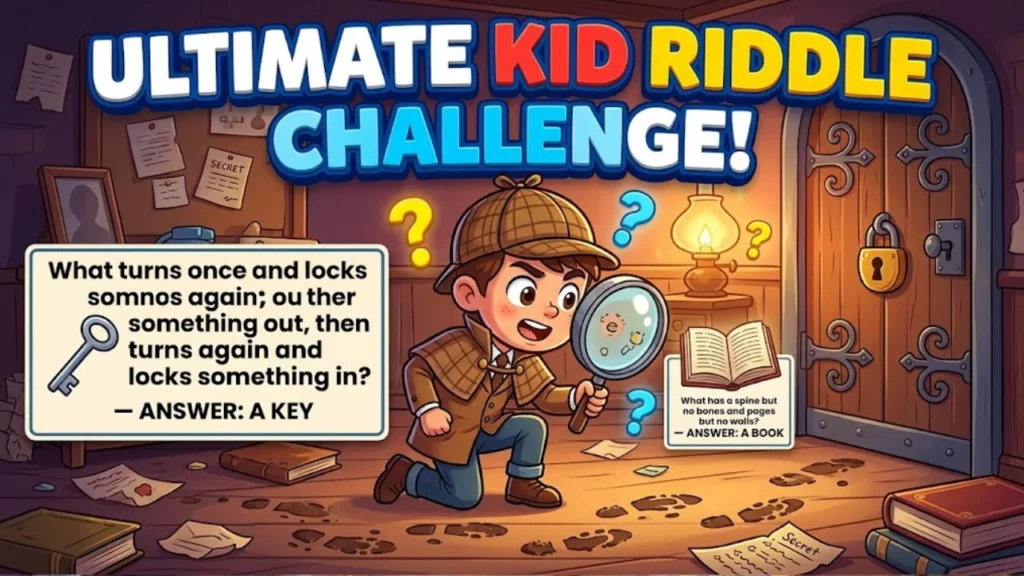
These math riddles, word riddles, and logic riddles are a little more challenging. They’re great for kids who already enjoy numbers, spelling, or puzzles that make them pause and rethink their first answer.
141. If you have two apples and take away one, how many do you have?
Answer: One.
142. What number comes next: 2, 4, 6, 8, ___?
Answer: 10.
143. I am an odd number. Take away one letter and I become even. What number am I?
Answer: Seven, since removing the “s” leaves “even.”
144. A bat and a ball cost $1.10 together. The bat costs $1.00 more than the ball. What does the ball cost?
Answer: $0.05.
145. Use only addition to add eight 8’s and reach 1,000.
Answer: 888 + 88 + 8 + 8 + 8 = 1,000.
146. What three numbers give the same answer whether you add or multiply them?
Answer: 1, 2, and 3.
147. A farmer has 17 sheep, and all but 9 die. How many are left?
Answer: Nine.
148. What can you put between 7 and 8 so the result is more than 7 but less than 8?
Answer: A decimal point.
149. Which is heavier: a ton of bricks or a ton of feathers?
Answer: Neither, since both weigh exactly one ton.
150. Mary has four daughters, and each daughter has one brother. How many kids does Mary have?
Answer: Five, since all four daughters share the same brother.
151. What comes once in a minute, twice in a moment, but never in a thousand years?
Answer: The letter M.
152. Double a number, multiply it by 4, then divide by 8. What do you get?
Answer: The original number.
153. Two fathers and two sons go fishing and catch exactly three fish, one each. How?
Answer: They were a grandfather, his son, and his grandson.
154. What number becomes zero when you subtract 15 from half of it?
Answer: 30.
155. I am a three-digit number. My second digit is four times my third, and my first is three less than my second. What am I?
Answer: 141.
156. If you multiply me by any number, the answer is always that same number. What am I?
Answer: The number 1.
157. A man buys a pencil for $1 and a notebook for $2, spending exactly $30 on 30 items. How many of each did he buy?
Answer: 20 pencils and 10 notebooks.
158. What is half of 2 plus 2?
Answer: 3, since half of two is one, plus two equals three.
159. If two’s company and three’s a crowd, what are four and five?
Answer: Nine.
160. How many months have 28 days?
Answer: All 12 months.
161. What goes up and never comes back down except in age?
Answer: Your birthday count.
162. A clock shows 3:15. What angle do the hour and minute hands form?
Answer: 7.5 degrees.
163. If a train leaves at noon going 60 mph, how far has it gone by 2 p.m.?
Answer: 120 miles.
164. What number is one less than 100 doubled?
Answer: 199.
165. I’m the only even prime number. What am I?
Answer: Two.
166. How many sides does a hexagon have?
Answer: Six.
167. What shape has three sides and three corners?
Answer: A triangle.
168. If Monday is two days after Saturday, what day is today based on that math?
Answer: Monday, since Saturday plus two days lands on Monday.
169. What is the sum of all numbers from 1 to 10?
Answer: 55.
170. A rooster lays an egg on a barn roof. Which way does it roll?
Answer: Roosters don’t lay eggs.
171. What five-letter word becomes shorter when you add two letters to it?
Answer: Short.
172. What word begins and ends with “E” but only has one letter?
Answer: An envelope.
173. What starts with T, ends with T, and has T inside it?
Answer: A teapot.
174. What word looks the same upside down, forward, and backward?
Answer: NOON.
175. Forward I am heavy, but backward I am not. What word am I?
Answer: Ton.
176. What is the only place where today comes before yesterday?
Answer: The dictionary.
177. What word is always spelled wrong in the dictionary?
Answer: The word “wrong.”
178. I am a word of three letters. Add two more and I become fewer. What word am I?
Answer: Few.
179. What common English word contains “gas” but is unrelated to fuel?
Answer: Gasoline is related, but “gaslight” hides it inside a lamp-related word.
180. What word becomes its own opposite when you flip its first letter?
Answer: Loose and moose, or many similar pairs depending on the letter swapped.
181. What word can follow “sun,” “moon,” and “star” to make new words?
Answer: Light, as in sunlight, moonlight, and starlight.
182. What single letter is found in every season but no single day of the week?
Answer: The letter S.
183. What has one syllable yet becomes three when you add two letters?
Answer: Plural, since adding “-al” turns “plur” into more syllables (a classic wordplay twist).
184. What word means “silent” and is also a keyword in Scrabble?
Answer: Mute.
185. What compound word combines “any” with a place?
Answer: Anywhere.
186. I’m a word that describes a citrus fruit and a color. What word am I?
Answer: Orange.
187. What four-letter word for “help” sounds like the letters “A” and “D”?
Answer: Aid.
188. What’s the longest word in most dictionaries, using a classic riddle trick?
Answer: “Smiles,” because there’s a mile between its first and last letters.
189. What word becomes a new word when you remove its first letter, then again after removing the next?
Answer: Stable becomes table, then able.
190. What word means a baby dog and also a small unit of measurement in old slang?
Answer: Pup, though this varies by region.
191. I am a container of thoughts, spelled the same forward as “diary” minus one letter. What am I?
Answer: Diar isn’t a word, but “diary” itself holds the answer to reflection.
192. What starts with “P,” ends with “E,” and has thousands of letters inside?
Answer: A post office.
193. What is the first thing you do every morning that starts with the last letter of the alphabet?
Answer: You open your eyes, tied to the letter Z for “zzz.”
194. What word means “quiet” and rhymes with “list”?
Answer: Hushed doesn’t rhyme, but “whist” (an old card term) does.
195. What two-letter word means “yes” in many casual conversations?
Answer: OK.
196. What English letter sounds exactly like a question?
Answer: Y, since it sounds like “why.”
197. What single letter completes water, air, and fire when read as a riddle about elements missing “earth”?
Answer: The letter E ties “earth” to the other elements phonetically.
198. What word for a king’s home also means to keep something safe?
Answer: Castle can also mean to protect in chess.
199. What is a word for “quick glance” that’s also a kind of window covering?
Answer: Peek and peak sound alike, but “blind” fits both meanings best.
200. What letter, when added to “car,” makes a fruit?
Answer: Adding “e” makes “care,” but adding letters to “car” spells “carrot” with more letters, a fruit-and-veggie riddle twist.
201. I follow you everywhere but you can never touch me. What am I?
Answer: Your shadow.
202. If you’re in a race and pass the person in second place, what place are you in?
Answer: Second place.
203. The more you take, the more you leave behind. What are they?
Answer: Footsteps.
204. What can you break without ever touching it?
Answer: A promise.
205. What has to be broken before you can use it?
Answer: An egg.
206. What gets bigger the more you take away from it?
Answer: A hole.
207. What question can you never truthfully answer with “yes”?
Answer: Are you asleep right now?
208. If you drop me, I’ll crack, but smile at me and I’ll smile back. What am I?
Answer: A mirror.
209. What word describes something you can hold without ever touching it?
Answer: A conversation.
210. What is easy to get into but hard to get out of?
Answer: Trouble.
211. What can be given but never actually given away entirely, like advice?
Answer: Advice, since giving it doesn’t take it from you.
212. If a plane crashes exactly on the border of two countries, where do survivors get buried?
Answer: Nowhere, since survivors are still alive.
213. What is always coming but never actually arrives?
Answer: Tomorrow.
214. What has an end but no real beginning?
Answer: A circle has neither, making it the twist answer to this classic.
215. What can you hold in your left hand but never in your right?
Answer: Your right elbow.
216. What kind of coat can only be worn while wet?
Answer: A coat of paint.
217. What building has the most floors but no elevator required to explain its riddle?
Answer: The library, since it’s full of stories.
218. What goes up a chimney down but can’t go down a chimney up?
Answer: An umbrella.
219. If an electric train travels north, which way does the smoke blow?
Answer: There is no smoke, since electric trains don’t burn fuel.
220. What is so fragile that saying its name can break it?
Answer: Silence.
221. What can run but never walks, and has a bed but never sleeps?
Answer: A river.
222. What has one head, one foot, and four legs?
Answer: A bed.
223. What word describes light that isn’t really light at all, but something you learn from mistakes?
Answer: Hindsight.
224. What always arrives at night without being invited and disappears at dawn?
Answer: The stars.
225. What goes through cities and fields but never actually moves an inch?
Answer: A road.
Hard, Tricky & Mystery Riddles for Kids
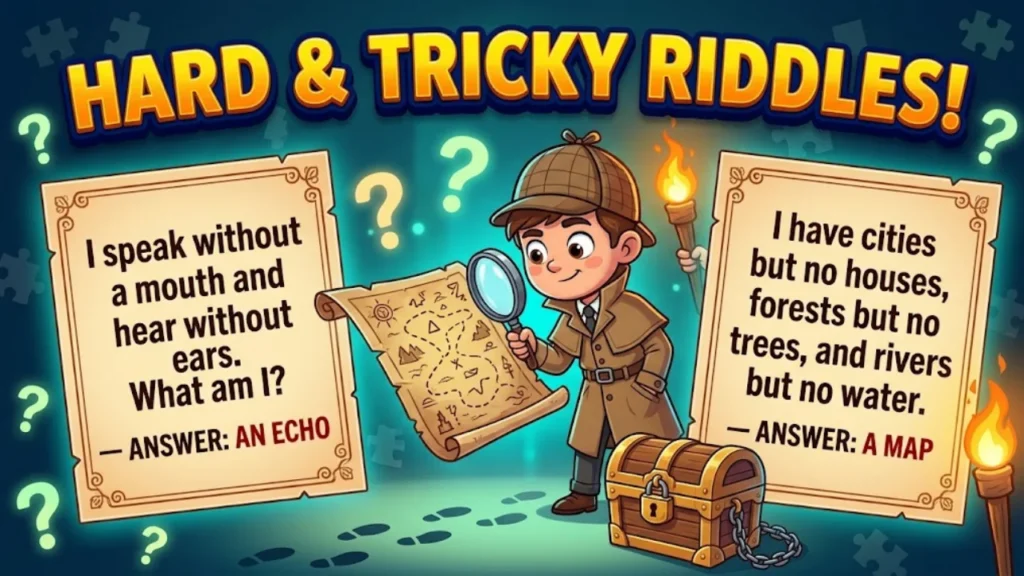
This final stretch is where things get tough. It includes hard riddles, tricky riddles, and a set of kid-friendly mystery riddles built around clues, secrets, and detective-style thinking.
226. I speak without a mouth and hear without ears. What am I?
Answer: An echo.
227. What word is spelled incorrectly in every single dictionary?
Answer: “Incorrectly.”
228. I’m tall when I’m young and short when I’m old. What am I?
Answer: A candle.
229. What has branches but no fruit, trunk, or leaves?
Answer: A bank.
230. What is not alive, yet it grows, needs air, but has no lungs?
Answer: Fire.
231. What turns once and locks something out, then turns again and locks something in?
Answer: A key.
232. I have cities but no houses, forests but no trees, and rivers but no water. What am I?
Answer: A map.
233. What can fly without wings and cry without eyes?
Answer: A cloud.
234. What loses its head in the morning and gets it back at night, in a manner of speaking?
Answer: A pillow, since it’s fluffed each morning and used again at night.
235. What has a bed but never sleeps and a mouth but never eats?
Answer: A river.
236. What is the beginning of eternity, the end of time, and appears twice in every corner?
Answer: The letter E.
237. A man walks in the rain without an umbrella or hat and stays completely dry-headed. Why?
Answer: He was bald.
238. What breaks yet never falls, and what falls yet never breaks?
Answer: Day and night.
239. What kind of tree can you carry in one hand?
Answer: A palm.
240. I have a golden head and a golden tail but no body at all. What am I?
Answer: A coin.
241. What can be measured but has no real length, width, or height?
Answer: Time.
242. What travels the world yet always stays in the same corner of every envelope?
Answer: A stamp.
243. What holds two people together but can be broken with a single word?
Answer: A promise.
244. I have no life, yet I can die. What am I?
Answer: A battery.
245. What can you serve but never eat?
Answer: A volleyball, or a tennis serve.
246. What five-letter word, when you take away the first letter, becomes a homophone for a body part?
Answer: “Chair” minus “C” sounds like “hair.”
247. What has many rings but no fingers?
Answer: A telephone.
248. What object gets sharper the more it’s used?
Answer: Your brain.
249. What has a spine but no bones and pages but no walls?
Answer: A book.
250. What word means “a group of geese” and also describes something silly?
Answer: Gaggle.
251. What is the only thing that gets bigger when it’s shared equally among more people?
Answer: Happiness, or knowledge.
252. What can be cut, shuffled, and dealt but is never actually food?
Answer: A deck of cards.
253. What has a thumb and four fingers but no bones inside?
Answer: A glove.
254. What word for money is also found hiding along the edge of a river?
Answer: Bank.
255. What can be described as “always coming, never arriving, but always near”?
Answer: The future.
256. What has many teeth but can never actually chew food?
Answer: A comb, or a saw.
257. What sits in a corner yet travels the whole globe on the back of an envelope?
Answer: A stamp.
258. What is the only number that is spelled with the same number of letters as its value?
Answer: Four.
259. What has feathers but is not a bird, and shafts but is not an arrow?
Answer: A dart.
260. What word for a light source also names a small, delicate flying insect at night?
Answer: Moth-light isn’t quite right, but a “firefly” fits the theme best.
261. What can be driven but has no wheels, and struck but never breaks?
Answer: A golf ball.
262. What makes a loud pop, gets bigger, but weighs less once it changes?
Answer: Popcorn.
263. What has a ring yet is never worn on a finger?
Answer: A telephone.
264. What kind of test has no questions, yet everyone eventually takes it?
Answer: The test of time.
265. What can be shared but never divided evenly, like a secret?
Answer: A secret.
266. What goes through pockets and drawers, yet takes up almost no space?
Answer: Lint.
267. What word means “quiet” but is also the name of a famous nursery rhyme character?
Answer: Hush.
268. What has a face that never smiles, yet tells you the time all day?
Answer: A clock.
269. What has one horn but no mouth to blow it?
Answer: A rhinoceros.
270. What is full of questions but never once speaks?
Answer: A test paper.
271. A locked room has no windows and only one door, which is bolted from the inside. How did the thief get out with the missing painting?
Answer: The thief never left; they hid the painting inside the room and reported it as stolen.
272. A detective finds a note that says only “?” on a desk. Who left it?
Answer: Someone named Mark, since “?” is called a question mark.
273. Two identical twins are questioned about a broken vase, and both say they didn’t do it. How does the detective know one is lying?
Answer: One twin has a scratch fresh on their hand from the broken glass.
274. A woman is found in a puddle of water and glass, with no windows broken. What happened?
Answer: She was a statue made of ice that melted after being knocked over.
275. A guard says the missing jewel case was locked all night, yet it’s empty. How was it opened without force?
Answer: The guard is lying because he unlocked it himself.
276. Every clue points to the housekeeper, but the room has perfectly round walls. Why is that suspicious?
Answer: A circular room has no corners, so the mention of “hiding in a corner” rules her out.
277. A man calls for help from a locked cabin with no phone signal, yet rescuers arrive within minutes. How?
Answer: He used a signal fire or mirror to flag a nearby search plane.
278. Footprints lead into a house but none lead back out. Where did the visitor go?
Answer: They walked backward out of the house, matching the same prints.
279. A code left at a crime scene reads the same both forward and backward. What kind of code is this called?
Answer: A palindrome.
280. The suspect claims he was home asleep, but the streetlight outside his window was broken all week. Why does this matter?
Answer: His alibi about seeing a shadow from the streetlight can’t be true.
281. A letter is found signed only with a smudge of ink and one letter, “Q.” Who is the likely sender?
Answer: Someone whose first name starts with Q, a small but key clue.
282. A vault opens only with a six-digit code, and the last clue found is a torn calendar page. What’s the connection?
Answer: The code is the date shown on the torn page.
283. Two suspects both had access to the same key, but only one had muddy shoes matching the crime scene. What does this tell the detective?
Answer: The muddy suspect was physically present at the scene.
284. A witness says she “heard nothing” during a robbery next door, yet she was watching TV with headphones on. Is her testimony reliable?
Answer: No, since headphones would have blocked outside sound either way.
285. A missing recipe is found hidden inside a hollowed-out book on a kitchen shelf. What genre of book was it?
Answer: A cookbook, the most logical hiding spot.
286. A thief steals only left shoes from a shop window, never right ones. What might this suggest about the thief?
Answer: The thief may be missing a right foot or collecting single shoes for a specific reason.
287. A locked diary has a riddle instead of a password: “I am always ahead of you, but you never catch me.” What unlocks it?
Answer: Your shadow, or the word “future.”
288. A candle is found burned at both ends in a locked study. What does this suggest about the timeline?
Answer: Someone was working desperately fast against a deadline.
289. A house has one broken window, but the shards of glass are found outside on the lawn. What does this reveal?
Answer: The window was broken from the inside, not by an intruder.
290. A safe combination is hidden in a set of numbers written on a torn ticket stub. What kind of code was used?
Answer: A simple substitution code, common in beginner detective riddles.
291. A missing dog is found because of muddy paw prints leading straight to the garden shed. What was inside the shed?
Answer: The dog itself, having wandered in and gotten stuck.
292. A mysterious key with no matching lock is found in an old attic trunk. What is it most likely for?
Answer: A diary or a small keepsake box, based on its tiny size.
293. A message reads: “Look where the sun never sets on me.” Where should the detective search?
Answer: Inside, since indoor lighting never truly follows the sun.
294. A note is found that says only “9:30 AM,” but the crime happened at night. Why does this matter?
Answer: It proves the suspect’s alibi is fake since they claimed to be somewhere else that morning.
295. A house key is found buried under a rose bush instead of on the usual hook. What might this suggest?
Answer: Someone hid it there for a secret visitor to find later.
296. A jewel thief always leaves a playing card at the scene. What might the specific card suggest about their identity?
Answer: It could be a signature or nickname clue, like the Joker hinting at a disguise-loving thief.
297. A locked greenhouse shows footprints only on one side of the glass. What does this reveal?
Answer: No one actually entered; the prints were made from outside pressing against the glass.
298. A will is found with a hidden line that only appears under lamplight. What kind of ink was used?
Answer: Invisible ink, which reacts to heat or light.
299. Two brothers both claim ownership of a lost wallet, but only one knows what’s inside without looking. What proves ownership?
Answer: The one who correctly describes the contents beforehand is the true owner.
300. A garden gate is found unlocked, though the gardener swears she locked it. What’s the simplest explanation?
Answer: Someone else has a spare key.
301. A cracked phone screen is the only clue at a scene with no other damage. What might this suggest happened?
Answer: A struggle or a fall involving only the phone, not the person.
302. A treasure map’s final clue says, “Where shadows point at noon, dig there.” What time should searchers dig?
Answer: Right at noon, when shadows are shortest and most direct.
303. A missing necklace turns up in the family dog’s favorite hiding spot. What does this suggest about the “theft”?
Answer: There was no thief; the dog carried it off.
304. A code found at the scene uses only numbers 1 through 26. What’s the likely key?
Answer: Each number matches a letter of the alphabet.
305. A door alarm never triggered during a break-in. What’s the most likely reason?
Answer: The alarm was disarmed from the inside beforehand.
306. A hidden note under a floorboard reads only, “Ask the clock.” What should the detective check?
Answer: Inside or behind the actual clock for a hidden item.
307. A witness recalls hearing footsteps but saw no one enter the room. Who, or what, might explain it?
Answer: An echo from another hallway, or someone in socks moving quietly.
308. A mystery guest signs the hotel register only with initials and a symbol of a star. What might this suggest?
Answer: A well-known guest is trying to stay anonymous, like a celebrity.
309. A stolen recipe card is found with a coffee ring stain covering one key ingredient. What must the detective do?
Answer: Recreate the dish through trial and error to reveal the missing step.
310. A suspect’s alibi checks out for the entire evening except for a 10-minute gap. What should investigators focus on?
Answer: Exactly what happened during that unaccounted-for 10 minutes.
311. A sealed letter is postmarked from a town the sender never visited. What does this reveal?
Answer: Someone else mailed it on their behalf, or the postmark was faked.
312. A final clue reads: “I am the answer everyone already knows, but no one says it out loud.” What is it?
Answer: The truth.
FAQs
What are fun riddles for kids?
Fun riddles for kids are short, playful questions with a clever or surprising answer. They often use wordplay, silly comparisons, or a twist that makes kids rethink their first guess, which is exactly what makes them entertaining and mentally engaging.
What are some good short riddles?
Good short riddles are quick, one-line puzzles like “What has hands but cannot clap?” (a clock) or “What gets wetter the more it dries?” (a towel). These work best for younger kids since they’re easy to say out loud and quick to solve.
What are some good mystery riddles for kids?
Good mystery riddles for kids use small clues and simple logic, like detective-style puzzles about broken windows, missing objects, or suspicious alibis. They’re solved by paying attention to small details rather than guessing randomly, which builds deductive reasoning skills.
What are 20 riddles?
Twenty riddles is a common, manageable set size for a quick game night or classroom activity. You’ll find exactly 20 short, easy riddles at the very start of this list, ready to use as a standalone set.
Conclusion
Riddles give kids a fun reason to slow down and really think. Whether you use the short riddles, the animal and food riddles, or the hard mystery riddles near the end, every single one here comes with its answer ready to go. Pick a few, gather your kids, and see how many they can solve before you can reveal the answer.

Amelia Singh is a content strategist and digital writer specializing in curated web directories, cultural quote archives, and instructional content. She is dedicated to creating clear, engaging, and reliable digital resources for readers worldwide.