Word riddles are short brain teasers that play with letters, sounds, and meanings. They are simple to read but not always simple to solve. Below you will find 120+ Brilliant word riddles with answers, sorted by type, so you can jump straight to the ones that fit your mood — short, funny, hard, or kid-friendly.
Every riddle below has a clear, bolded answer. No scrolling through ads or clicking “reveal” buttons. Just read, guess, and check. Ready to test your brain?
Table of Contents
What Are Word Riddles? (And Why They Still Stump Us in 2026)
A word riddle is a puzzle built from language itself, not math or logic alone. It hides its answer inside a play on spelling, sound, or double meaning. This is different from a logic puzzle, which relies on reasoning steps, or a math riddle, which relies on numbers.
Word riddles work because the human brain likes patterns. When a sentence sounds like it should mean one thing but actually means another, your mind pauses. That pause is the fun part. According to language researchers, wordplay activates both the language centers and the problem-solving centers of the brain at the same time, which is part of why puzzles like this feel satisfying to solve (Frontiers in Psychology on riddle comprehension).
People use word riddles with answers in a lot of everyday settings:
- Family game nights — easy ones for kids, tricky ones for parents
- Classrooms — teachers use them to build vocabulary and critical thinking
- Team-building events — HR teams use riddles as quick icebreakers
- Road trips and waiting rooms — a fast way to pass time together
- Social media — short riddles get shared because they are easy to post and easy to argue about
Word riddles are not new. Riddling shows up in Old English poetry, in the Exeter Book from over a thousand years ago, and even in ancient Greek myth, like the riddle of the Sphinx. The format has survived because it is short, portable, and works for almost any age group.
Must Visit: 150+ Powerful Riddler Riddles With Answers to Challenge Your Brain
120+ Word Riddles With Answers (Numbered & Organized by Type)
Below are 120+ word riddles, grouped into six easy categories. Each one is numbered, and each answer is bolded right under the question. Try guessing before you look down.
Short & Easy Word Riddles
These are quick, gentle word riddles — great for warming up or for younger solvers.
- What has to be broken before you can use it? Answer: An egg
- What gets wetter the more it dries? Answer: A towel
- What has a face but no eyes, hands but no arms? Answer: A clock
- What travels around the world but stays in one corner? Answer: A stamp
- What has a neck but no head? Answer: A bottle
- What kind of room has no doors or windows? Answer: A mushroom
- What runs but never walks? Answer: Water
- What has one eye but cannot see? Answer: A needle
- What has legs but cannot walk? Answer: A table
- What has hands but cannot clap? Answer: A clock
- What can you hold without ever touching it? Answer: A conversation
- What has teeth but cannot bite? Answer: A comb
- What goes up but never comes down? Answer: Your age
- What can fill a room but takes up no space? Answer: Light
- What has a bed but never sleeps? Answer: A river
- What has a thumb and four fingers but is not alive? Answer: A glove
- What building holds the most stories? Answer: A library
- What is always coming but never arrives? Answer: Tomorrow
- What can you keep even after giving it to someone else? Answer: Your word
- What has many keys but cannot open a single door? Answer: A piano
Funny Word Riddles
These funny riddles add a laugh to the challenge, perfect for parties or lightening the mood.
- What do you call a bear with no teeth? Answer: A gummy bear
- What is worse than finding a worm in your apple? Answer: Finding half a worm
- Why did the letter A refuse to go to school? Answer: Because it already knew the alphabet
- What kind of band never plays music? Answer: A rubber band
- What is worse than a bottle that is half empty? Answer: A bottle that is half full, because that means it’s already going down (awful)
- What has a bark but no bite? Answer: A tree
- Why did the word “long” break up with the word “short”? Answer: They were opposites and never saw eye to eye
- What kind of coat is best put on wet? Answer: A coat of paint
- Why can’t a nose be 12 inches long? Answer: Because then it would be a foot
- What has words but never talks back? Answer: A book
- What did the big flower say to the little flower? Answer: “Hi, bud!”
- What kind of tree fits in your hand? Answer: A palm tree
- What did one wall say to the other wall? Answer: “I’ll meet you at the corner”
- Why did the scarecrow win an award? Answer: Because he was outstanding in his field
- What has ears but cannot hear? Answer: A cornfield
- Why did the cookie go to the doctor? Answer: Because it felt crummy
- What gets bigger the more you take away from it? Answer: A hole
- What has a spine but no bones? Answer: A book
- What can you serve but never eat? Answer: A tennis ball
- What word starts with “e,” ends with “e,” but only has one letter in it? Answer: An envelope
Clever Riddles for Adults
These clever riddles lean into wordplay and double meanings, built for grown-up brains that like a real challenge.
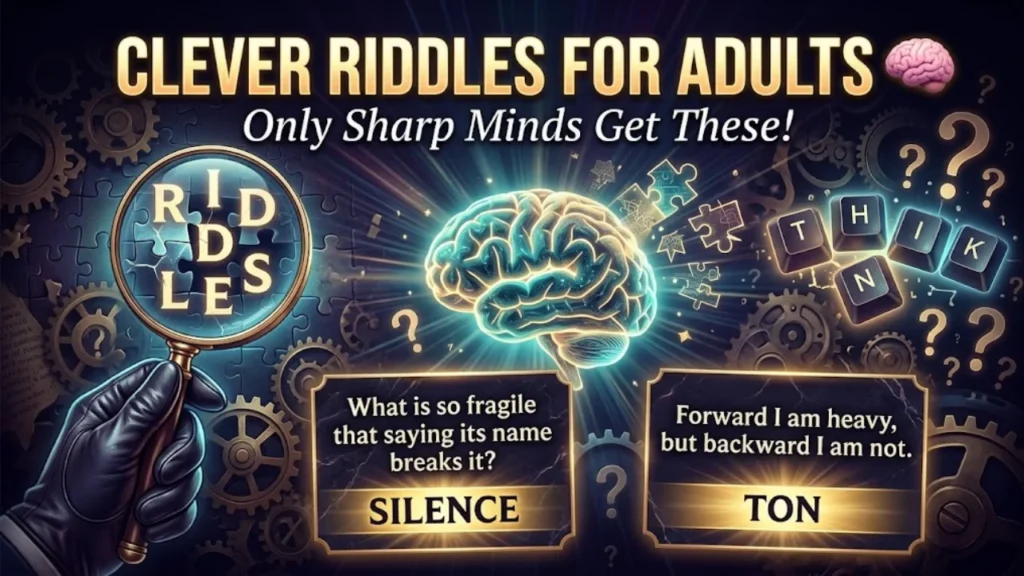
- What is so fragile that saying its name breaks it? Answer: Silence
- Forward I am heavy, but backward I am not. What word am I? Answer: Ton
- What five-letter word becomes shorter when you add two letters to it? Answer: Short
- I am a word of three letters. Add two more, and I become fewer. What word am I? Answer: Few
- What word begins and ends with “e” but usually only has one letter in it? Answer: Envelope
- What English word retains its pronunciation even after you remove four of its five letters? Answer: Queue
- What word looks the same forward, backward, and even upside down? Answer: NOON
- What is always in front of you but can never be seen? Answer: The future
- What can travel through walls without breaking them? Answer: Your voice
- What word means both “to strike with a closed hand” and “a small tool used for driving nails”? Answer: Hammer
- I am the beginning of eternity, the end of time and space. What letter am I? Answer: The letter “E”
- What word in English contains all 26 letters? Answer: Alphabet, since it names the full set even though it does not contain every letter itself — a fun trick answer used often in classic wordplay
- What English word has three sets of double letters in a row? Answer: Bookkeeper
- What can be cracked, made, told, and played, all at once? Answer: A joke
- I have keys but no locks, space but no room. What am I? Answer: A keyboard
- What word is pronounced the same even if you take away its middle letter? Answer: Queue (again proves that spelling and sound do not always match in English)
- What is at the end of a rainbow? Answer: The letter “W”
- What word describes both “a piece of paper money” and “a bill given to a bird’s beak”? Answer: Bill
- What can you break without touching it? Answer: A promise
- What word becomes its own opposite when you add the letters “un” in front of it? Answer: Lock, since “unlock” reverses the meaning
Hard & Tricky Word Riddles
These are the toughest entries on this list — genuinely hard riddles that make people stop and think twice.
- What word of five letters has only one letter left once you remove two? Answer: Stone, remove “St” and “one” remains
- What English word becomes its opposite when you add just one letter? Answer: Loved becomes Unloved with “un” added, showing how a single prefix flips meaning entirely
- A word I know, six letters it contains. Remove one letter, and twelve remains. What is the word? Answer: Dozens
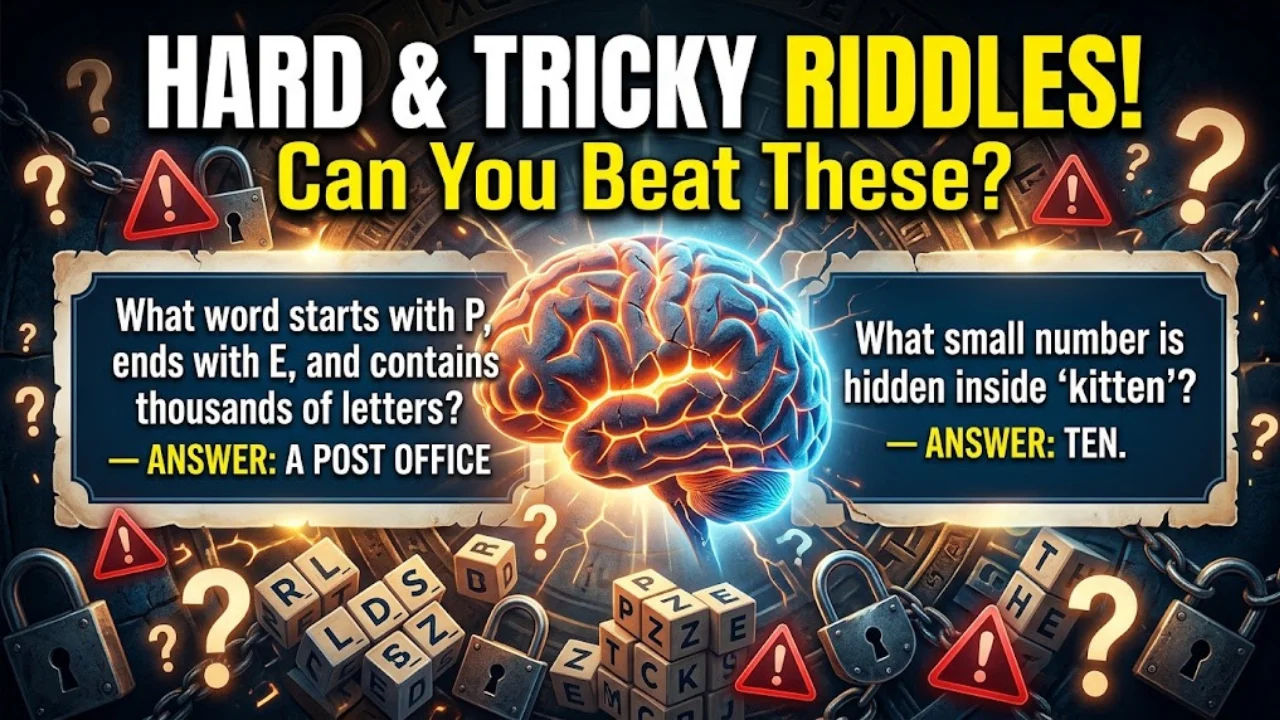
- What word starts with “P,” ends with “E,” and contains thousands of letters? Answer: A post office
- What word stays exactly the same whether you say it forward or read only its last three letters aloud? Answer: Eye, since it sounds identical to the letter “I”
- What common word contains the letters “XOP” together? Answer: Saxophone
- What is the longest word many riddle books claim fits in the dictionary, based on a wordplay trick? Answer: Smiles, because there is a “mile” between the two S letters
- What small number is hidden inside the word “kitten”? Answer: Ten
- What word can be written the same three different ways: forward, backward, and upside down? Answer: NOON
- I am a word that becomes longer when you remove my third letter. What word am I? Answer: Lounger, since removing the “u” or reshaping it plays on how odd this trick spelling riddle can feel
- Change the first letter of “Cat” to a “B” and you get a completely different animal. What is it? Answer: Bat
- What is heavier: a pound of words or a pound of silence? Answer: Neither — a pound is a pound, no matter what it measures
- What word means the opposite of itself depending on how it is used in a sentence? Answer: Dust, since it can mean adding fine particles or removing them, making it a true contronym
- What other common English word works the same way as “dust,” meaning two opposite things? Answer: Sanction, which can mean either to approve something or to punish it
- What five-letter word has six left after two letters are removed? Answer: Sixty, remove the letters “S” and “y” to leave “ixt” — this one plays purely on spelling, not real math
- What word do you get if you take away the front and back letters of “starting” one at a time until one letter remains? Answer: Starting, staring, string, sting, sing, sin, in, I
- What three numbers give the same result whether they are multiplied or added together? Answer: One, two, and three
- What word sounds like a single letter of the alphabet but is spelled with several letters? Answer: Queue sounds like the letter “Q”
- What English word is the only one that becomes plural by adding “ren” instead of “s”? Answer: Child becomes Children
- What is the shortest complete sentence in the English language? Answer: “I am.”
Letter, Spelling & Alphabet Riddles
These focus on letters and spelling, a favorite category for classrooms and word-game fans.
- Which word is always spelled incorrectly, no matter who writes it? Answer: “Incorrectly”
- What is at the middle of the word “Toronto”? Answer: The letter “O”
- What letter of the alphabet has the most water? Answer: The letter “C,” which sounds like “sea”
- You see me once in June, twice in November, but never in May. What am I? Answer: The letter “E”
- What letter comes next in this pattern: M, A, M, J, J, A, S, O, ___? Answer: N, for November, since the pattern follows the first letters of the months
- What word begins with the letter “I” and becomes a new word with the same sound once you add an “A”? Answer: Isle becomes Aisle
- What common word has one left when you remove its first and last letters? Answer: Stone, once “st” and “e” are gone, “on” remains, close to “one” in sound
- What single letter completes every month somewhere in its name? Answer: The letter “R,” found in every month except May, June, and July
- What word is spelled with the same four letters no matter which direction you read it? Answer: NOON
- What has five vowels and no consonants at all? Answer: “Eunoia,” a real English word meaning a state of calm and beauty of thought
- What letter sounds exactly like a question when spoken aloud? Answer: “Y,” which sounds like “why”
- What single letter, when doubled, becomes a common farm sound? Answer: “Oo,” as in “Moo”
- What is the only letter that does not appear in any U.S. state name? Answer: The letter “Q”
- Add three letters to the word “car” and turn it into a vegetable. What is the vegetable? Answer: Carrot
- What is the shortest word in English that contains all five vowels? Answer: Eunoia
- What letter is silent in the word “island”? Answer: The letter “S”
- What word has all its letters in alphabetical order? Answer: Almost, or the shorter example, “Ghost”
- What is the only number spelled with letters in alphabetical order? Answer: Forty
- What is the only number spelled with its letters in reverse alphabetical order? Answer: One
- What letter is used the most in the English language? Answer: The letter “E,” which appears more often than any other letter in written English, according to standard letter-frequency studies used in cryptography and typography (Cornell University letter frequency data)
Word Riddles for Kids & Family Game Night
These are simple riddles for kids, made for family game night, classrooms, and young solvers just learning wordplay.
- What has many pages but cannot be read out loud by itself? Answer: A book
- What kind of tree can you carry in your hand? Answer: A palm
- What jumps when it walks and sits when it stands? Answer: A kangaroo
- What has a tongue but cannot talk? Answer: A shoe
- What has four legs in the morning, two legs at noon, and three legs at night? Answer: A person, crawling as a baby, walking as an adult, using a cane when old
- A boy’s parents have three sons: Snap, Crackle, and one more. What is the third son’s name? Answer: The boy’s own name, since he is the third son (the riddle is written from his point of view)
- What has a head, a tail, but no body at all? Answer: A coin
- What word means to be quiet and also describes a peaceful night? Answer: Calm
- What has one head, one foot, and four legs? Answer: A bed
- What has to be broken before you can eat it, besides an egg? Answer: Bread, since a loaf must be broken or sliced first
- What is black when clean and white when dirty? Answer: A chalkboard
- What can you catch but never throw? Answer: A cold
- What has many teeth but cannot chew? Answer: A comb
- What is full of holes yet still holds water? Answer: A sponge
- What goes around the yard but never moves? Answer: A fence
- What has words on it but never says a single one out loud? Answer: A page
- What word describes both a small stream and the sound water makes? Answer: Brook
- What do you call a story with no real ending? Answer: To be continued
- What is easy to get into but hard to get out of? Answer: Trouble
- What is at the beginning of every meal but never the end of one? Answer: The letter “M”
- What word means “a place with books” and also describes a “collection of stories”? Answer: Library
- What always answers without ever speaking first? Answer: An echo
How to Solve Word Riddles Like a Pro
Solving word riddles gets easier once you know the common tricks writers use. Here is what to watch for.
Look for double meanings. Many word riddles use one word that can mean two different things, like “bark” (a dog sound or tree covering). This is the single biggest pattern in wordplay.
Say the riddle out loud. Some answers only click when you hear the words instead of reading them. Homophones like “queue” and “Q” only make sense out loud.
Break the word apart. Riddles about letters often ask you to add, remove, or rearrange letters. Try writing the word down and physically crossing out letters as the riddle describes.
Don’t overthink simple riddles. Easy riddles usually have a simple, everyday answer. If your guess feels too complicated, step back and think about common objects first.
Read it twice. Word riddles hide their trick in phrasing. A second read often reveals a clue you missed the first time.
Why Word Riddles Are Great for Brain Health, Parties & Team Building
Word riddles are not just for fun. Research on cognitive activity shows that puzzle-solving activities, including wordplay, support memory and processing speed in both children and adults (National Institute on Aging on cognitive activities). Regularly practicing wordplay strengthens vocabulary and pattern recognition, two skills tied closely to reading comprehension.
Riddles also work well socially. A short word riddle breaks the ice at the start of a meeting, warms up a classroom, or fills a quiet moment on a long car ride. Because they take only a few seconds to read, they fit almost any setting without needing extra materials.
Teachers often use word riddles to teach new vocabulary in a memorable way. HR teams use them as light team-building tools because everyone can join in regardless of age or background. Families use them simply because they are free, fast, and fun.
FAQs
What are some good word riddles?
Good word riddles mix everyday objects with clever wordplay, like “What has a neck but no head?” (a bottle) or “What can you break without touching it?” (a promise). The best ones are short, have one clear answer, and use words with double meanings.
What are some riddles with answers?
Riddles with answers pair a short question with a stated solution, such as “What has to be broken before you can use it? An egg.” This format lets solvers try to guess first, then check the answer right away, which is why it is the most common style used across riddle collections.
What are the top 10 hardest riddles?
The hardest word riddles usually involve spelling tricks, contronyms (words that mean their own opposite), or letter-removal puzzles. Examples from this list include the “dust” contronym riddle (#73), the “Dozens” riddle (#63), the “Eunoia” vowel riddle (#95), and the “Bookkeeper” triple double-letter riddle (#53). These require more than one read to solve.
What are some good short riddles
Short riddles get straight to the point in one sentence, like “What runs but never walks? Water” or “What has one eye but cannot see? A needle.” They work well for kids, quick icebreakers, and anyone new to solving word riddles.
Conclusion
Word riddles are one of the simplest ways to sharpen your thinking while having fun. Whether you picked the short riddles, the funny ones, or the truly hard riddles further down the list, every one of these 120+ entries comes with a clear, bolded answer so you can check your guess right away.
Try a few with your family tonight, share your favorites at your next get-together, or use them to warm up a classroom or team meeting. A good word riddle never really gets old — it just waits for the next person to give it a try.

Amelia Singh is a content strategist and digital writer specializing in curated web directories, cultural quote archives, and instructional content. She is dedicated to creating clear, engaging, and reliable digital resources for readers worldwide.