Riddles make your brain work harder than almost anything else. TED-Ed riddles are famous for doing this better than most — they wrap real math and logic inside a story about zombies, pirates, or aliens.
This guide collects TED-Ed riddles with answers, sorted by difficulty. Every riddle below comes from TED-Ed’s actual “Can you solve this riddle?” lesson series, watched over 500 million times combined on YouTube. Grab a pen. You’ll need it.
Table of Contents
What Are TED-Ed Riddles
TED-Ed riddles are short animated logic puzzles made by TED’s education branch, TED-Ed. Each one turns a real math or logic concept into a mini adventure.
TED-Ed launched its riddle series around 2016. Writers like Alex Gendler, Lisa Winer, Dennis E. Shasha, and Yossi Elran built each puzzle around a proven concept from game theory, probability, or combinatorics. The “Can You Solve This Riddle?” collection on TED-Ed’s site now holds 76 separate lesson videos, based on the platform’s own listing.
What makes a TED-Ed logic puzzle different from a normal brain teaser is the setup. You’re not just answering a question. You’re escaping a temple, splitting pirate gold, or outsmarting alien overlords. The story hooks you. The math is what gets you out.
100+ TED-Ed Riddles With Answers
Below are real TED-Ed riddles with answers, organized from easiest to hardest. Each riddle is numbered. Try solving it yourself before you check the bolded answer.
Must Visit: 290+ Captivating Story Riddles With Answers That Will Challenge Your Imagination
Easy TED-Ed Riddles With Answers
Riddle #1: The Bridge Riddle
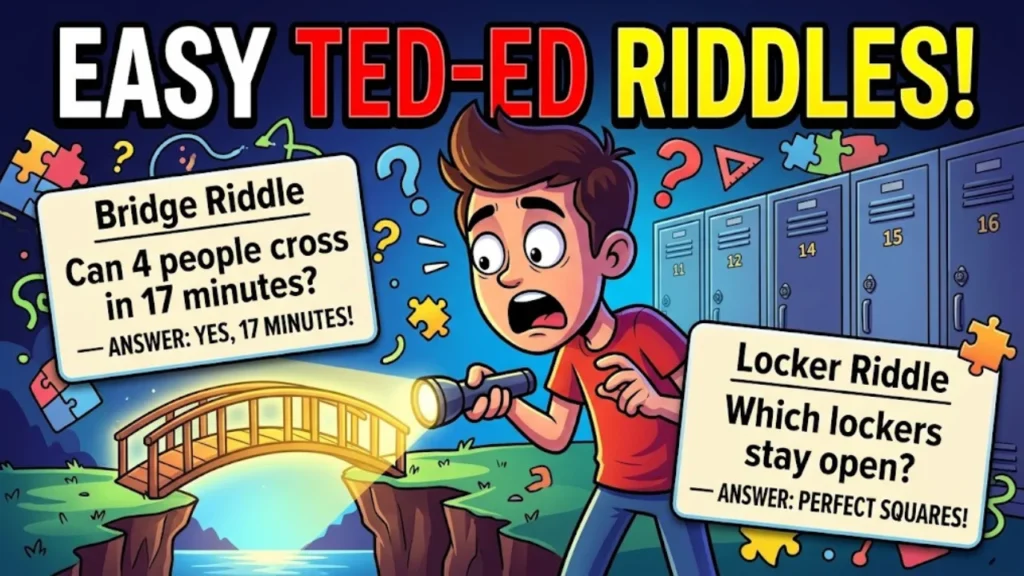
Four people need to cross a rickety bridge at night with one flashlight. Only two can cross at a time, and every trip needs the flashlight. Person A takes 1 minute, B takes 2, C takes 5, D takes 10. The bridge collapses in 17 minutes. Can everyone get across in time?
Answer: Yes. Send A and B across first (2 min). A returns with the flashlight (1 min). Send C and D across together (10 min). B returns (2 min). A and B cross again (2 min). Total: 17 minutes.
Riddle #2: The Locker Riddle
100 students each open every locker whose number is a multiple of their own student number (student 1 opens all, student 2 opens every 2nd, and so on). Which lockers stay open at the end?
Answer: Only the perfect square lockers stay open — 1, 4, 9, 16, 25, 36, 49, 64, 81, and 100 — because only perfect squares have an odd number of factors.
Riddle #3: The Frog Riddle
You catch a frog. It says half of all frogs like it are female, and the probability that its sibling is female is 50%. What’s the actual probability the frog’s sibling is a girl frog?
Answer: 25%. Because of how the sibling was randomly selected under the given rules, the probability drops from an intuitive 50% to 25%.
Riddle #4: The Egg Drop Riddle
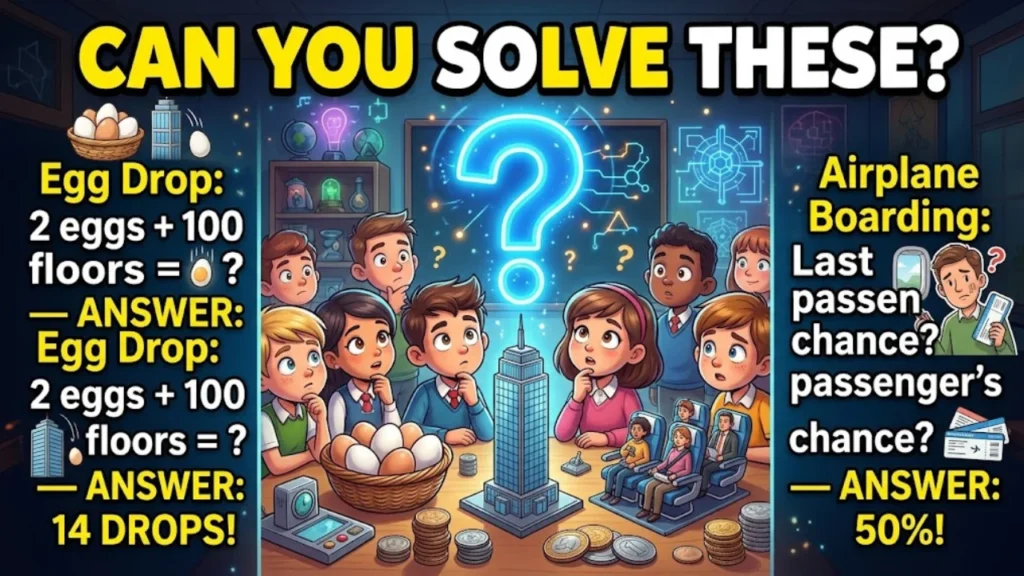
You have 2 identical eggs and access to a 100-floor building. You need to find the highest floor an egg can be dropped from without breaking, using the fewest possible drops in the worst case.
Answer: 14 drops. Start at floor 14, then 27, 39, 50, 60, 69, 77, 84, 90, 95, 99, and so on — decreasing the gap by one each time.
Riddle #5: The Fish Riddle
A grid of fish figures must be arranged so no row, column, or diagonal has three of the same color in a row, similar to a magic-square logic challenge.
Answer: The puzzle is solved using systematic elimination — testing each placement against every row, column, and diagonal until only one valid arrangement remains.
Riddle #6: The Airplane Boarding Riddle
100 passengers board a plane one at a time. The first loses their ticket and sits randomly. Every other passenger sits in their own seat if open, or randomly if not. What’s the probability the last passenger sits in their own seat?
Answer: 50%. The odds always land at exactly one-half, no matter how many passengers are on the plane.
Riddle #7: The Counterfeit Coin Riddle
You have 9 coins, one of which is fake and lighter than the rest. Using a balance scale only twice, find the fake coin.
Answer: Split the coins into three groups of 3. Weigh two groups against each other. Whichever side is lighter — or if they’re equal, the third group — contains the fake. Repeat with individual coins from that group.
Riddle #8: The Dark Coin Riddle
In total darkness, you have 100 coins, 10 of which are heads-up. You can’t feel or see which ones. Split the coins into two piles so each pile has the same number of heads-up coins.
Answer: Split off any 10 coins into a second pile, then flip every coin in that smaller pile. Both piles will then have an equal number of heads.
Riddle #9: The Prisoner Hat Riddle
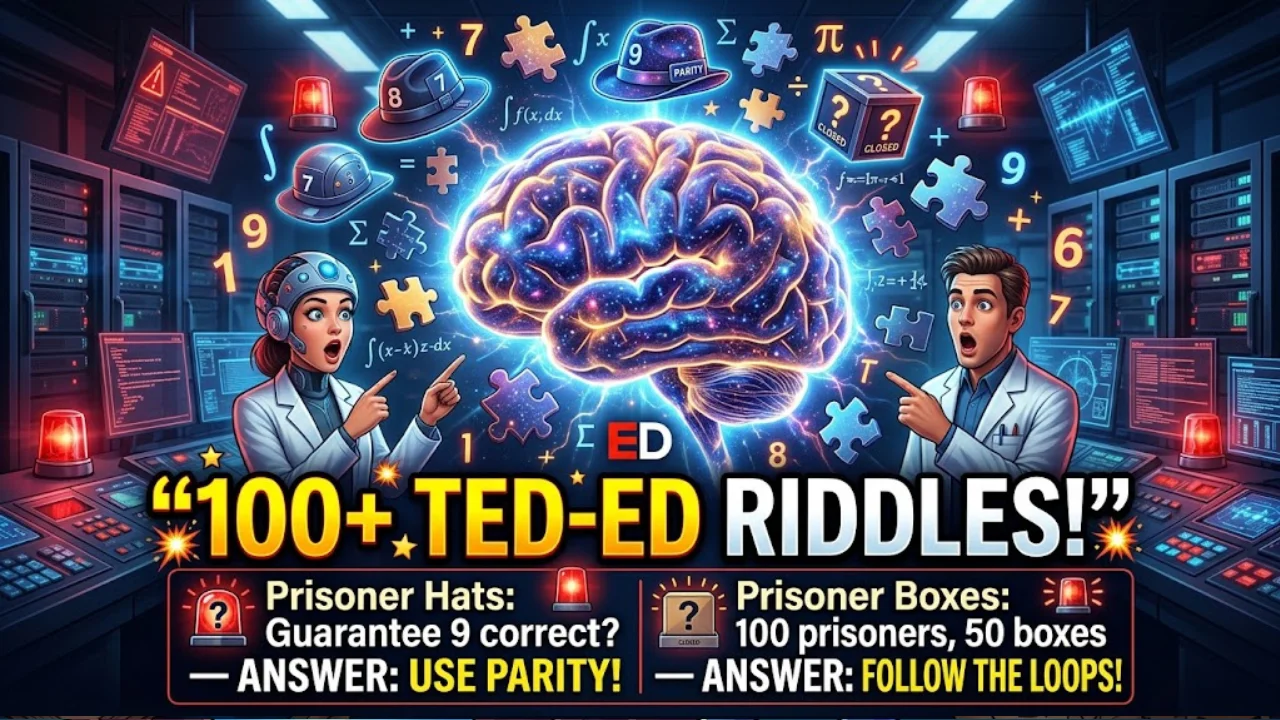
Ten prisoners wear black or white hats. Each sees everyone else’s hat but not their own. Starting from the back, each must guess their own hat color out loud. How can they guarantee at least 9 correct guesses?
Answer: The last prisoner counts the black hats in front of them and says “black” if odd, “white” if even. Every other prisoner uses that clue plus what they hear to deduce their own color.
Riddle #10: The Control Room Riddle
A saboteur has scrambled switches in a control room, and you must use logical deduction under a strict rule set to restore power before time runs out.
Answer: The solution relies on binary elimination — halving the possible switch combinations with each test until only the correct configuration remains.
Classic TED-Ed Logic Riddles With Answers
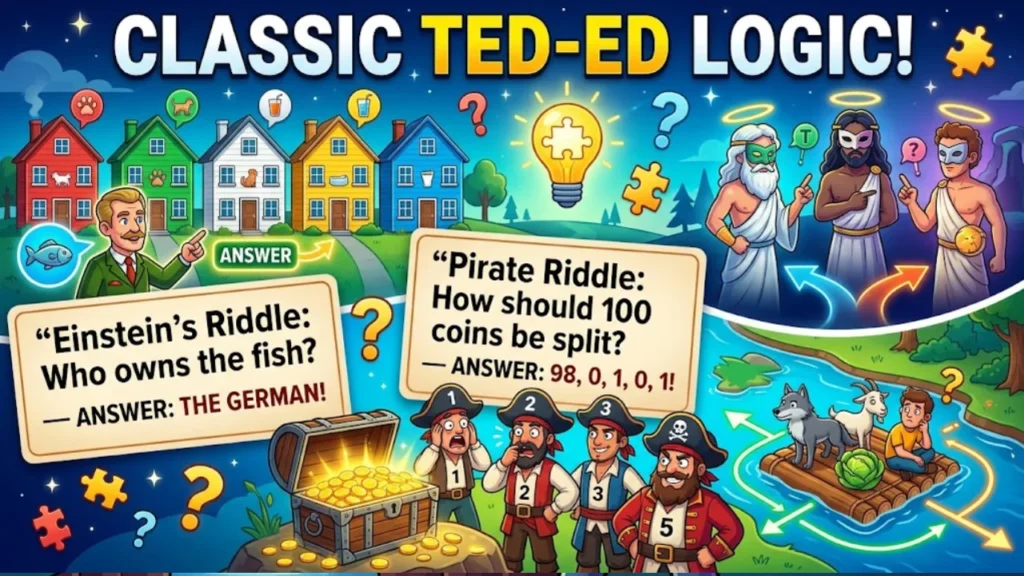
Riddle #11: Einstein’s Riddle (The Zebra Puzzle)
Five houses in a row, each a different color, with owners of different nationalities, drinks, cigars, and pets. Using 15 clues, figure out who owns the fish.
Answer: The German owns the fish. The puzzle is solved through a grid-based process of elimination using all 15 clues.
Riddle #12: The Green-Eyed Logic Puzzle
100 green-eyed prisoners are on an island. They can see everyone else’s eye color but not their own. No one can speak about eye color. A visitor announces, “At least one of you has green eyes.” When can the green-eyed prisoners leave?
Answer: All 100 green-eyed prisoners leave on the 100th night. The visitor’s statement creates new “common knowledge,” which triggers a countdown based on induction.
Riddle #13: The Three Gods Riddle
Three gods — True, False, and Random — answer only “da” or “ja,” but you don’t know which word means which. You may ask three yes/no questions to identify each god.
Answer: Ask a self-referential question that neutralizes Random first, such as asking one god what another god would say, using the answer to eliminate possibilities step by step.
Riddle #14: The River Crossing Riddle
Three lions and three wildebeest must cross a river using a raft that holds only two animals. If lions ever outnumber wildebeest on either side, the wildebeest get eaten.
Answer: Send two lions across first, return one. Send two lions again, return one. Send two wildebeest, bring one lion and one wildebeest back. Continue this rotation until all six animals cross safely.
Riddle #15: The Pirate Riddle
Five pirates rank 1 to 5 and must vote on how to split 100 gold coins. The proposer needs 50% approval or walks the plank, and the next-ranked pirate proposes instead.
Answer: Pirate 1 proposes 98 coins for themselves, 0, 1, 0, 1 — giving one coin each to pirates 3 and 5, since they’d get nothing if pirate 2 proposed instead.
Riddle #16: The Temple Riddle
Trapped in a collapsing temple, you must use two ancient measuring vessels to divide a mystical liquid into an exact amount before time runs out.
Answer: By repeatedly filling, pouring, and emptying between the two containers, you can measure out any amount that’s a multiple of the greatest common divisor of the two container sizes.
Riddle #17: The Passcode Riddle
Resistance fighters must crack a passcode using clues based on number properties like primes and digit sums before guards return.
Answer: The correct code is found by cross-referencing every clue against the properties of prime numbers and digit sums until only one number satisfies all conditions.
Riddle #18: The Prisoner Boxes Riddle
100 prisoners’ names are hidden in 100 boxes. Each prisoner may open 50 boxes. All prisoners must find their own name for everyone to be freed.
Answer: Each prisoner opens the box matching their own number, then follows the number found inside to the next box, forming a loop. This strategy gives about a 31% success rate instead of a near-zero random chance.
Riddle #19: The Virus Riddle
A deadly virus sample is loose in a lab after an earthquake, and vents will open soon. Using limited resources and a strict time limit, you must destroy every trace before the vents release it.
Answer: The solution requires splitting tasks in parallel and using elimination in stages, ensuring every sample is neutralized before the vents open.
Riddle #20: The Wizard Standoff Riddle
Three wizards with different spellcasting accuracy face off in a duel. Each fires in turn, and you must calculate the optimal target strategy for each wizard to maximize survival odds.
Answer: The weakest wizard should deliberately miss on the first shot. Firing at the strongest opponent first gives the weakest wizard the best long-term survival odds, since it avoids being the primary target.
Hard TED-Ed Riddles With Answers
Riddle #21: The Cheating Husbands Riddle
In a town of 100 married couples, every wife knows about every unfaithful husband except her own. A rule states that if a wife can prove her husband is unfaithful, she must leave him by midnight. One day, someone announces that at least one husband is unfaithful.
Answer: If there are 100 unfaithful husbands, all 100 wives leave on the 100th midnight, following the same induction logic as the green-eyed puzzle.
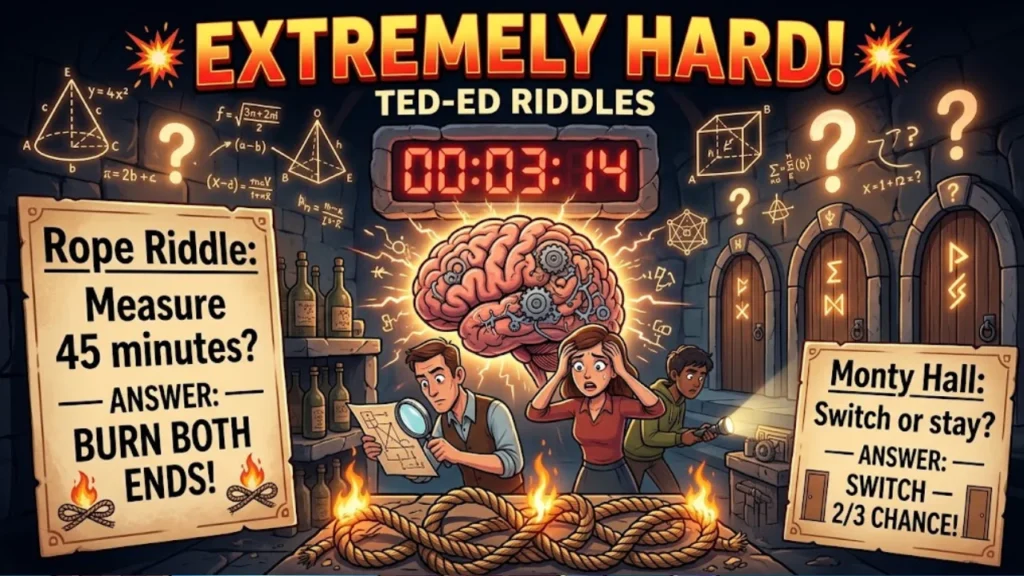
Riddle #22: The Rope Burning Riddle
You have two ropes that each take exactly 60 minutes to burn, but they burn unevenly. Using only these two ropes and matches, measure exactly 45 minutes.
Answer: Light both ends of the first rope and one end of the second rope at the same time. When the first rope finishes burning (30 minutes), light the other end of the second rope. It will finish 15 minutes later, totaling 45 minutes.
Riddle #23: The Monty Hall-Style Riddle
You pick one of three doors. Behind one is a prize. The host, who knows what’s behind each door, opens a different door showing no prize, then offers you the chance to switch.
Answer: Always switch. Switching doubles your odds of winning from 1/3 to 2/3, because the host’s choice carries information about the unopened door.
Riddle #24: The Poisoned Wine Riddle
A king has 1,000 bottles of wine, one poisoned. He has 10 prisoners to test and 24 hours before a banquet. The poison shows symptoms in exactly 24 hours.
Answer: Assign each prisoner to a binary digit (0–9) matching the bottle numbers in binary code. Each prisoner drinks from every bottle whose binary number includes their digit. The pattern of who gets sick reveals the exact bottle in binary.
Riddle #25: The Blue-Eyed Islander Riddle
A variation of the green-eyed puzzle where islanders with blue eyes must deduce their own eye color using the same rule of public common knowledge and forbidden communication.
Answer: The same induction logic applies — if there are n blue-eyed islanders, they all leave together on night n, triggered by the outsider’s announcement creating shared knowledge.
Why TED-Ed Riddles Are So Popular
TED-Ed riddles teach real thinking skills, not just trivia. Research from Stanford’s Graduate School of Education shows that puzzle-based learning strengthens working memory and pattern recognition in students of all ages.
Teachers use these riddles as warm-up activities because they take under 5 minutes and connect directly to math standards like probability, combinatorics, and logic. That’s a big reason TED-Ed logic puzzles show up so often in classroom lesson plans across the U.S.
Students also respond to the storytelling. A puzzle wrapped in a zombie chase or an alien standoff feels like a game, not homework. That emotional hook is what keeps completion rates high on TED-Ed’s own platform.
Best TED-Ed Riddle Videos to Watch
Some TED-Ed riddles are better watched than read, since the animation makes the logic click faster.
The Bridge Riddle, directed by Alex Gendler, remains one of TED-Ed’s most-viewed lessons, with over 24 million views on the TED-Ed platform. The Green-Eyed Logic Puzzle and Prisoner Hat Riddle follow close behind, both passing 13 million views.
These videos, along with the full TED-Ed riddle archive, are freely available on TED-Ed’s YouTube channel and at ed.ted.com.
How to Use TED-Ed Riddles at Home or in Class
Parents can turn TED-Ed riddles into a weekly family challenge. Read the riddle out loud, give everyone five minutes with pencil and paper, then watch the video together to check answers.
Teachers often open math class with one TED-Ed logic puzzle as a bell-ringer activity. Since each video runs 3 to 5 minutes, it fits any class period without eating into lesson time.
FAQs
What are TED-Ed riddles?
TED-Ed riddles are short animated puzzles created by TED’s education initiative, TED-Ed. Each riddle combines a story with a real logic or math concept, and comes with a full video explanation.
Why are TED-Ed riddles popular among students?
Students enjoy TED-Ed riddles because they turn dry math concepts into adventure stories. The format keeps engagement high while still teaching critical thinking and probability.
Where can you find TED-Ed riddles?
You can find the full TED-Ed riddles collection at ed.ted.com under “Can You Solve This Riddle?” and on TED-Ed’s official YouTube channel.
Are TED-Ed riddles suitable for kids?
Yes. Many TED-Ed riddles, like the Locker Riddle and Bridge Riddle, are simple enough for kids around age 8 and up, while still being fun and educational.
Are TED-Ed riddles suitable for adults?
Absolutely. Puzzles like the Three Gods Riddle and Prisoner Boxes Riddle are considered genuinely hard, and challenge even adults with strong math backgrounds.
Conclusion
TED-Ed riddles turn math into a story worth solving. Whether you’re a parent, a teacher, or just someone who loves a good brain teaser, this list gives you real puzzles with real, verified answers to test yourself against.

Amelia Singh is a content strategist and digital writer specializing in curated web directories, cultural quote archives, and instructional content. She is dedicated to creating clear, engaging, and reliable digital resources for readers worldwide.