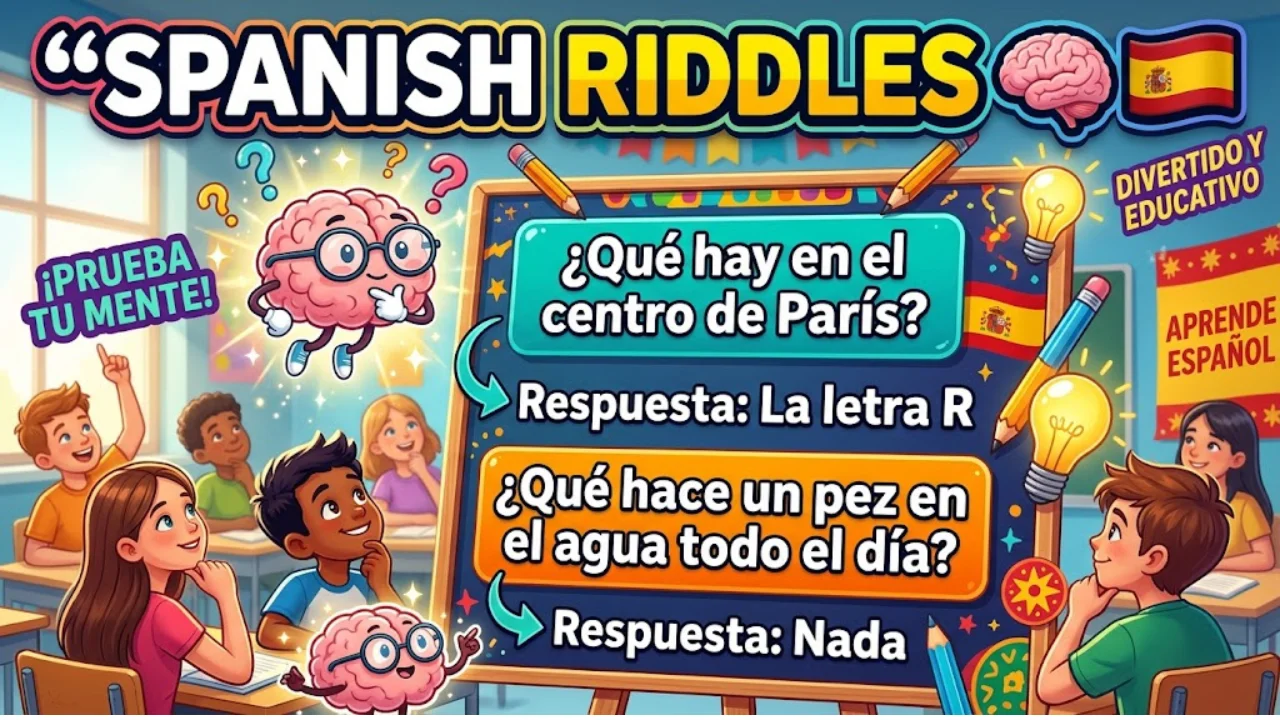
Riddles in Spanish are called adivinanzas, and families have passed them down for generations. Here are 62 Spanish riddles with answers, each with an English translation.
Read every riddle out loud, because many only click when you hear them. They suit Spanish learners, kids, adults and classrooms across the U.S., and they fit right in with Hispanic Heritage Month (Sept. 15 to Oct. 15).
Table of Contents
What Are Riddles in Spanish? (Adivinanzas Explained)
Spanish riddles are short, clever puzzles, and many rhyme. Here is what to know before you start.
A riddle in Spanish is an adivinanza. The word comes from adivinar, which means “to guess.” You may also see acertijo and enigma.
Want to start a riddle the Spanish way? Say “Adivina, adivinanza” (“Guess, riddle”) or “A ver si adivinas” (“Let’s see if you can guess”).
Why learn this way? Spain’s Ministry of Foreign Affairs, citing the Instituto Cervantes, reports more than 600 million potential Spanish speakers worldwide, with almost 500 million who speak it natively. See the official figures. In the U.S., Pew Research Center’s analysis of Census data found that Spanish is by far the most spoken non-English language in American homes. Read the Pew analysis. exteriorespewresearch
Most adivinanzas lean on rhyme, wordplay and double meaning. That makes them a quick way to build vocabulary and to think in Spanish instead of translating.
Use these tips to solve Spanish riddles faster:
- Read it aloud. Sound tricks like espera / es pera hide the answer.
- Watch the verbs. One verb can carry two meanings, like nada (“swims” or “nothing”).
- Picture the clues. Ask what has “teeth” but does not bite.
- Say the answer with its article. Using el or la teaches you the noun’s gender too.
Difficulty key: ⭐ easy, ⭐⭐ medium, ⭐⭐⭐ hard. Each answer sits right under its riddle, so cover it with your hand!
Easy Riddles in Spanish With Answers for Beginners and Kids
⭐ These easy Spanish riddles use animals, food and everyday objects. They work well for beginners, kids and classroom warm-ups.
Must Visit : 120+ Extremely Hard Riddles With Answers That Will Absolutely Stump Your Brain in 2026
Try one riddle a day at breakfast or in the car. Kids can guess in English first, then say the answer in Spanish.
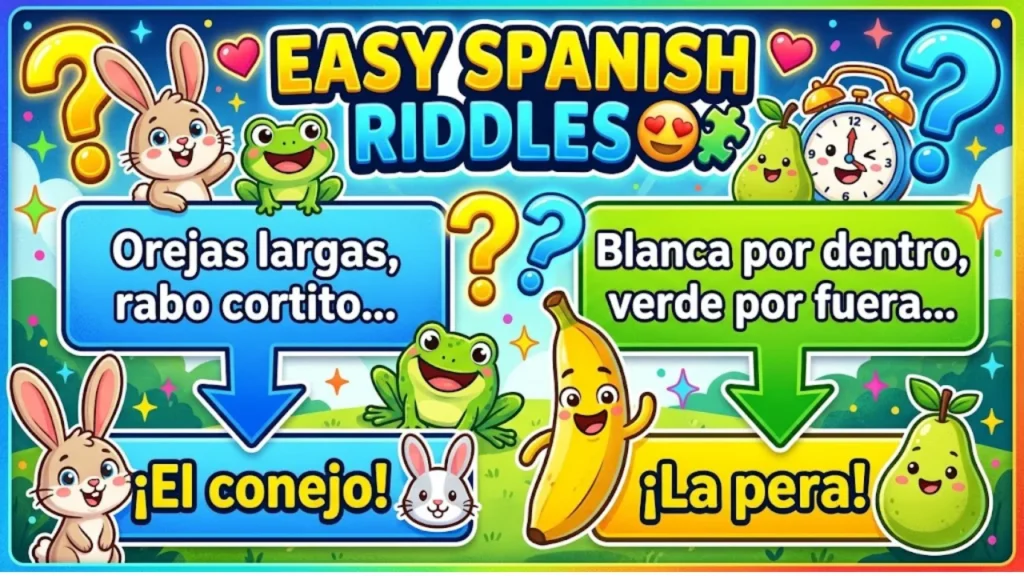
- Orejas largas, rabo cortito; corro y salto muy ligerito.
Long ears, a short tail; I run and jump very lightly.
Answer: El conejo (the rabbit) - En la charca hago “croac, croac”, salto lejos y sé nadar. Antes fui renacuajo. ¿Quién soy?
In the pond I go “ribbit, ribbit,” I jump far and I can swim. I used to be a tadpole. Who am I?
Answer: La rana (the frog) - Vuelo de noche, duermo en el día, y nunca verás plumas en ala mía.
I fly at night, I sleep by day, and you will never see feathers on my wing.
Answer: El murciélago (the bat) Fun fact: murciélago holds all five vowels. - Soy pez, pero parezco un caballo. Nado de pie y vivo en el mar.
I am a fish, but I look like a horse. I swim upright and live in the sea.
Answer: El caballito de mar (the seahorse) - Si digo mi nombre, me da hipo. Soy enorme y me baño en el río.
When I say my name, I get the hiccups. I am huge and I bathe in the river.
Answer: El hipopótamo (the hippo) The word comes from Greek terms for “river horse.” - Oro parece, plata no es. Abre la cortina y verás lo que es.
It looks like gold, but it is not silver. Open the curtain and you will see what it is.
Answer: El plátano (the banana or plantain) Say plata no es fast and you hear plátano es. - Blanca por dentro, verde por fuera. Si quieres que te lo diga, espera.
White inside, green outside. If you want me to tell you, wait.
Answer: La pera (the pear) Espera also sounds like es pera (“it is a pear”). - En el campo me crié, atada con verdes lazos; y aquel que llora por mí me está partiendo en pedazos.
I grew up in the field, tied with green ribbons; and whoever cries over me is cutting me to pieces.
Answer: La cebolla (the onion) - Tengo blanca la camisa y amarillo el corazón. No me abren con llave, sino con un golpe.
I have a white shirt and a yellow heart. You open me not with a key, but with a tap.
Answer: El huevo (the egg) - Agua pasa por mi casa, cate de mi corazón.
Water passes by my house, “cate” of my heart.
Answer: El aguacate (the avocado) The clue is hidden inside: agua + cate. - Somos cinco hermanos que viven en una mano, y ninguno mide igual.
We are five siblings who live on one hand, and no two are the same length.
Answer: Los dedos (the fingers) - Treinta y dos caballitos blancos viven en un corral rojo. Unas veces muerden, otras descansan.
Thirty-two little white horses live in a red corral. Sometimes they bite, sometimes they rest.
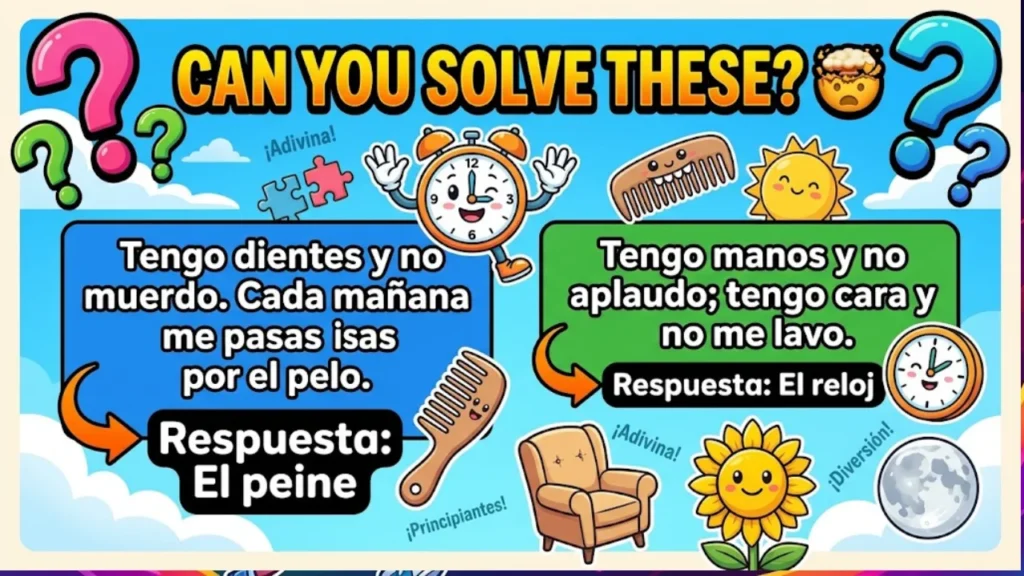
Answer: Los dientes (the teeth) Adults have 32 teeth, wisdom teeth included. - Tengo manos y no aplaudo; tengo cara y no me lavo. Siempre te digo la hora.
I have hands but I do not clap; I have a face but I do not wash it. I always tell you the time.
Answer: El reloj (the clock) - Tengo dientes y no muerdo. Cada mañana me pasas por el pelo.
I have teeth but I do not bite. Every morning you run me through your hair.
Answer: El peine (the comb) - Tengo cuatro patas y no camino. Todos me usan para descansar.
I have four legs but I do not walk. Everyone uses me to rest.
Answer: La silla (the chair) - Sale por la mañana y se esconde por la tarde. Da luz y calor a todo el mundo.
It rises in the morning and hides in the evening. It gives light and heat to everyone.
Answer: El sol (the sun) - Cambio de forma cada noche: soy redonda, media o casi nada.
I change shape every night: I am round, half or almost nothing.
Answer: La luna (the moon) - Soy una flor amarilla. Mi nombre dice que giro y también dice “sol”.
I am a yellow flower. My name says I turn, and it also says “sun.”
Answer: El girasol (the sunflower) Gira means “turns” and sol means “sun.” - Corro sin piernas, canto sin voz y siempre termino en el mar.
I run without legs, I sing without a voice and I always end at the sea.
Answer: El río (the river) - Nazco del fuego, subo sin escalera y me deshago con el viento.
I am born from fire, I climb without a ladder and I fade in the wind.
Answer: El humo (the smoke)
Medium Spanish Riddles With Answers and Wordplay
⭐⭐ Now the fun shifts to letters, sound tricks and family logic. Read each one slowly and say it out loud.
Spanish speakers also love colmos. These joke riddles start with “¿Cuál es el colmo de…?” (“What is the ultimate irony of…?”). You will meet two below.
- ¿Qué letra abre “sol” y cierra “mes”?
Which letter opens “sol” and closes “mes”?
Answer: La S (the letter S) - ¿Qué letra está al principio de “ojo” y al final de “pelo”?
Which letter is at the start of “ojo” and the end of “pelo”?
Answer: La O (the letter O) - ¿En qué terminan siempre el día y la alegría?
What do “día” and “alegría” always end in?
Answer: En la letra A (in the letter A) - ¿Qué hay en el centro de París?
What is in the center of Paris?
Answer: La letra R (the letter R) The middle letter of París is R. - ¿Qué hay entre “playa” y “mar”?
What is between “playa” and “mar”?
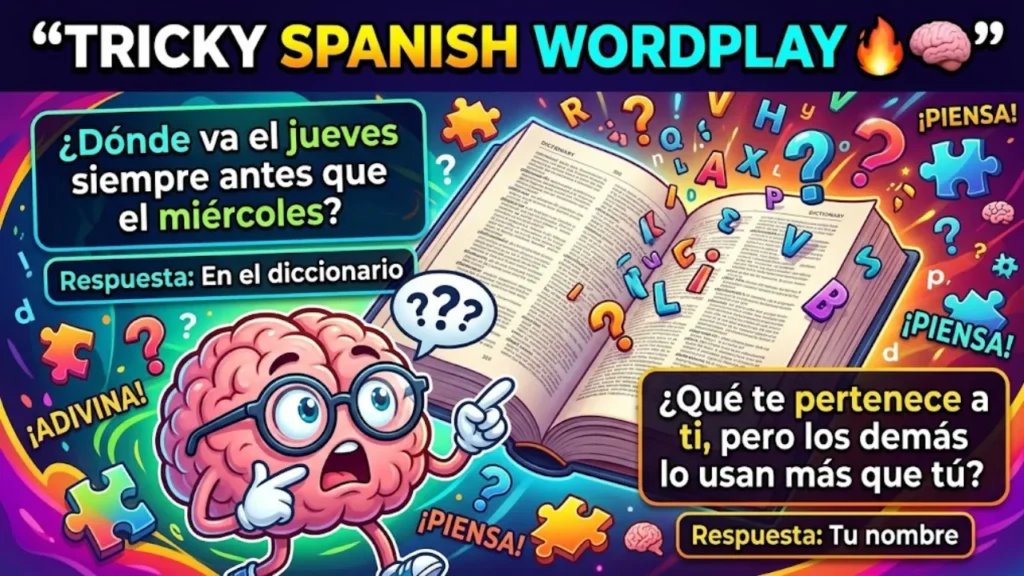
Answer: La letra Y (the letter Y) Read it as “playa y mar,” where y means “and.” - ¿Dónde va el jueves siempre antes que el miércoles?
Where does Thursday always come before Wednesday?
Answer: En el diccionario (in the dictionary) Alphabet order puts jueves (J) before miércoles (M). - ¿Qué hace un pez en el agua todo el día?
What does a fish do in the water all day?
Answer: Nada (swims / nothing) Nada means both “swims” (from nadar) and “nothing.” - Si digo mi nombre, desaparezco. ¿Quién soy?
If I say my name, I disappear. Who am I?
Answer: El silencio (silence) - ¿Qué le dijo un techo a otro techo?
What did one ceiling say to another ceiling?
Answer: “Techo de menos” (I miss you) It sounds like te echo de menos, which means “I miss you.” - ¿Cuál es el colmo de un jardinero?
What is the “colmo” (the ultimate irony) for a gardener?
Answer: Que su novia se llame Rosa y lo deje plantado (that his girlfriend is named Rose and leaves him “planted”) Dejar plantado means “to stand someone up.” - Un niño y un pato nacieron el mismo día. Al cabo de un año, ¿cuál es mayor?
A boy and a duck were born on the same day. After one year, which is older?
Answer: El pato (the duck) Un año y pico means “a year and a bit,” but pico is also a beak. - ¿Cuál es el colmo de un electricista?
What is the “colmo” for an electrician?
Answer: Que su esposa se llame Luz y sus hijos le sigan la corriente (that his wife is named Light and his kids “follow the current”) Seguir la corriente means “to go along with.” - ¿Qué te pertenece a ti, pero los demás lo usan más que tú?
What belongs to you, but other people use it more than you do?
Answer: Tu nombre (your name) - Es hijo de tu abuelo y hermano de tu tío, pero no es tu tío. ¿Quién es?
He is your grandfather’s son and your uncle’s brother, but he is not your uncle. Who is he?
Answer: Tu padre (your father) Draw a family tree if it helps. - En un auto iban dos madres y dos hijas, pero solo había tres personas. ¿Cómo es posible?
Two mothers and two daughters rode in a car, but there were only three people. How?
Answer: Una abuela, su hija y su nieta (a grandmother, her daughter and her granddaughter) - Algunos meses tienen 30 días y otros 31. ¿Cuántos tienen 28?
Some months have 30 days and others have 31. How many have 28?
Answer: Todos (all of them) Every month has at least 28 days. - Vivo en tu bolsillo o en un llavero. Tengo dientes de metal y abro puertas.
I live in your pocket or on a key ring. I have metal teeth and I open doors.
Answer: La llave (the key) - ¿Dónde hay ríos sin agua, ciudades sin casas y montañas sin árboles?
Where are there rivers without water, cities without houses and mountains without trees?
Answer: En un mapa (on a map) - Cuanto más me quitas, más grande me hago. ¿Qué soy?
The more you take away from me, the bigger I get. What am I?
Answer: Un agujero (a hole) - ¿Qué cosa cuanto más se moja, más seca?
What thing dries more the wetter it gets?
Answer: La toalla (the towel)
Hard Riddles in Spanish to Test Your Brain
⭐⭐⭐ These hard Spanish riddles use lateral thinking. The answer is often simpler than it looks, so question the setup.
- Un prisionero debe elegir entre tres cuartos: uno lleno de fuego, otro con explosivos que estallan al abrir la puerta y otro con leones que no comen desde hace años. ¿Cuál elige para sobrevivir?
A prisoner must pick one of three rooms: one full of fire, one with explosives that go off when the door opens, and one with lions that have not eaten in years. Which room saves him?
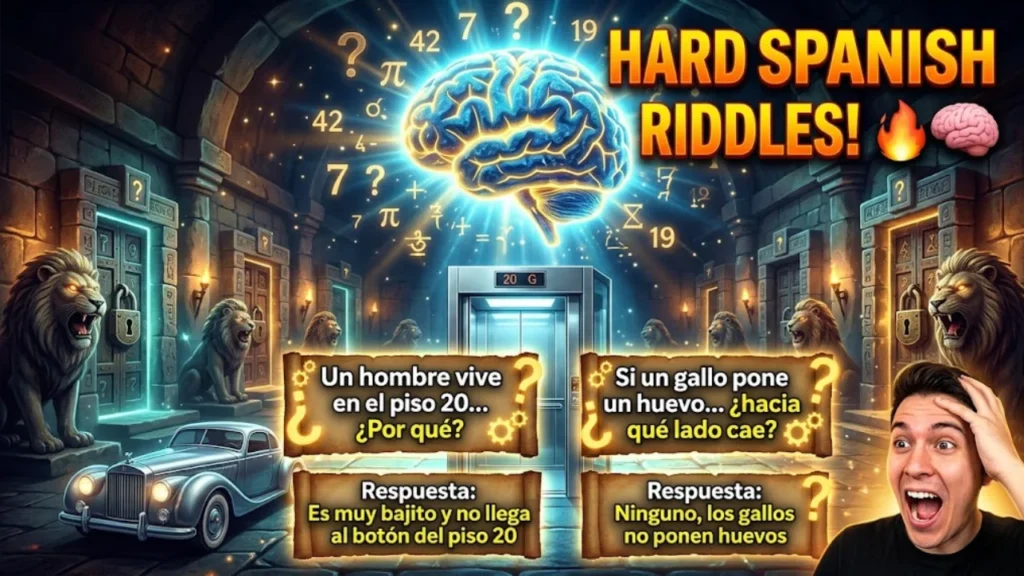
Answer: El tercero (the third one) Lions that have not eaten for years would be dead. - Un hombre vive en el piso 20. Cada día baja en ascensor. Al volver, sube en ascensor hasta el piso 10 y sigue por las escaleras. ¿Por qué?
A man lives on the 20th floor. Every day he rides the elevator down. On the way back, he rides up to the 10th floor and takes the stairs. Why?
Answer: Porque es muy bajito y no llega al botón del piso 20 (because he is short and cannot reach button 20) - Un hombre empuja su coche hasta un hotel y le dice al dueño que está en la ruina. ¿Qué pasa?
A man pushes his car to a hotel and tells the owner he is ruined. What is going on?
Answer: Está jugando al Monopoly (he is playing Monopoly) - ¿De qué color son las mangas del chaleco de Napoleón?
What color are the sleeves of Napoleon’s vest?
Answer: De ningún color (no color) Vests have no sleeves. - Se da, se cumple y a veces se rompe. Nadie la puede tocar. ¿Qué es?
It is given, it is kept and sometimes it is broken. Nobody can touch it. What is it?
Answer: Una promesa (a promise) - Siempre cae, pero nunca se hace daño. Llega cuando el sol se va.
It always falls, but it never gets hurt. It arrives when the sun leaves.
Answer: La noche (the night) Spanish says cae la noche (“night falls”). - ¿Cuántos segundos tiene un año?
How many seconds are in a year?
Answer: Doce (twelve) Count the “second” of each month: 2 de enero, 2 de febrero, and so on. - Hay un número que nunca está a la venta. ¿Cuál es?
There is a number that is never for sale. Which one?
Answer: El 90 (ninety) Noventa sounds like no venta (“not for sale”). - La mamá de Ana tiene tres hijas: Rosa, Lucía y… ¿cómo se llama la tercera?
Ana’s mom has three daughters: Rosa, Lucía and… what is the third one called?
Answer: Ana Ana is one of the three daughters. - ¿Qué número vale menos si lo pones al revés?
Which number is worth less when you turn it upside down?
Answer: El 9 (nine) Upside down, a 9 looks like a 6. - Si un gallo pone un huevo en lo alto de un tejado, ¿hacia qué lado cae?
If a rooster lays an egg on top of a roof, which way does it fall?
Answer: Ninguno (neither) Roosters do not lay eggs. - Tres gatos cazan tres ratones en tres minutos. ¿Cuántos gatos hacen falta para cazar cien ratones en cien minutos?
Three cats catch three mice in three minutes. How many cats do you need to catch 100 mice in 100 minutes?
Answer: Tres (three) Each cat catches one mouse every three minutes. - ¿Por qué la tele se puso a dieta?
Why did the TV go on a diet?
Answer: Porque quería tener la pantalla plana (because it wanted a flat screen) The joke plays on plana (“flat”). - ¿Por qué la caja fue al gimnasio?
Why did the box go to the gym?
Answer: Porque quería ser una caja fuerte (because it wanted to be a safe) Caja fuerte means “safe,” and fuerte also means “strong.” - ¿Por qué están tristes los libros de matemáticas?
Why are math books sad?
Answer: Porque tienen muchos problemas (because they have a lot of problems) - ¿Por qué los pájaros vuelan al sur en invierno?
Why do birds fly south in winter?
Answer: Porque caminando tardarían demasiado (because walking would take too long) - ¿Por qué el espantapájaros ganó un premio?
Why did the scarecrow win an award?
Answer: Porque era sobresaliente en su campo (because he was outstanding in his field) Sobresaliente means “outstanding,” and campo means “field.” - ¿Qué hace una abeja en el gimnasio?
What does a bee do at the gym?
Answer: ¡Zum-ba! (Zumba) Zumbar means “to buzz.” - Vivo detrás de rejas blancas, no tengo huesos y siempre estoy mojada. Sin mí no hay sabor ni palabra.
I live behind white bars, I have no bones and I am always wet. Without me there is no taste or word.
Answer: La lengua (the tongue) - Voy contigo a todas partes y me hago enorme al atardecer. Sin luz, desaparezco.
I go everywhere with you and I grow huge at sunset. Without light, I vanish.
Answer: Tu sombra (your shadow) - Todas las noches me visitas y nadie más me ve. A veces soy bonito, a veces me da miedo.
You visit me every night and nobody else sees me. Sometimes I am lovely, sometimes I am scary.
Answer: Un sueño (a dream) - Todos pasan y preguntan por mí, pero yo no paso ni pregunto por nadie.
Everyone passes and asks for me, but I never pass or ask for anyone.
Answer: La calle (the street)
How did you score? 0–20 correct: Beginner. 21–40 correct: Intermediate. 41–62 correct: Riddle Master. Share your score and challenge a friend!
FAQs
Here are quick answers to the most common questions about Spanish riddles.
What are some riddles in Spanish?
Two classics are Oro parece, plata no es (riddle 6, answer: plátano) and Blanca por dentro, verde por fuera (riddle 7, answer: la pera). The list above has 62 riddles in Spanish to try, from easy to hard.
What is the Spanish word for riddle?
The Spanish word for riddle is adivinanza. Other words are acertijo and enigma.
What are 10 good riddles?
Ten crowd-pleasers from the list are riddle 6 (plátano), 7 (pera), 8 (cebolla), 9 (huevo), 13 (reloj), 33 (tu nombre), 38 (mapa), 39 (agujero), 48 (noventa) and 59 (lengua). They mix sound tricks, objects and number play.
How do you say “riddle me this” in Spanish?
Say “Adivina, adivinanza” or “A ver si adivinas.” Both open a riddle in a playful way, much like “riddle me this” in English.
Conclusion
Riddles in Spanish are a fast, fun way to grow vocabulary and think in a new language. Save this list, try a riddle at dinner, on a road trip or as a class warm-up, and keep score. Then invent your own adivinanza and stump someone.

Amelia Singh is a content strategist and digital writer specializing in curated web directories, cultural quote archives, and instructional content. She is dedicated to creating clear, engaging, and reliable digital resources for readers worldwide.