Math riddles are more than just fun. They stretch your logical thinking, sharpen your number sense, and turn plain old arithmetic into a game you actually want to play. Whether you’re a parent hunting for classroom warm-ups, a teacher planning a brain break, or just someone who loves a good puzzle, this list has something for you.
Below you’ll find 165+ math riddles with answers, sorted from easy to hard, plus a few funny ones thrown in for good measure. Every riddle is numbered, every answer is bolded, and every category is built to test a different kind of brain muscle. Let’s get solving.
Table of Contents
Why Math Riddles With Answers Are Good for Your Brain
Riddles do something worksheets rarely manage: they make math feel like play instead of pressure.
Solving a good math riddle forces your brain to slow down and question the obvious answer, which is exactly the skill behind critical thinking. Research on cognitive flexibility consistently shows that puzzle-solving activities help both kids and adults switch between different problem-solving strategies faster (Cambridge study on flexible thinking). That flexibility carries over into real math class, where a single problem often has more than one path to the answer.
Math riddles also build number sense — the intuitive feel for how numbers behave — without a single worksheet in sight. A child who plays with age riddles or sequence puzzles is quietly practicing multiplication, ratios, and pattern recognition, all while thinking it’s a game.
There’s a memory angle too. Puzzles that require you to hold two or three pieces of information in your head at once give your working memory a workout, which is closely tied to reading comprehension and problem-solving in school (American Psychological Association). In short, riddles aren’t a distraction from learning math. They’re one of the more effective ways to practice it.
Must visit: 15+ Funny Riddles With Answers That Will Make You Laugh, Think & Say “Aha!” in 2026 😂🧠
165+ Math Riddles With Answers (Easy to Hard)
Here’s the full collection, grouped by difficulty so you can pick the right level for your kid, your classroom, or your own brain. Each riddle is numbered and every answer is bolded right underneath it.
Easy Math Riddles With Answers
Perfect for younger kids or a quick warm-up, these easy math riddles focus on basic number sense and simple arithmetic.
1. What number comes after 99? Answer: 100
2. I have three sides and three angles. What shape am I? Answer: A triangle
3. If you have 5 apples and eat 2, how many are left? Answer: 3
4. What is half of 20? Answer: 10
5. How many days are in a week? Answer: 7
6. What number is both a square and a cube? Answer: 64 (8² and 4³)
7. If a hen lays 1 egg a day, how many eggs in a week? Answer: 7
8. What comes next: 2, 4, 6, 8, __? Answer: 10
9. How many sides does a hexagon have? Answer: 6
10. What is 10 minus 10? Answer: 0
11. I am an even number. Take away one letter and I become odd. What number am I? Answer: Seven (remove the “s” and it becomes “even”)
12. How many minutes are in an hour? Answer: 60
13. What do you call a number that can’t be divided evenly by 2? Answer: An odd number
14. What is 7 + 8? Answer: 15
15. If today is Monday, what day is it in 3 days? Answer: Thursday
16. What is the smallest whole number? Answer: Zero
17. How many corners does a square have? Answer: 4
18. What number is missing: 1, 2, __, 4, 5? Answer: 3
19. If you have 10 fingers and lose none, how many do you have? Answer: 10
20. What is double 15? Answer: 30
21. How many months have 30 days? Answer: 4 (April, June, September, November)
22. What is 100 divided by 10? Answer: 10
23. I am a shape with no corners at all. What am I? Answer: A circle
24. How many legs do 2 spiders have combined? Answer: 16
25. What is 3 times 3? Answer: 9
26. How many hours are in a day? Answer: 24
27. What number rhymes with “tree” and comes after two? Answer: Three
28. If you split 8 candies between 2 kids equally, how many does each get? Answer: 4
29. What is the sum of 5 and 5? Answer: 10
30. How many zeros are in one thousand? Answer: 3
31. What is the next number: 5, 10, 15, __? Answer: 20
32. How many wheels do 3 cars have altogether? Answer: 12
33. What number is one less than 50? Answer: 49
34. If a triangle has 3 sides, how many sides do 2 triangles have? Answer: 6
35. What is 9 minus 4? Answer: 5
36. How many seconds are in a minute? Answer: 60
37. What number comes before 10? Answer: 9
38. If you have 2 dimes, how many cents do you have? Answer: 20 cents
39. What is the first odd number after zero? Answer: 1
40. How many sides does a cube have? Answer: 6
Medium Math Riddles With Answers
These medium math riddles mix in word problems, age puzzles, and simple sequences — great for older kids and adults who want a slightly bigger challenge.
41. A farmer has 17 sheep. All but 9 die. How many are left? Answer: 9
42. If two’s company and three’s a crowd, what are four and five? Answer: Nine
43. I am four times as old as my son. In 20 years I’ll be twice his age. How old am I now? Answer: 40
44. There are 12 kids in a room. 6 wear socks and 4 wear shoes, with 3 wearing both. How many are barefoot? Answer: 5
45. A number doubled and then reduced by 6 equals 14. What is the number? Answer: 10
46. Complete the sequence: 1, 1, 2, 3, 5, 8, __? Answer: 13 (the Fibonacci sequence)
47. Jack is twice as old as Jill was when Jack was as old as Jill is now. If their combined age is 63, how old is Jack? Answer: 36
48. A store sells apples for 40 cents, bananas for 60 cents, and grapefruit for 80 cents. Based on the pattern, how much is a pear? Answer: 80 cents (priced by number of letters, not fruit type)
49. If 5 machines make 5 widgets in 5 minutes, how long do 100 machines take to make 100 widgets? Answer: 5 minutes
50. What is 1/2 of 2/3 of 3/4 of 100? Answer: 25
51. Sally’s mother is 80. Sally is 54. How many years ago was Sally’s mother three times her age? Answer: 41 years ago
52. A pizza is cut into 8 slices. If you take 3 away, how many slices are left? Answer: 5
53. What three-digit number has a second digit four times the third, and a first digit three less than the second? Answer: 141
54. A pond doubles in size every day. It’s fully covered on day 48. On which day was it half covered? Answer: Day 47
55. Two trains leave the same station one hour apart, going 240 kph and 360 kph. When does the second catch up? Answer: 3 hours after it departs
56. What comes next: 3, 6, 12, 24, __? Answer: 48
57. If you multiply me by 3 and subtract 7, you get 20. What number am I? Answer: 9
58. A book is opened and the sum of the two visible page numbers is 21. What do you get if you multiply them? Answer: 110 (pages 10 and 11)
59. How many times does the digit 9 appear between 1 and 100? Answer: 20
60. Four years ago, Alex was twice as old as Jake. In four years, Jake will be 3/4 of Alex’s age. How old is Alex now? Answer: 28
61. A dad is 42 and his son is 6. In how many years will the dad be four times as old as his son? Answer: 6 years
62. What number is 90 centimeters plus half of itself? Answer: 180 centimeters
63. A group of friends splits a $529 bill equally, and each person’s share in dollars equals the number of people. How many friends are there? Answer: 23 people
64. What is the missing number: 8, 27, 64, 125, __? Answer: 216 (cubes of 2, 3, 4, 5, 6)
65. If a shirt costs $20 after a 20% discount, what was the original price? Answer: $25
66. A clock shows 3:15. What is the angle between the hour and minute hands? Answer: 7.5 degrees
67. If it takes 6 people 6 days to build 6 walls, how many days for 3 people to build 3 walls? Answer: 6 days
68. A ladder has 10 rungs, spaced 1 foot apart. How far apart are the first and last rung? Answer: 9 feet
69. What is the next term: 100, 96, 88, 76, __? Answer: 60 (differences increase by 4 each time)
70. A farm has ducks and cows totaling 7 heads and 18 legs. How many ducks are there? Answer: 5 ducks
71. If you’re 8 feet from a door and move half the remaining distance each time, how many moves to reach the door exactly? Answer: You never reach it exactly (this is a classic limit puzzle)
72. What is the sum of all numbers from 1 to 10? Answer: 55
73. A number’s digits sum to 9, and the number is divisible by 9. What is the smallest two-digit example? Answer: 18
74. If a train travels 60 miles in 45 minutes, what is its speed in miles per hour? Answer: 80 mph
75. What comes next: 2, 3, 5, 8, 13, __? Answer: 21 (each term is the sum of the two before it)
76. A rope is cut into 3 equal pieces, then each piece is cut into 4. How many pieces total? Answer: 12
77. Two people share $100, and one has $40 more than the other. How much does each person have? Answer: $30 and $70
78. A school has 120 students. 75 play baseball, 60 play soccer, 30 play both. How many play neither? Answer: 15 students
79. What is the value of x if 3x + 5 = 20? Answer: x = 5
80. If a person walks 3 km south, then 4 km east, how far are they from the start? Answer: 5 km (Pythagorean theorem)
81. A number increased by 25% becomes 100. What was the original number? Answer: 80
82. How many 3-digit numbers are there in total? Answer: 900
83. What is the average of 4, 8, 12, and 16? Answer: 10
84. A tank fills in 6 hours with one pipe and empties in 8 hours with a drain. If both are open, how long to fill it? Answer: 24 hours
85. If today is 5 days before the day after tomorrow from yesterday, what day is it counting from Monday? Answer: Wednesday
86. What number, when squared, equals its own double? Answer: 2 (2² = 4, and 2 × 2 = 4)
87. A wallet has $1.19 in 10 coins, but no combination gives exact change for $1. What coins are they? Answer: 3 quarters, 4 dimes, 2 pennies (no nickel, so change can’t be made for smaller amounts)
88. If you flip a fair coin 10 times and it lands heads every time, what’s the chance it lands heads on the 11th flip? Answer: 50 percent (each flip is independent)
89. What is the missing number: 7, 14, 28, 56, __? Answer: 112 (each number doubles)
90. A bat and a ball cost $1.10 total. The bat costs $1 more than the ball. How much is the ball? Answer: 5 cents
Must Visit: 160+ Easy Riddles With Answers That Will Instantly Boost Your Brainpower in 2026
Hard Math Riddles With Answers
These hard math riddles lean on lateral thinking more than raw calculation. The trick is usually in how the question is framed, not the math itself.
91. What number is halfway between 1/3 and 1/5? Answer: 4/15
92. There are 500 coffins and 500 people. Person 1 opens every coffin. Person 2 closes every second one. Person 3 toggles every third, and so on to person 500. How many coffins stay open? Answer: 22 (the perfect squares up to 500)
93. How do you turn 98 into 720 using just one letter? Answer: Add an “!” — 6! (factorial) equals 720, but if you already have 98, add “!” to make it “98!” — trickier version: the answer to the classic riddle is turning 6 into 6! = 720
94. Three brothers all have prime ages, and the difference between their ages is also prime. What are the smallest possible ages? Answer: 2, 5, and 7
95. A lily pad patch doubles daily and covers the lake on day 48. On what day is the lake one-quarter covered? Answer: Day 46
96. Add me to myself, multiply by 4, then divide by 8, and you get me again. What number am I? Answer: Any number (the operations cancel out)
97. I am a number with a couple of friends, a quarter of a dozen, and you’ll find me again. What number am I? Answer: 3 (a couple is 2, a quarter of a dozen is 3, and 3 shows up twice in the riddle)
98. What 3-digit number equals the sum of the cubes of its digits? Answer: 153 (1³ + 5³ + 3³ = 153)
99. If you have 14 brown socks, 14 blue socks, and 14 black socks in a drawer, how many must you pull out blindly to guarantee a matching pair? Answer: 4
100. Three times a number is no larger than double that same number. What is the number? Answer: 0 or any negative number
101. What number, multiplied by itself, gives a result identical to adding it to itself? Answer: 2
102. How can you give someone exactly $83 using 7 bills, without a single $1 bill? Answer: One $50, one $20, one $10, four $… — specifically: 1x$50 + 1x$20 + 1x$5 + 4x$2 = $83
103. If two fathers and two sons buy one candy bar each at 50 cents, and the total is $1.50, how is this possible? Answer: They are a grandfather, father, and son — only three people, but two father-son pairs
104. What number multiplied by all the digits on a phone keypad gives zero? Answer: Any number, since the keypad includes a 0
105. In a race, the runner who finished two spots ahead of the last-place runner also finished one spot ahead of the runner in 5th. How many runners were there? Answer: 6 runners
106. A daughter has as many sisters as brothers. Each brother has twice as many sisters as brothers. How many sons and daughters are there? Answer: 4 sons and 3 daughters
107. One brick weighs 1 kilogram plus half a brick. What does one brick weigh? Answer: 2 kilograms
108. There are 25 red, 47 green, and 3 blue balls in a basket. What’s the minimum number a blind person must draw to guarantee two different colors? Answer: 48 (worst case, all green first)
109. Using the digits 2, 3, 4, and 5 with only + and =, write a true equation. Answer: 2 + 3 = 5 (with 4 unused, or arranged creatively depending on rules given)
110. What time is it if two hours from now is twice as far from midnight as one hour from now? Answer: 9 p.m.
111. If it’s twice as long until midnight as it was an hour ago, and right now it’s 2 hours before that point, what time is it? Answer: 8 p.m.
112. What are three positive numbers that give the same result whether multiplied or added? Answer: 1, 2, and 3 (1+2+3 = 6, and 1×2×3 = 6)
113. When is 1,500 plus 20 the same as 1,600 minus 40? Answer: Always, since both equal 1,560
114. Two crocodiles and an elephant weigh 1,200 kg. Two crocodiles and four monkeys weigh 400 kg. An elephant and four monkeys weigh 1,000 kg. What does each animal weigh? Answer: Elephant: 900 kg, crocodile: 150 kg, monkey: 25 kg
115. Using exactly six zeros and any math symbols, how do you reach 720? Answer: (0! + 0! + 0! + 0! + 0! + 0!)! = 720
116. What comes next in this pattern: 123 = 0, 4235 = 0, 656 = 2, 5390 = 2, 8890 = 6? What does 19235 equal? Answer: 1 (the value equals the number of enclosed loops in the digits)
117. A person walks 8 feet from a door, moving half the remaining distance with each step. How many steps until they’re less than an inch away? Answer: Roughly 10 steps
118. What is the smallest number divisible by every digit from 1 to 9? Answer: 2,520
119. If a polygon is made only of straight lines, how can it have exactly two sides? Answer: Draw it on a sphere — two lines from pole to pole form a valid two-sided shape
120. What is the next number in this sequence: 4, 9, 25, 49, 121, __? Answer: 169 (squares of prime numbers: 2, 3, 5, 7, 11, 13)
121. In 1990, a person is 15. In 1995, that same person is 10. How is this possible? Answer: The years refer to birth years — 1990 minus 1975 is 15, and 1995 minus 1985 is 10, describing two different people, or one person’s age is being counted in reverse using different reference dates
122. What number stays the same when its digits are reversed and squared? Answer: 121 (11² = 121, a palindrome)
123. A jar has coins worth $6.35 total, made only of quarters and dimes, totaling 41 coins. How many of each? Answer: 21 quarters and 20 dimes
124. What is the only number whose spelled-out name has letters in alphabetical order? Answer: Forty
125. If you rearrange the letters in “eleven plus two,” what math phrase do you get? Answer: “Twelve plus one” (both equal 13, and both use the same letters)
126. A number’s square root and cube root are both whole numbers. What’s the smallest number greater than 1 with this property? Answer: 64
127. What is the sum of the first 100 whole numbers? Answer: 5,050 (Gauss’s famous shortcut: 100 × 101 ÷ 2)
128. If a rectangle’s length is triple its width and its perimeter is 32, what are its dimensions? Answer: Width 4, length 12
129. What is the missing number: 1, 4, 9, 16, __, 36? Answer: 25
130. How many times do a clock’s hands overlap in 24 hours? Answer: 22 times
131. A number is tripled, then 9 is subtracted, giving the same result as the original number doubled. What is it? Answer: 9
132. What is the next number: 2, 6, 12, 20, 30, __? Answer: 42 (each number is n × (n+1))
133. If you fold a piece of paper in half 7 times, how many layers does it have? Answer: 128 layers
134. A number minus its reverse equals 792. What could the original three-digit number be? Answer: 981 (981 − 189 = 792)
135. What is the probability of rolling two dice and getting a sum of 7? Answer: 1 in 6
136. If a number is increased by 50% and then decreased by 50%, is the result the same as the original? Answer: No, it ends up 25% smaller
137. What is the next number in 1, 2, 4, 7, 11, 16, __? Answer: 22 (the gap increases by one each time)
138. A cube’s volume equals its surface area numerically. What is the side length? Answer: 6
139. What is the smallest positive number that leaves a remainder of 1 when divided by 2, 3, 4, 5, and 6? Answer: 61
140. If you write out numbers 1 to 1,000 in words, which letter appears the least? Answer: The letter “a” never appears in numbers 1 through 999 in standard English
Funny and Clever Math Riddles With Answers
Not every math riddle has to be a brain-buster. These funny math riddles lean on wordplay and puns, and they’re a favorite for classrooms and family game night.
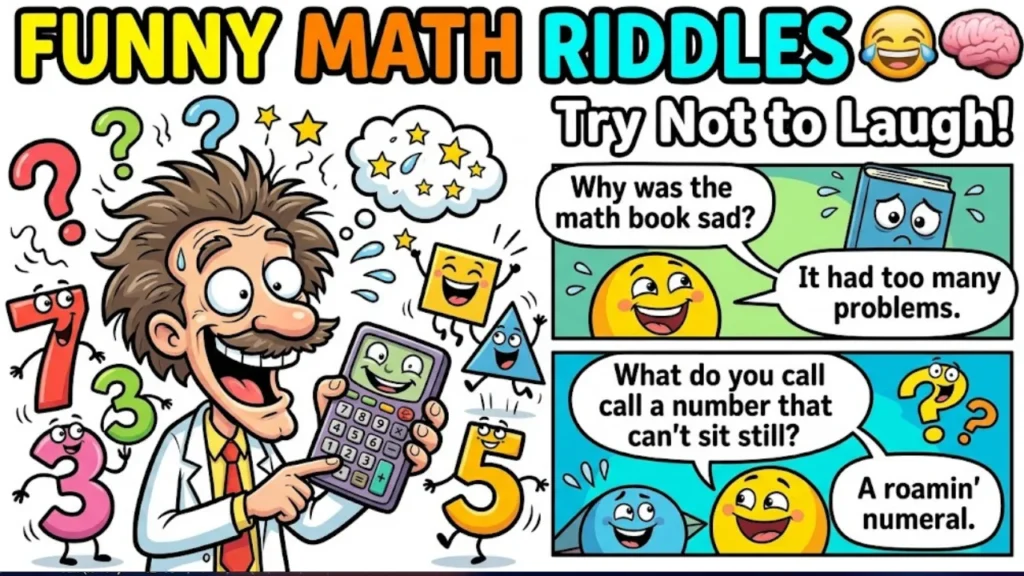
141. Why was the math book sad? Answer: It had too many problems
142. What do you call a number that can’t sit still? Answer: A roamin’ numeral
143. Why did the two 4’s skip lunch? Answer: Because they already 8 (ate)
144. What did the triangle say to the circle? Answer: “You’re pointless”
145. Why was the equal sign so humble? Answer: Because it knew it wasn’t less than or greater than anyone else
146. What do mathematicians eat for breakfast? Answer: Square meals
147. Why did the student wear glasses in math class? Answer: To improve di-vision
148. What did one math book say to another? Answer: “I’ve got a lot of problems”
149. Why is a math teacher good at solving problems? Answer: Because they have a lot of experience with variables
150. What is a bird’s favorite type of math? Answer: Owl-gebra
151. Why couldn’t the angle get a loan? Answer: Its parents wouldn’t co-sine
152. What tool do you use for math homework on Halloween? Answer: A pumpkin calculator, mostly for the pumpkin pi
153. Why did the obtuse angle go to the beach? Answer: Because it was never right
154. What do you call more than one L? Answer: A parallel
155. Why was six afraid of seven? Answer: Because seven ate (8) nine
156. What did the zero say to the eight? Answer: “Nice belt”
157. Why do plants hate math? Answer: It gives them square roots
158. What is a math teacher’s favorite season? Answer: Sum-mer
159. Why did the fraction feel insecure? Answer: Because it was never a whole number
160. How do you make seven an even number? Answer: Remove the “s”
161. What did the calculator say to the student? Answer: “You can always count on me”
162. Why was the geometry teacher’s garden perfectly shaped? Answer: Because it had a lot of right angles
163. What is a snake’s favorite subject? Answer: Hiss-tory of numbers, but really it’s hiss-metry (symmetry)
164. Why did the number 1 need a coach? Answer: Because it wanted to multiply
165. What do you get when you cross a math teacher and a clock? Answer: Someone who’s always got the right time and the right answer
166. Why did nobody want to date the fraction? Answer: Because it wasn’t looking for anything improper
167. What did the math teacher say about circles? Answer: “There’s no point in arguing about them”
Fun Math Tricks to Sharpen Your Brain
Beyond riddles, a few classic math tricks can make you look like a genius at parties or homework time.
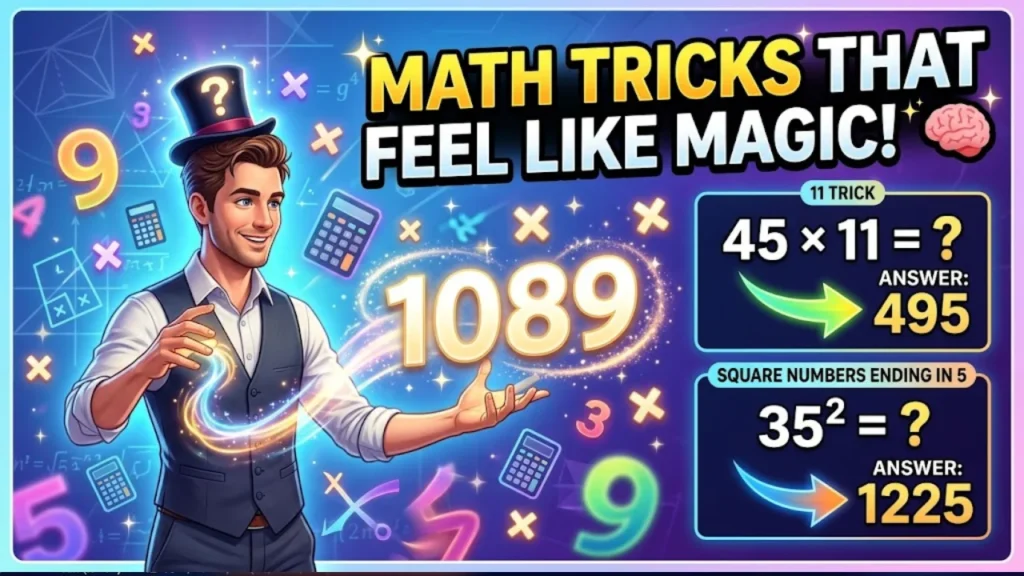
The 11 trick makes multiplying two-digit numbers by 11 almost instant. Take the number, split the two digits apart, and place their sum in the middle. For 45 × 11: add 4 and 5 to get 9, slide it between them, and you get 495.
The divisibility by 9 shortcut works every time. Add up all the digits of a number. If that sum divides evenly by 9, so does the original number. Try it with 549: 5 + 4 + 9 = 18, and 18 ÷ 9 = 2, so 549 is divisible by 9.
Squaring numbers ending in 5 is surprisingly fast. Take the digit before the 5, multiply it by itself plus one, then attach 25 to the end. For 35²: 3 × 4 = 12, so the answer is 1225.
The 1089 trick feels like magic. Pick any 3-digit number with different digits, reverse it, subtract the smaller from the larger, then add that result to its own reverse. You’ll land on 1089 every single time.
Finger multiplication for 9s is a classroom favorite. Hold up both hands, fold down the finger matching the number you’re multiplying by 9, and count the fingers on each side of the fold — that gives you the tens and ones digit of the answer.
The Hardest Math Riddle in the World
Some math riddles aren’t just tricky. They’re famous for stumping nearly everyone who tries them, including plenty of adults with advanced degrees.
The bat-and-ball problem is one of the most well-known examples in behavioral economics. A bat and ball cost $1.10 combined, and the bat costs $1 more than the ball. Most people instinctively say the ball costs 10 cents, but the correct answer is 5 cents, since $1.05 plus $0.05 equals $1.10. Researchers at Princeton have used this exact riddle to study how quickly the brain jumps to a wrong but tempting answer (Princeton cognitive reflection research).
The coffin riddle (question 92 above) is another that trips up even strong math students, since it’s really a disguised version of a number theory problem about perfect squares. Out of 500 coffins, only the ones matching a perfect square position end up open, because those are the only numbers with an odd number of factors.
A third contender is the Collatz-style number riddle: pick any number, if it’s even divide by 2, if it’s odd multiply by 3 and add 1, then repeat. Every number tested so far eventually reaches 1, but mathematicians have never been able to prove this holds true for every possible number, making it one of the few “riddles” that remains genuinely unsolved.
What makes these riddles hard isn’t the arithmetic. It’s that they’re built to trigger a fast, confident, and wrong first guess.
FAQs
Can you give me 10 math riddles with answers?
Sure — riddles 1 through 10 above cover exactly that. They range from basic addition to shape identification, perfect for a quick 10-riddle warm-up with kids or a classroom.
What are some fun math tricks?
The 11 trick, the divisibility-by-9 shortcut, squaring numbers ending in 5, the 1089 trick, and finger multiplication for 9s are five of the most popular. All five are covered in detail above.
What is the hardest math riddle in the world?
Most experts point to the bat-and-ball problem, since it’s been studied extensively and consistently fools people who are otherwise strong at math. The coffin riddle and Collatz-style puzzles are close runners-up for sheer difficulty.
What are some fun math questions?
Fun math questions usually mix real numbers with a twist, like the sock-drawer riddle (#99) or the age puzzles found in the medium section. They test logic more than memorized formulas, which is what makes them enjoyable instead of stressful.
What is “I love you” in math?
A popular version is 143, based on the number of letters in each word: “I” (1 letter), “love” (4 letters), “you” (3 letters). It’s a common hidden message in pager codes, jewelry, and math-themed valentines.
Conclusion
Math riddles turn ordinary numbers into something worth chewing on. Whether you started with the easy set or jumped straight to the hardest math riddle in the world, every riddle above is built to sharpen the same skills: pattern recognition, patience, and a healthy suspicion of your own first guess. Save this list, share it with a classroom or a car full of kids on a road trip, and come back whenever your brain needs a workout.

Amelia Singh is a content strategist and digital writer specializing in curated web directories, cultural quote archives, and instructional content. She is dedicated to creating clear, engaging, and reliable digital resources for readers worldwide.