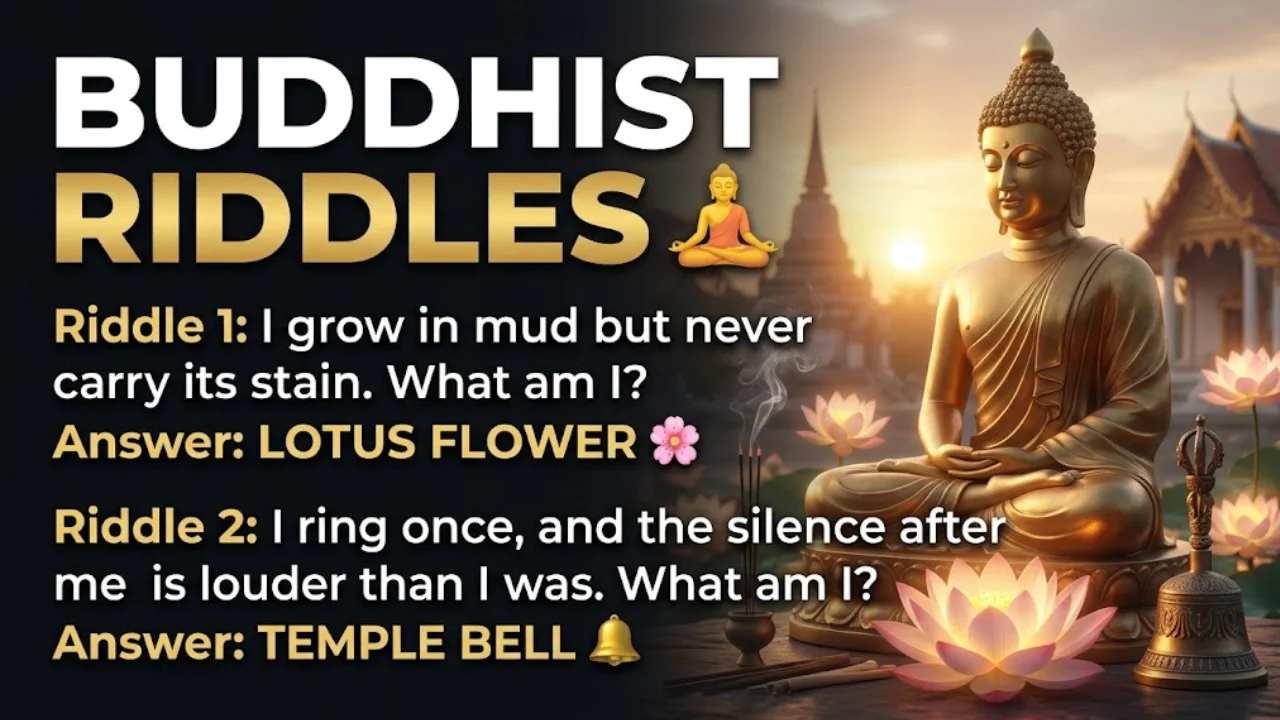
Buddhist riddleshave puzzled thinkers for over 2,500 years, and they still work today. Some are playful. Some are old Zen koans built to stop the thinking mind in its tracks.
Below you’ll find 290+ Buddhist riddles with answers, sorted from easy to deep. Pick one, sit with it, and see what it teaches you.
Table of Contents
Buddhist Riddles for Beginners
New to riddles in Buddhism? Start here. These use plain objects — bells, robes, bowls — to introduce big ideas in a small package.
1. I sit still, yet I travel the farthest of all. What am I? Answer: The mind during meditation.
2. I grow in mud but never carry its stain. What am I? Answer: The lotus flower.
3. I ring once, and the silence after me is louder than I was. What am I? Answer: A temple bell.
4. I own no house, yet I am never lost. What am I? Answer: A wandering monk.
5. I hold no water, yet I can hold the whole sky. What am I? Answer: An empty alms bowl.
6. I burn away to nothing while I light the room. What am I? Answer: A stick of incense.
7. I am worn every day, yet I own nothing. What am I? Answer: A monk’s robe.
8. I sat beneath a tree and changed history without moving an inch. Who am I? Answer: The Buddha, seated under the Bodhi tree.
9. I have eight parts, but only one goal. What am I? Answer: The Noble Eightfold Path.
10. I am spoken four times before anything else in the teaching is explained. What am I? Answer: The Four Noble Truths.
11. I turn without wheels and carry no passenger. What am I? Answer: The Wheel of Dharma.
12. I am counted bead by bead, yet I calm an entire mind. What am I? Answer: A mala, or set of prayer beads.
13. I am a question with no clean answer, and I still teach everything. What am I? Answer: A koan.
14. I am a group of people, and I am also a form of shelter. What am I? Answer: The Sangha, the community of practitioners.
15. I sit between two extremes and never touch either one. What am I? Answer: The Middle Way.
16. I am three things a person can turn to, though none of them is a wall. What am I? Answer: The Three Jewels: Buddha, Dharma, and Sangha.
17. I am taken, though nothing is handed to you. What am I? Answer: Refuge in the Three Jewels.
18. I am five, and I ask you to avoid harm before it happens. What am I? Answer: The Five Precepts.
19. I am a circle full of shapes, built to hold the whole universe in a picture. What am I? Answer: A mandala.
20. I am a mound of stone that holds no living thing, yet pilgrims travel far to walk around me. What am I? Answer: A stupa.
21. I am made with fingers, and I speak without a single word. What am I? Answer: A mudra, or symbolic hand gesture.
22. I am struck once and call an entire hall to attention. What am I? Answer: A meditation gong.
23. I am carried by a monk who owns almost nothing else. What am I? Answer: A walking staff.
24. I am carried from house to house, and I am filled by strangers. What am I? Answer: A begging bowl, used on the alms round.
25. I am read aloud for centuries, yet I never grow old. What am I? Answer: A sutra.
26. I am repeated by many voices until they sound like one. What am I? Answer: Chanting.
27. I hold candles, flowers, and incense, but I am not a shop. What am I? Answer: A temple altar.
28. I dance without feet and vanish without a sound. What am I? Answer: A candle flame.
29. I fell from the tree of awakening, and I am kept as a reminder. What am I? Answer: A Bodhi leaf.
30. I am spoken by a teacher, yet I ask you to think for yourself. What am I? Answer: A dharma talk.
31. I am flat, round, and firm, and I hold the same seat for hours. What am I? Answer: A zafu, or meditation cushion.
32. I say nothing, and I still answer the hardest question. What am I? Answer: Silence.
33. I cost nothing to give, yet I change how a whole day feels. What am I? Answer: Gratitude.
34. I grow only when I am given away. What am I? Answer: Generosity, or dana.
35. I am tested most by the people who annoy me the most. What am I? Answer: Patience.
36. I shrink the ego without anyone noticing I was there. What am I? Answer: Humility.
37. I own less every year, and I feel lighter for it. What am I? Answer: Simplicity.
38. I let go of the rope before it pulls me down. What am I? Answer: Non-attachment.
39. I feel another person’s pain as if it were my own. What am I? Answer: Compassion.
40. I wish every being well, even ones I’ve never met. What am I? Answer: Metta, or loving-kindness.
41. I am not information, though I look like it from far away. What am I? Answer: Wisdom, or prajna.
42. I am one of eight paths, and I ask you to speak only what is true and kind. What am I? Answer: Right Speech.
43. I am one of eight paths, and I ask you to act without causing harm. What am I? Answer: Right Action.
44. I am one of eight paths, and I ask how you earn your bread. What am I? Answer: Right Livelihood.
45. I am one of eight paths, and I ask you to keep trying without straining. What am I? Answer: Right Effort.
46. I am one of eight paths, and I ask you to notice this moment fully. What am I? Answer: Right Mindfulness.
47. I am one of eight paths, and I steady the mind on a single point. What am I? Answer: Right Concentration.
48. I am one of eight paths, and I ask you to see life clearly, not as you wish it were. What am I? Answer: Right View.
49. I am one of eight paths, and I shape the will before the deed. What am I? Answer: Right Intention.
50. I am carved in gold or stone, and my eyes are always half closed. What am I? Answer: A statue of the Buddha, resting between sleep and full waking, a symbol of calm awareness.
Must Visit: 140+ Hilarious Jokes and Riddles That Will Blow Your Mind & Make You Laugh Out Loud
Zen Buddhist Riddles and Koans With Answers
Zen Buddhist riddles, known as koans, are not meant to be solved with logic. They are meant to short-circuit it. Sit with each one slowly.
51. Two hands clap and there is a sound. What is the sound of one hand? Answer: There is no separate sound to find — the question itself points past the split between one and two.
52. What did your face look like before your parents were born? Answer: Your nature before any name, role, or story was placed on top of it.
53. Does a dog have Buddha-nature? Answer: Mu — a word that refuses the yes-or-no frame of the question itself.
54. A monk asked, “What is Buddha?” The teacher answered, “Three pounds of flax.” What did he mean? Answer: Buddha is not found apart from the ordinary object right in front of you.
55. A monk asked, “What is Buddha?” Another teacher answered, “Dried dung.” What did he mean? Answer: Nothing, however plain, sits outside of awakened nature.
56. Two monks argued whether the flag or the wind was moving. A third said neither moved. What moved? Answer: The mind of the observer was what moved.
57. If you meet the Buddha on the road, what should you do? Answer: Let go of that image, since clinging to any fixed idea of Buddha blocks the real thing.
58. A student says his cup is already full. Can it still be filled? Answer: No — until it is emptied of old opinions, nothing new can be poured in.
59. The mind swings from thought to thought like something restless in the trees. What is it called? Answer: Monkey mind, the untrained wandering of attention.
60. A raft carries a traveler across a river. Once across, should he carry the raft on his back? Answer: No — a teaching that served its purpose should be set down, not worshipped forever.
61. A father tells his children the house is on fire to get them outside, though the smoke they later find is only playful. Was the warning false? Answer: No — a skillful lie that saves a life serves a truth deeper than the words themselves.
62. A man is shot with a poisoned arrow but refuses treatment until every detail about the shooter is known. What should he do first? Answer: Remove the arrow — some questions can wait; suffering cannot.
63. Several blind men touch different parts of the same elephant and argue about what it is. Who is right? Answer: Each holds a piece of the truth, and none holds the whole of it.
64. A grieving mother is told to find a mustard seed from a house untouched by death. She cannot. What has she learned? Answer: That loss touches every household, and grief is a shared thread, not a private curse.
65. Try to hold the wind still in your closed hand. What happens? Answer: Nothing — trying to grasp what is meant to move only proves it cannot be caught.
66. A man without a shadow draws water from a well. How? Answer: He has let go of the self that casts a shadow of ego over every act.
67. A fish swims its whole life in water and never notices it is wet. Why? Answer: What surrounds us completely becomes invisible to us — like the mind we swim in daily.
68. A bird flies across the whole sky and leaves no trace behind. Where did it go? Answer: Nowhere it needed to leave a mark — true freedom moves without residue.
69. A cloud drifts overhead, casting no shadow of its own will. Who decides its shape? Answer: Conditions decide it — nothing exists independent of what shaped it.
70. The moon rests on the surface of still water without ever getting wet. How? Answer: A reflection touches nothing; the mind can hold an image the same way, lightly.
71. Footprints in the snow vanish the moment the sun returns. Where did the walker go? Answer: The path was always temporary — like every mark the self leaves behind.
72. A teacher sits facing a bare wall for nine years without speaking. What is he teaching? Answer: That stillness itself, without a single word, can be the whole lesson.
73. A monk pounds rice quietly in the back room while scholars debate loudly up front. Who understands the teaching better? Answer: Often the quiet one — realization does not need an audience.
74. A student studies for years, then wakes up in a single instant over something small, like a stone hitting bamboo. What happened? Answer: Satori — sudden insight that years of practice had quietly prepared.
75. A brief glimpse of one’s true nature passes in a flash and is gone. What was it? Answer: Kensho — a first true look behind the curtain of the ordinary self.
76. A group sits together in total silence for many days straight, with no phones, no talking, no plans. What are they doing? Answer: Sesshin — an intensive meditation retreat meant to gather the scattered mind.
77. An artist draws a single circle in one breath, leaving the line slightly unfinished. What does it mean? Answer: The enso represents wholeness, imperfection, and the present moment in one stroke.
78. A garden holds only raked gravel and a few still stones, yet visitors call it peaceful. Why? Answer: Emptiness arranged with care can say more than a garden full of flowers.
79. A gate has no door, yet travelers still speak of passing through it. What gate is this? Answer: The Gateless Gate — awakening has no literal entrance, only a shift in how you see.
80. Ten pictures show a boy searching for, finding, taming, and finally losing sight of an ox. What is the ox? Answer: The ox is the true self, and losing sight of it, at the end, means the search itself has dissolved.
81. A teacher says the ordinary, everyday mind is the path. What is unusual about that answer? Answer: Nothing — that is the point. The extraordinary is hiding inside the plain and familiar.
82. What should a hungry person do? What should a tired person do? Answer: Eat, and sleep — enlightenment does not remove you from ordinary life; it meets you inside it.
83. A student asks a hard question. The teacher only shouts once, or stays silent. Why? Answer: Some truths cannot survive being turned into more words.
84. A teacher says not knowing is the most intimate state of all. What does that mean? Answer: Certainty keeps the world at arm’s length; not-knowing lets you meet it directly.
85. A student walks the whole path and arrives feeling neither richer nor poorer than before. Did the walk fail? Answer: No — the path was never about gain, only about seeing clearly.
86. A farmer walks home with empty hands, and yet a hoe rests over his shoulder. How? Answer: He has stopped clinging to the tool as separate from himself; the hands that hold nothing still do the work.
87. A man walks on foot, and yet he says he is riding a water buffalo. How? Answer: The one who walks and the one who rides are not as separate as they first appear.
88. A monk stands on a bridge and says the bridge is flowing while the river underneath stands still. What did he mean? Answer: He shifted the fixed point of reference — motion and stillness depend on where the mind stands.
89. Pick up a single stone resting six miles under the ocean, using only dry hands. How? Answer: By letting go of the assumption that mind and matter are separated by distance at all.
90. Make a great, unmoving mountain take three steps forward. How? Answer: By recognizing the mountain never stood still to begin with; everything is already in motion.
91. Why do we not speak with our own tongue? Answer: Because speech, like everything else, arises from causes and conditions, not from a private, separate self.
92. Why do crimson lines of life never stop flowing? Answer: Because life force, like a river, has no true starting point to pause at.
93. Take hold of a plough using only empty, open hands. How? Answer: By working fully in the moment without gripping the outcome.
94. Why is the principle of Zen described as complete freedom? Answer: Because nothing is being defended, chased, or held onto.
95. How does someone step off the top of a hundred-foot pole? Answer: By releasing every last handhold of certainty and trusting the ground beneath the fear.
96. A candle is blown out mid-flame. Where did the flame go? Answer: Nowhere — it simply stopped being conditions for burning, the same way suffering ends when its causes end.
97. If a tree falls in a forest with nobody present, does it make a sound? Answer: The question assumes a fixed, separate observer — an assumption Zen asks you to question first.
98. What did you look like before your mother and father ever met? Answer: You did not exist yet as a separate, nameable self.
99. What is the taste of the wind? Answer: Whatever taste the tasting mind decides to add to it.
100. Does even a broken roof tile hold Buddha-nature? Answer: Yes — nothing ordinary is left out of awakened nature.
101. A student counts breaths until the breath itself seems to disappear. What is left? Answer: Bare, quiet attention, with nothing left to count.
102. A finger points at the moon. Is the finger the moon? Answer: No — don’t mistake the teaching, or the words about truth, for truth itself.
103. After the meal, a teacher tells a student simply to wash his bowl. What is the deeper instruction? Answer: The next ordinary task is itself the practice; nothing is outside of it.
104. A novice sweeps fallen leaves from the courtyard each morning, knowing more will fall by evening. Why keep sweeping? Answer: The sweeping was never really about a clean courtyard; it was the practice itself.
105. A shadow follows a person all day with no light source it can call its own. What does the shadow represent? Answer: Karma — the trace an action leaves, without needing to be visible to be real.
106. An echo answers a question that was never actually asked aloud. Who is speaking? Answer: The mind, replying to its own hidden assumptions.
107. A tightly tied knot loosens on its own the moment no one tries to force it open. Why? Answer: Because struggle often tightens what patience alone can release.
108. A door opens by itself the instant no one pushes against it. Why? Answer: Because resistance was the only thing holding it shut.
109. Why is silence sometimes louder than the loudest shout? Answer: Because silence forces you to listen to what you were avoiding.
110. A hard question answers itself the moment the asker stops demanding an answer. How? Answer: Because grasping for the answer was blocking it from being seen.
111. A mirror reflects a passing face without ever holding onto the image. What quality is this? Answer: A clear, unclinging mind — reflecting fully, then releasing fully.
112. A temple bell is said to be heard before it is even struck. How? Answer: Because true attention, once trained, senses conditions arising before the event completes.
113. A student becomes a true teacher only after unlearning everything the first teacher gave him. Why? Answer: Because wisdom is not collected information; it is what remains after false ideas are dropped.
114. Why did Bodhidharma come from India into China? Answer: There is no fixed answer meant to satisfy the intellect — the question is meant to break the habit of seeking answers outside yourself.
115. A monk hangs by his teeth from a branch above a cliff. If he speaks to answer a shouted question, he falls. If he stays silent, he is also lost. What should he do? Answer: There is no safe answer inside the trap itself — the koan points to the moment beyond both speaking and silence, where clinging to survival is finally let go.
Hard Buddhist Riddles About Karma, Rebirth and Enlightenment
These hard Buddhist riddles mix philosophy with wordplay. Expect to read some twice before it clicks.
116. I follow every person alive, but I am not a shadow. What am I? Answer: Karma.
117. I am planted today, but I ripen in a life not yet lived. What am I? Answer: A karmic seed.
118. I am owed, though no bank on Earth keeps track of me. What am I? Answer: Karmic debt.
119. I decide what a person becomes next, without ever asking permission. What am I? Answer: Karma.
120. I am a wheel with six realms as my spokes. What am I? Answer: The Wheel of Samsara.
121. I am good, and I still pull you back to be born again. What am I? Answer: Good karma, since even wholesome deeds can bind a person to further rebirth.
122. I am the gap between one life ending and the next one starting. What am I? Answer: The bardo, described in some Buddhist traditions.
123. I return again and again, but I am never quite the exact same being twice. What am I? Answer: Rebirth.
124. I let a small act echo across years, unseen. What law am I? Answer: The law of cause and effect.
125. I am not fixed fate, because you help write me with every choice. What am I? Answer: Karma.
126. I come before every action, even before the smallest word or gesture. What am I? Answer: Intention, known as cetana.
127. I am reached only when there is nothing left for karma to burn. What am I? Answer: Liberation.
128. I explain how one thing arises because something else arose first, in a chain of twelve links. What law am I? Answer: Dependent origination.
129. I appear empty, yet I somehow contain everything that exists. What am I? Answer: Shunyata, or emptiness.
130. I am a fixed, separate self that Buddhism says was never really there. What am I? Answer: The ego.
131. I am both the cause and the result, happening at once. What am I? Answer: Karma.
132. I am neither pure existence nor pure non-existence. What concept am I? Answer: Dependent origination.
133. I am a fire that goes out completely, once there is no more fuel to feed me. What state am I? Answer: Nirvana.
134. I hold no fixed shape of my own, yet every shape depends on me. What am I? Answer: Emptiness.
135. I am born again and again, yet I am never the exact same being. What am I? Answer: Rebirth.
136. I am neither one single thing nor cut off from everything else. What teaching am I? Answer: Non-duality.
137. I walk the narrow line between pleasure and pain, never leaning fully into either. What am I? Answer: The Middle Way.
138. I am a wheel that has no clear beginning and no clear end. What am I? Answer: The cycle of samsara.
139. I name suffering, and I also point the way out of it, in four short statements. What am I? Answer: The Four Noble Truths.
140. I make a tiny act ripple forward for years without anyone noticing at first. What law am I? Answer: Cause and effect.
141. I am the strange act of watching my own awareness watch itself. What is this? Answer: Meditation on the nature of mind.
142. I am the fixed self you are told to search for, yet you can never actually find me. What am I? Answer: Anatta, or non-self.
143. I am freedom that only shows up once you stop wanting anything at all. What state am I? Answer: Liberation, called moksha in the wider Indian tradition.
144. I am three marks stamped on everything that exists: change, suffering, and no fixed self. What am I? Answer: The Three Marks of Existence.
145. I am three forces that poison the mind: craving, hatred, and confusion. What am I? Answer: The Three Poisons.
146. I am the root cause of most suffering, holding on too tightly. What am I? Answer: Attachment.
147. I am the fire that lights up every single craving. What am I? Answer: Desire.
148. I change every single second, yet I always feel the same to you. What am I? Answer: Impermanence.
149. I am the exact opposite of clinging. What am I? Answer: Letting go.
150. I am a goal so strange that chasing me only pushes me further away. What am I? Answer: Enlightenment.
151. I am a cycle that repeats without any clear finish line. What am I? Answer: Samsara.
152. I have six realms, from gods to hell-beings, and rebirth moves between all of them. What am I? Answer: The Six Realms of rebirth.
153. I am always hungry, no matter how much I am fed. What am I? Answer: A hungry ghost, a being trapped by endless craving.
154. I am one of the six realms, and I am painful, but I am not eternal punishment. What am I? Answer: The hell realm, temporary even in its intensity.
155. I am considered the rarest and most precious of the six realms to be born into. What am I? Answer: The human realm, prized for its balance of suffering and clarity.
156. I build up quietly through kind, generous acts over a lifetime. What am I? Answer: Merit.
157. I choose to delay my own final peace so I can help every other being first. Who am I? Answer: A bodhisattva.
158. I have ended my own personal suffering completely. Who am I? Answer: An arhat.
159. My name means “one who has thus gone,” or “thus come.” Who am I? Answer: A Tathagata, a title for a fully awakened being.
160. I am the light already inside every being, just waiting to be uncovered. What am I? Answer: Buddha-nature.
161. I am not something gained from outside, only something uncovered from within. What am I? Answer: Awakening.
162. I am a chain of twelve links, and I begin with plain ignorance. What am I? Answer: The Twelve Links of Dependent Origination.
163. I sit at the very root of the whole cycle of suffering. What am I? Answer: Ignorance.
164. I am five bundles that a person mistakes for a solid, permanent self. What am I? Answer: The Five Aggregates.
165. I am form, feeling, perception, mental formations, and consciousness, bundled together. What am I? Answer: The Five Aggregates.
166. I am the teaching that no fixed, unchanging self exists anywhere in this bundle. What am I? Answer: Anatta, or non-self.
167. I am the very first stage of awakening on the path to full liberation. What am I? Answer: Stream-entry.
168. I am the second stage, where a person returns to this world only once more. What am I? Answer: The once-returner stage.
169. I am the third stage, where a person never needs to return to this human realm again. What am I? Answer: The non-returner stage.
170. I am the fourth and final stage, where every trace of craving has ended. What am I? Answer: Arhatship, the final stage of liberation.
171. I describe nirvana as it is experienced while the body is still alive. What am I? Answer: Nirvana with residue.
172. I describe the final passing of a fully awakened being, when the body ends too. What am I? Answer: Parinirvana.
173. I create most of my own suffering, then blame the world around me for it. What am I? Answer: The untrained mind.
174. I end the moment craving itself finally ends. What am I? Answer: Suffering.
175. I see things exactly as they are, without adding a story on top. What am I? Answer: Wisdom.
176. I am insight practice that trains a person to see clearly, moment by moment. What am I? Answer: Vipassana.
177. I am emptiness, and yet I am also every form you see around you. What teaching am I? Answer: The teaching that form is emptiness, and emptiness is form.
178. I am one of the most quoted short texts on the nature of emptiness. What am I? Answer: The Heart Sutra.
179. I teach that even the most solid-seeming ideas should not be clung to, using the image of a hard, cutting gem. What am I? Answer: The Diamond Sutra.
180. I teach that Buddha-nature belongs to every being without exception. What am I? Answer: The Lotus Sutra.
181. I am a teaching bent and shaped to fit whoever is listening. What am I? Answer: Skillful means, or upaya.
182. I am two levels of reality: one everyday, one absolute. What am I? Answer: The Two Truths.
183. I exist quietly inside every single sentient being, without exception. What am I? Answer: Buddha-nature.
184. I am shaped, in part, by the very last thought a person holds at the moment of death. What am I? Answer: The next rebirth.
185. I am good action, dedicated outward to every other being instead of kept for myself. What am I? Answer: Merit, dedicated for the benefit of all beings.
186. I extend kindness to every being, even the ones hardest to love. What am I? Answer: Compassion.
187. I am one of two wings a person needs to fly toward awakening; the other is compassion. What am I? Answer: Wisdom.
188. I am not the end of the self, only the end of its endless craving. What am I? Answer: Nirvana.
189. I am available right now, in this very life, not only after death. What am I? Answer: Awakening.
190. I was never actually separate from you to begin with. What am I? Answer: Enlightenment.
Buddhist Riddles About the Buddha, Meditation and Mindfulness
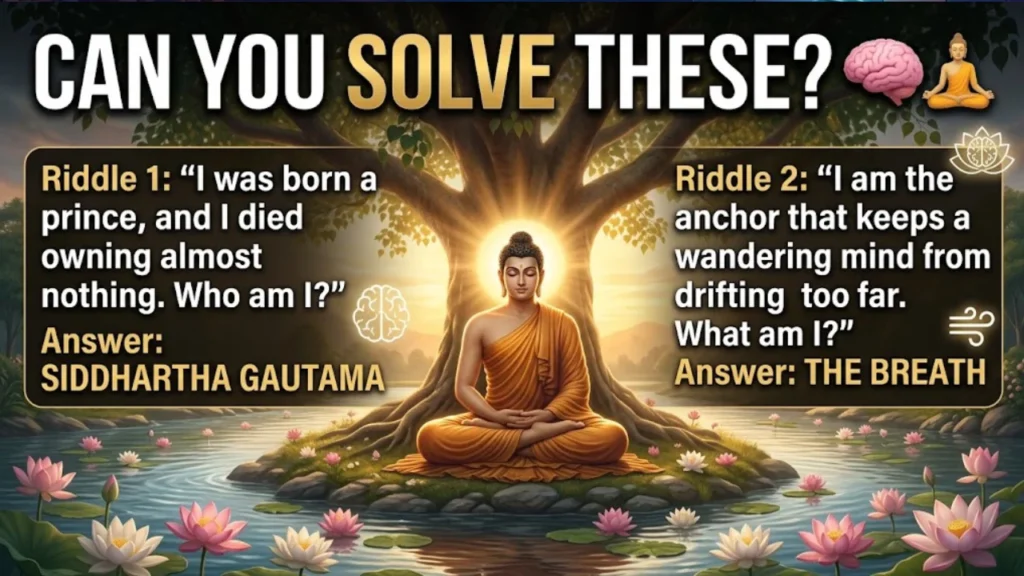
This next set of Buddhist riddles with answers moves between the Buddha’s own life story and the meditation habits monks still practice today.
191. I was born a prince, and I died owning almost nothing. Who am I? Answer: Siddhartha Gautama.
192. I saw four sights outside the palace walls that changed my whole life. What were they? Answer: An old man, a sick man, a dead man, and a wandering monk.
193. I walked away from a palace, a wife, and a son to search for an answer in the forest. What is this moment called? Answer: The Great Renunciation.
194. I starved myself for six years searching for truth through pain alone. What did I learn from it? Answer: That extreme suffering, like extreme pleasure, does not lead to awakening.
195. I found a path between comfort and starvation after years of extremes. What path is this? Answer: The Middle Way.
196. I sat beneath one tree for 49 days without leaving. What tree was I under? Answer: The Bodhi tree.
197. I sent temptation, fear, and doubt to stop an awakening from happening. Who am I? Answer: Mara, a personification of temptation and delusion.
198. I appeared in the sky at the exact moment enlightenment finally arrived. What am I? Answer: The morning star.
199. I gave my very first teaching in a quiet park full of deer. What is this event called? Answer: The First Sermon at Sarnath.
200. I was one of five ascetics who became the very first students. Who am I? Answer: One of the Buddha’s first five disciples.
201. I describe the moment the first teaching set a whole new practice into motion. What am I? Answer: The Turning of the Wheel of Dharma.
202. I taught for 45 years after that very first sermon. Who am I? Answer: The Buddha.
203. I passed away lying between two trees, surrounded by students. What is this event called? Answer: Parinirvana.
204. I am the garden where the Buddha was born. What am I? Answer: Lumbini.
205. I am the royal family the Buddha was born into. What clan am I? Answer: The Shakya clan.
206. My title means “sage of the Shakyas.” What title am I? Answer: Shakyamuni.
207. I appeared in a dream as a white elephant, right before a great birth. Who saw me? Answer: Queen Maya, the Buddha’s mother.
208. I taught meditation methods to Siddhartha before he found his own path beyond them. Who am I? Answer: One of his early teachers, whose methods he eventually moved past.
209. I stayed by the Buddha’s side for decades as his closest, most devoted attendant. Who am I? Answer: Ananda.
210. I was a cousin who tried more than once to challenge the Buddha’s leadership. Who am I? Answer: Devadatta.
211. I was the Buddha’s own son, left behind during the Great Renunciation. Who am I? Answer: Rahula.
212. I was the wife left behind when the palace gates closed for the last time. Who am I? Answer: Yasodhara.
213. I walk from door to door each morning, accepting whatever food is offered. What am I? Answer: The alms round.
214. I taught freely, regardless of a person’s caste or background. What quality is this? Answer: The Buddha’s teaching of spiritual equality.
215. My last words told each student to be a light for themselves. What were they? Answer: “Be a lamp unto yourself.”
216. I hold small remains, kept and honored inside a stupa after death. What am I? Answer: A relic.
217. I am the anchor that keeps a wandering mind from drifting too far. What am I? Answer: The breath.
218. I sit crossed, with a spine held straight and tall. What posture am I? Answer: The lotus position.
219. I ask for nothing more than sitting, fully and simply, without a goal. What am I? Answer: Zazen.
220. I am a single word or phrase, repeated until the noise in the mind settles. What am I? Answer: A mantra.
221. I hold attention on one single point until the rest of the room disappears. What am I? Answer: Concentration meditation.
222. I move one slow step at a time, turning walking itself into practice. What am I? Answer: Walking meditation.
223. I move attention slowly through the whole body, without judging any part of it. What am I? Answer: Body scan meditation.
224. I send warmth and goodwill outward, even to people I barely know. What practice am I? Answer: Metta, or loving-kindness meditation.
225. I sit with eyes half open, neither fully shut nor fully alert. What posture is this? Answer: The traditional zazen gaze.
226. I am the exact moment a thought stops chasing after another thought. What am I? Answer: A moment of mental clarity.
227. I am practiced daily for years, yet never fully mastered by anyone. What am I? Answer: Meditation itself.
228. I need no single object to rest on, only open, spacious attention. What am I? Answer: Open awareness meditation.
229. I slow a meal down until every single bite is fully tasted. What am I? Answer: Mindful eating.
230. I count ten slow breaths, then quietly start the count over again. What am I? Answer: A basic breath-counting practice.
231. I notice posture and movement while simply walking across a room. What am I? Answer: Mindfulness of the body.
232. I notice a feeling rise and pass, without pushing it away or grabbing it. What am I? Answer: Mindfulness of feelings.
233. I watch thoughts arrive and leave, like clouds crossing an open sky. What am I? Answer: Mindfulness of the mind.
234. I notice how every single thing around me keeps quietly changing. What am I? Answer: Mindfulness of impermanence.
235. I am the only moment that has ever truly existed. What am I? Answer: The present moment.
236. I see each ordinary thing as if it were brand new, without old assumptions layered on top. What mind is this? Answer: Beginner’s mind.
237. I swing wildly from branch to branch until steady practice finally calms me. What am I? Answer: The restless, untrained mind.
238. I am five separate obstacles that block deep concentration. What am I? Answer: The Five Hindrances.
239. I am wanting, and I pull attention away from stillness. What hindrance am I? Answer: Sensory desire.
240. I am irritation, and I push the mind away from what is actually here. What hindrance am I? Answer: Ill will.
241. I am a mind that cannot settle, jumping from plan to plan. What hindrance am I? Answer: Restlessness.
242. I am heaviness, sleepiness, and a dull, foggy mind during practice. What hindrance am I? Answer: Sloth and torpor.
243. I make a student question whether meditation is even working at all. What hindrance am I? Answer: Doubt.
244. I am a deep state of stillness reached through steady, sustained concentration. What am I? Answer: Jhana, or meditative absorption.
245. I am the calming branch of meditation, focused on settling the mind. What am I? Answer: Samatha meditation.
246. I am the insight branch of meditation, focused on seeing clearly. What am I? Answer: Vipassana meditation.
247. I stretch loving-kindness toward the one person hardest to feel warmth for. What practice is this? Answer: Metta directed at a difficult person.
248. I begin each morning simply by noticing what is already good. What practice is this? Answer: A gratitude practice.
249. I ask a person to feel kindness toward themselves before sending it anywhere else. What practice is this? Answer: Self-directed metta.
250. I gather a group into total silence for several days straight, away from ordinary life. What am I? Answer: A meditation retreat.
Fun and Easy Buddhist Riddles for All Ages
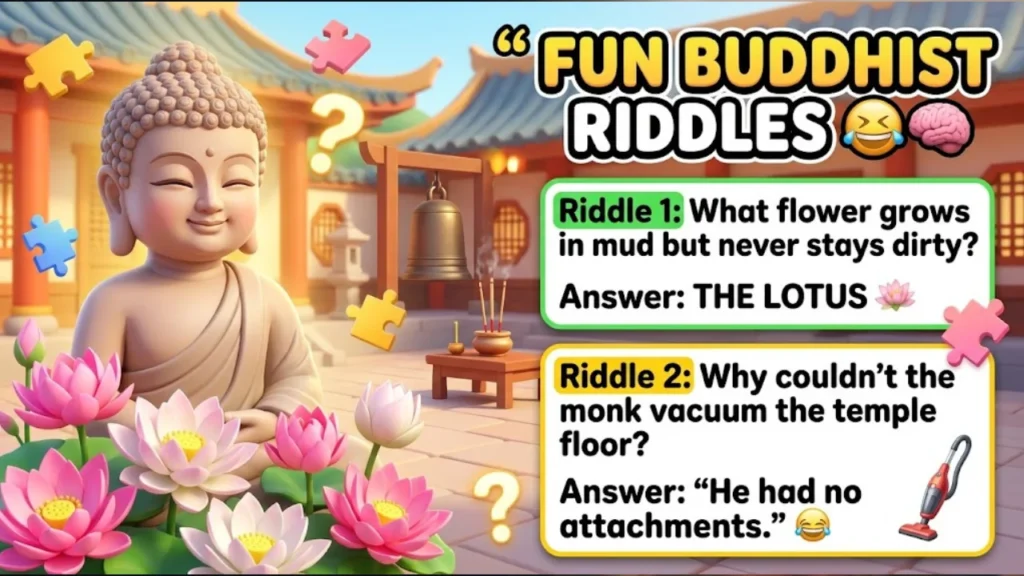
This last batch covers gentle Buddhist riddles for kids, along with a few lighthearted ones for a good laugh at temple life.
251. What flower grows in mud but never stays dirty? Answer: The lotus.
252. Who sat under a tree and became one of the wisest teachers in history? Answer: The Buddha.
253. What do monks ring to call everyone together? Answer: A bell.
254. What piece of clothing has no pockets at all? Answer: A monk’s robe.
255. What smells sweet in the room but turns to ash by the end? Answer: Incense.
256. What has beads, but isn’t worn just for fashion? Answer: Prayer beads.
257. What large, gentle animal is often shown standing near the Buddha in old paintings? Answer: An elephant.
258. What do you do quietly, with your eyes closed, to feel calmer? Answer: Meditate.
259. What building do monks live and pray inside? Answer: A temple.
260. What did the Buddha sit on while he meditated? Answer: The bare ground, or sometimes a simple cushion.
261. What word describes kindness given to strangers, with no conditions attached? Answer: Compassion.
262. What word means being fully present, right here, right now? Answer: Mindfulness.
263. What shape often sits on top of a temple roof? Answer: A dome or a spire.
264. What do you call a person who follows the Buddha’s teachings? Answer: A Buddhist.
265. What tree grew tall and gave shade during a very important moment? Answer: The Bodhi tree.
266. Why did the monk refuse to argue with anyone? Answer: He had no attachment to being right.
267. Why did the Buddhist traveler pack an empty suitcase? Answer: He believed in traveling light, in every sense of the phrase.
268. Why couldn’t the monk vacuum the temple floor? Answer: He had no attachments.
269. Why did the meditating student fail the pop quiz? Answer: He was too focused on the present moment.
270. Why did the monk turn down a sandwich at lunch? Answer: He said he could already make himself one with everything.
271. Why was the meditating monk terrible at poker? Answer: He never held onto anything, not even a good hand.
272. Why did the Buddhist skip the gym this week? Answer: He said he was already working hard on letting go.
273. Why did the monk carry a map with no destination marked on it? Answer: For him, the path itself was always the point.
274. Why did the candle seem to laugh quietly during evening meditation? Answer: It couldn’t help but be enlightened.
275. Why did the monk never lose a single argument? Answer: He simply stopped taking part in it.
276. Why did the Zen student fail his surprise history quiz? Answer: He said he was living entirely in the now.
277. Why did the monk bring an umbrella to his meditation session? Answer: In case enlightenment happened to shower down suddenly.
278. Why do monks never fight over the very last seat at dinner? Answer: They practice non-attachment, even at the table.
279. Why does the lotus flower get invited to every celebration? Answer: It always rises above the mud beneath it.
280. Why does the old temple statue never complain about sitting still all day? Answer: It had already found perfect stillness long ago.
281. Why did the wise old monk say nothing at all during the entire lesson? Answer: Because silence itself was the whole teaching that day.
282. Why did the monk misplace his keys twice in one morning? Answer: Even a calm mind still wanders sometimes.
283. Why was the Zen teacher’s grocery list only three items long? Answer: Simplicity was the whole lesson, even at the store.
284. Why did the calm barista turn a half-empty coffee cup into a small teaching? Answer: An empty cup, in her hands, became a lesson about letting go and starting fresh.
285. Why does the calm monk never seem to rush anywhere? Answer: In his mind, he had already arrived.
286. Why does one country have temples on almost every street corner? Answer: Because a very large share of its people practice Buddhism daily, a point covered more in the FAQ below.
287. Why do prayer flags flap loudly on temple roofs? Answer: They are believed to carry blessings outward on the wind.
288. What ties every single riddle in this whole list back together, from the first one to the last? Answer: They all point toward the same idea: a quiet, awake mind.
289. What is the one riddle in this list that answers all the others at once? Answer: The question of who, exactly, is doing the reading right now.
290. After reading 290 riddles, what have you actually become? Answer: Simply someone who paid closer attention than before — which is, itself, the beginning of practice.
FAQs
What are Buddhist riddles?
Buddhist riddles are short questions used to teach a lesson, not just to test cleverness. Some, called koans, come from the Zen tradition and are meant to quiet the logical mind rather than satisfy it. Others are simpler teaching riddles built around everyday Buddhist symbols like the lotus, the bell, and the alms bowl. Both types share one goal: helping the reader see a familiar idea in a new way.
What are the 14 questions Buddha did not answer?
These are known as the avyakata, or “unanswered questions.” According to the Encyclopedia of Buddhism, the Pali texts list ten of these questions, while the Sanskrit tradition expands the list to fourteen. They ask whether the universe is eternal or not, finite or infinite, whether the soul and body are the same or different, and whether an enlightened being exists, does not exist, both, or neither after death. The Buddha stayed silent on these because he taught that debating them does not lead to less suffering; it only feeds more speculation.
What are 5 unforgivable sins in Buddhism?
Traditional Buddhist texts describe five acts, called anantarika-karma, said to bring immediate and severe karmic consequences. According to Britannica, these five acts are: killing one’s mother, killing one’s father, killing an arhat (a fully liberated being), wounding a Buddha, and causing a split in the Sangha. These are considered uniquely serious because, unlike most karma, their effects are said to ripen immediately.
What country is 95% Buddhist?
Cambodia holds the highest share of any country in the world. According to Pew Research Center, roughly 97% of Cambodia’s population identifies as Buddhist, making it the country most often cited near the “95% Buddhist” mark. Thailand follows closely behind, with about 94% of its population identifying as Buddhist and the largest total number of Buddhists of any nation on Earth.
Conclusion
Buddhist riddles were never built for speed. They reward the reader who slows down, sits with discomfort, and lets an answer arrive on its own. Whether you picked a beginner riddle, a hard Zen koan, or a light one to share at dinner, the real prize isn’t the punchline — it’s the pause it gave your mind along the way.

Amelia Singh is a content strategist and digital writer specializing in curated web directories, cultural quote archives, and instructional content. She is dedicated to creating clear, engaging, and reliable digital resources for readers worldwide.