Stuck on a crossword clue about Buddhist riddles? Or looking for real Zen riddles to sharpen your mind? You’re in the right spot.
Below you’ll find the exact NYT crossword answer, plus a full list of 105+ Buddhist riddles with answers. Some are ancient Zen koans. Others are simple brain-benders inspired by Buddhist teaching. Every single one is numbered, with the answer bolded, so you can test yourself before peeking.
Table of Contents
What Are Buddhist Riddles?
Buddhist riddles are short questions or puzzles rooted in Zen Buddhism. Most people know them as koans — a Japanese word that roughly means “public case” or “test.”
A koan is not like a normal riddle. A normal riddle has one clean, logical answer. A koan often has no clean answer at all. That’s the point. Zen masters used koans to break students out of normal, step-by-step thinking. The goal wasn’t cleverness. It was insight — a sudden flash of understanding that words alone can’t give you.
This tradition goes back over a thousand years to Chan Buddhism in China, later spread through Zen Buddhism in Japan. Teachers would give a student one koan and ask them to sit with it — sometimes for years — until the answer stopped being a thought and became a felt experience.
That’s why you’ll see two kinds of entries in this list. Some are traditional koans with open, paradoxical answers. Others are lighter Buddhist riddles built more like classic puzzles, with a clear answer. Both fall under the same umbrella search term: Buddhist riddles.
Must Visit: 80+ Thanksgiving Riddles With Answers: Fun, Clever & Mind-Blowing Puzzles
Buddhist Riddles NYT Crossword Clue Answer
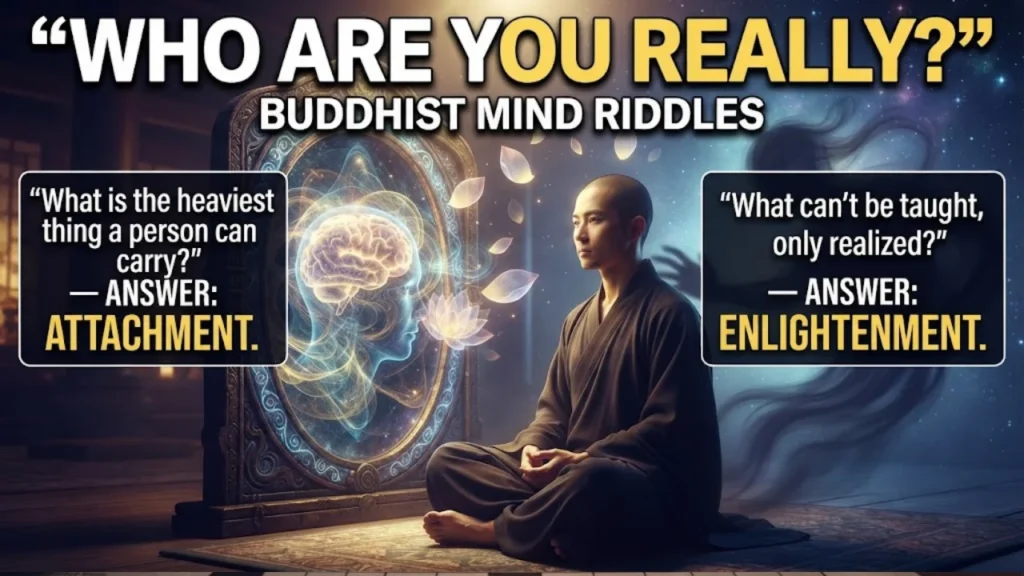
This is likely why many readers landed here. The New York Times crossword has used a few versions of this clue over the years.
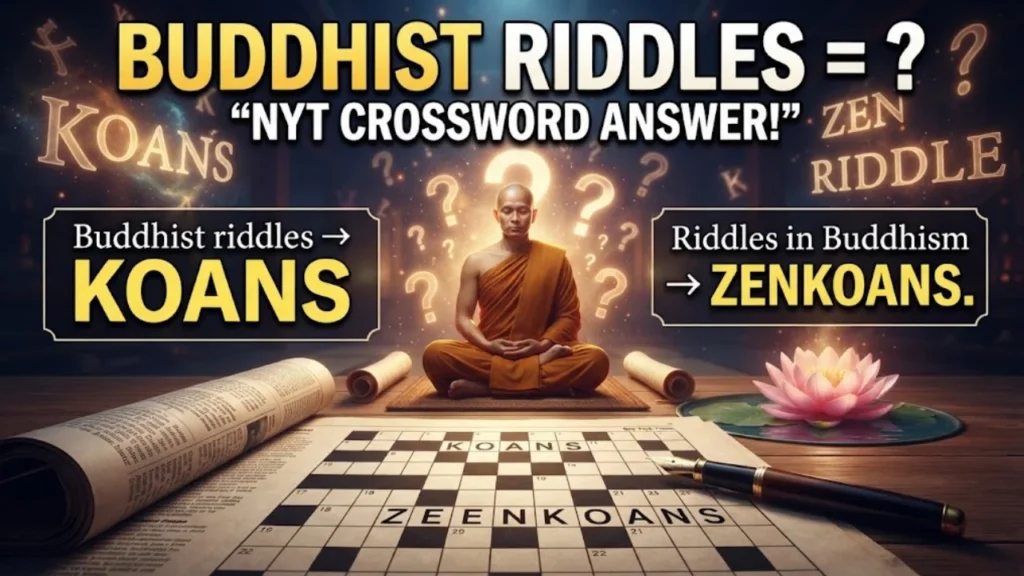
“Buddhist riddles” — Answer: KOANS (5 letters)
“Riddles in Buddhism” — Answer: ZENKOANS (8 letters)
Both answers point to the same idea. A koan is the technical term for a Buddhist riddle, and Zen koans is simply the fuller phrase used when the puzzle needs eight letters instead of five.
| Clue Variant | Answer | Letters |
|---|---|---|
| Buddhist riddles | KOANS | 5 |
| Riddles in Buddhism | ZENKOANS | 8 |
If your puzzle grid needs a shorter word, go with KOAN (singular, 4 letters) — it shows up in some daily puzzles too. Crossword clue databases confirm these are the most common accepted answers across major U.S. puzzles, including the NYT, LA Times, and Universal crossword.
105+ Buddhist Riddles With Answers
Ready to test your mind? Try to answer each one before you look at the bolded answer. Some have a clear solution. Others are true koans — meant to be felt, not solved.
Classic Zen Koans (1–25)
- What is the sound of one hand clapping? There is no sound — and that silence is the answer.
- Does a dog have Buddha-nature? Mu — a word beyond yes or no.
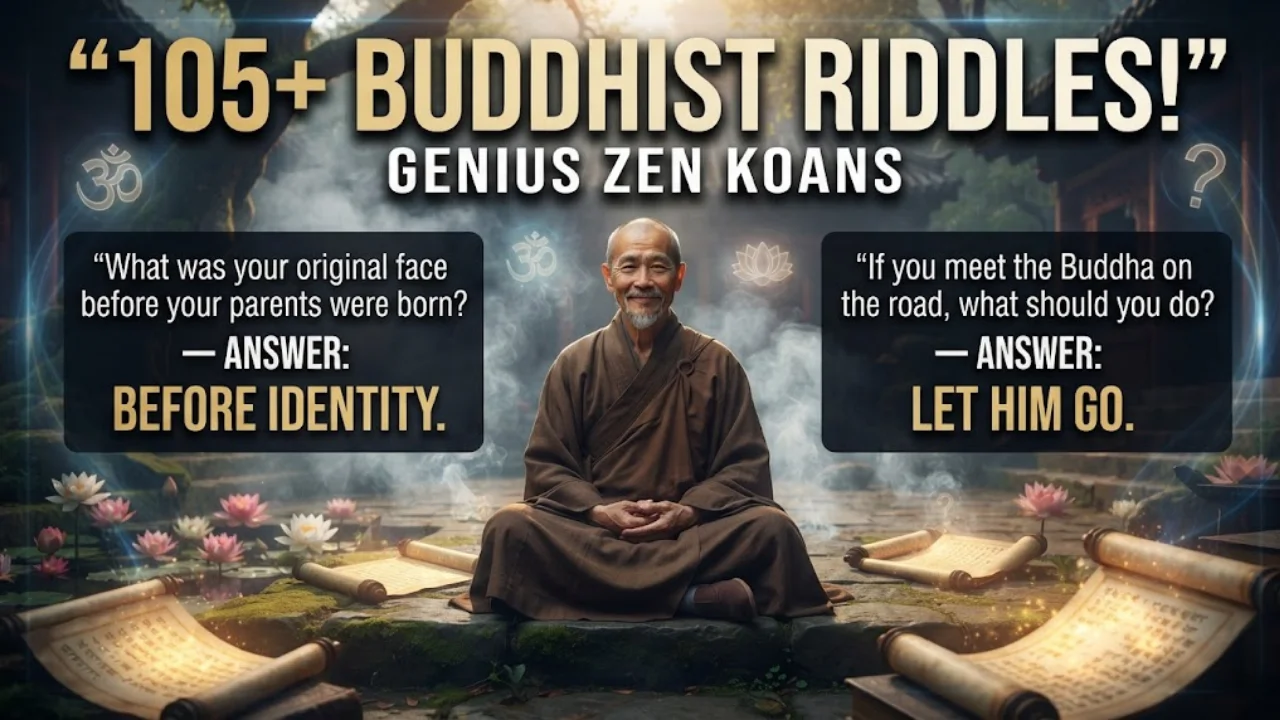
- What was your original face before your parents were born? The self you had before identity existed.
- If you meet the Buddha on the road, what should you do? Let him go — don’t cling even to enlightenment.
- Is it the flag or the wind that moves? Neither — it is the mind that moves.
- Why did the monk cut the cat in half? To show that clinging to ideas kills understanding.
- What is the Way? Ordinary mind is the Way.
- What are three pounds of flax? The answer to “What is Buddha?” — an object, not a concept.
- What is a dry shit-stick? Buddha is found in the plainest things.
- Does the cypress tree in the garden have meaning? Yes — everything ordinary already holds it.
- What should you do before eating? Wash your bowl.
- What happens after enlightenment? You chop wood and carry water, same as before.
- What is the taste of Zen? The taste of your own tea, right now.
- Where do you find the Buddha? Nowhere outside your own mind.
- Can two hands clap without sound? They can — silence is a sound too.
- What did the fox teach about karma? That even monks are bound by cause and effect.
- What is the gateless gate? A gate with no barrier, except the one in your mind.
- What is the sound of your own hearing? Awareness itself, before thought.
- Where does the wind rest? Nowhere — it rests in stopping to notice it.
- What is a finger pointing at? The moon — not the finger itself.
- What is the true self? The one watching this question.
- What happens when doubt is total? Great doubt leads to great awakening.
- Where is stillness found in motion? In the space between two thoughts.
- What is the shape of emptiness? No shape — that’s what makes it empty.
- What is the master’s true face? The one asking the question.
Nature & Emptiness Riddles (26–55)
- I am full of nothing, yet I hold everything. What am I? The sky.
- I disappear the moment you try to hold me. What am I? The present moment.
- I am born with every breath and die with every breath. What am I? This moment, again and again.
- What grows the more you let go of it? Peace.
- What is heavier — a mountain or a grudge? A grudge, because you carry it everywhere.
- What can you lose without losing anything? Your ego.
- I have no beginning and no end, yet I am everywhere. What am I? The present.
- What is the emptiest thing that is also the fullest? A quiet mind.
- I am a river, but I never step in the same place twice. What am I? Change itself.
- What do you find when you stop searching? What you were looking for.
- What is louder than silence? A busy mind.
- What can you give away infinitely without running out? Kindness.
- I vanish the second I am named. What am I? A feeling.
- What is the shortest distance to peace? Acceptance.
- What weighs nothing but can crush you? Worry.
- I am everywhere but own nothing. What am I? Space.
- What can be broken without ever being touched? A promise.
- What lasts forever but is never the same twice? Change.
- What do you carry that no one can see? Your thoughts.
- I flow but never move. What am I? Time.
- What can you hold onto that will only slip faster? Sand — and desire works the same way.
- What has no shadow, even in bright light? A clear mind.
- What do you find only when you stop looking for it? Contentment.
- What is stronger than any storm? A calm mind.
- I am the space between your thoughts. What am I? Stillness.
- What can’t be seen but shapes everything you see? Perception.
- What is the one thing you can’t lose, even if you try? Your breath, until it’s your last.
- What do all rivers have in common with the mind? Both are calmest when unobstructed.
- What is quieter than a whisper but louder than a shout? An honest thought.
- What melts away the moment you name it? Anger.
Mind & Self Riddles (56–85)
- Who is thinking this thought right now? You — but not the “you” you assume.
- What can see itself but never touch itself? The eye — and the mind.
- What is the one thing that follows you everywhere but is never truly yours? Your reputation.
- What do you lose the moment you try to define it? The self.
- What is easier to open than to close? The mind, once it’s curious.
- What grows stronger the less you fight it? Acceptance.
- What can you not see even though it’s always right in front of you? This present moment.
- Who is the enemy that lives inside every person? Ego.
- What is the heaviest thing a person can carry? Attachment.
- What do you need less of to have more of everything? Desire.
- What can only be found by stopping the search? Truth.
- What is the smallest thing that can hold the biggest world? Attention.
- What separates two people who are standing side by side? Judgment.
- What is free but priceless at the same time? A single breath.
- What can you never step in twice? The same moment.
- What is the one voice you can never fully silence? Your own mind.
- What do you already have, but keep chasing anyway? Happiness.
- What is the door that has no key? Acceptance.
- What can be given but never taken? Forgiveness.
- What connects every person without a single word? Suffering.
- What is the answer that ends every question? Silence.
- What can you master without ever finishing it? Patience.
- What is the truest mirror a person owns? Other people’s reactions to them.
- What is the lightest burden and the heaviest freedom? Letting go.
- What do you find only after you’ve lost it once? Gratitude.
- What never changes even though everything around it does? Awareness.
- What is the one thing thought can never fully capture? This exact moment.
- What do you build every day without laying a single brick? Habit.
- What can’t be taught, only realized? Enlightenment.
- What is the fastest way to lose your balance? Certainty.
Short Zen One-Liners (86–105)
- What did the Buddha find under the Bodhi tree? Awakening.
- What is the first noble truth? Suffering exists.
- What ends suffering, according to the Buddha? Letting go of craving.
- What is the “middle way”? The path between extremes.
- What is nirvana, in simple terms? The end of craving and suffering.
- What do Buddhists call the cycle of birth and rebirth? Samsara.
- What is karma, at its core? Cause and effect from your actions.
- What is meditation trying to quiet? The chattering mind.
- What is impermanence? The truth that everything changes.
- What is the eightfold path meant to lead to? The end of suffering.
- What is a bodhisattva? One who delays their own nirvana to help others.
- What is right mindfulness, in plain words? Paying full attention to now.
- What does “attachment causes suffering” really mean? Clinging to things that change will hurt you.
- What is compassion in Buddhist teaching? Wishing others free of suffering.
- What is the “self” according to Buddhism? An illusion built from changing parts.
- What is a mantra used for? To focus and quiet the mind.
- What is the lotus flower a symbol of? Rising clean out of muddy conditions.
- What is “beginner’s mind”? Seeing things fresh, without assumption.
- What does the Buddha’s smile represent? Peace found through letting go.
- What is the final teaching of every koan? The one you find yourself, in silence.
Famous Zen Koans and Their Deeper Meaning
A handful of these riddles have stood out for centuries because they capture Zen thinking in one short line. It helps to know why they matter, not just what the answer is.
“What is the sound of one hand clapping?” is likely the most quoted koan in the West. It’s designed to short-circuit logic — a clap needs two hands, so the question has no normal answer. That’s exactly the point. It forces the mind to stop reasoning and simply be present.
“Mu” — the answer to “Does a dog have Buddha-nature?” — is one of the most studied koans in Zen training. “Mu” isn’t a yes or a no. It rejects the entire premise of the question, teaching that reality often can’t be split into neat opposites.
“What was your face before your parents were born?” pushes students to look past their name, job, and personal history, toward something that existed before identity was built at all.
“If you meet the Buddha on the road, kill him” sounds shocking out of context. It actually warns against turning even enlightenment into another attachment. The real teaching: don’t worship the idea of awakening more than the practice of it.
These koans aren’t puzzles with a hidden trick. They’re tools. Zen teachers still use them today in meditation halls across the U.S. and Japan to train the mind to sit with uncertainty instead of rushing to close it.
How to Solve Buddhist Riddles Like a Zen Master
Approaching a Zen riddle the wrong way — like a math problem — usually leads nowhere. Here’s how practitioners actually work through them.
Drop the need for a “correct” answer. Many koans reward sitting with confusion, not solving it.
Sit with the question, don’t rush past it. Traditional Zen students spent months on a single koan. Give yours at least a few quiet minutes.
Notice your first reaction, then let it go. The mind’s fast answer is usually the wrong one — it’s just habit talking.
Treat it like meditation, not trivia. The value isn’t in “winning.” It’s in what the question reveals about how your mind works.
Read it slowly, out loud if you can. Zen riddles are built for the ear as much as the eye — the rhythm matters.
FAQs
What are Buddhist riddles?
Buddhist riddles are short questions rooted in Zen Buddhism, most often called koans. They’re used in meditation and teaching to move the mind past normal logic and toward direct insight.
What is the answer to the Zen riddle crossword clue?
For the clue “Zen riddle,” crossword databases most commonly list KOAN as the answer, since a koan is literally the term for a Zen riddle.
What is the answer to the New York Times crossword puzzle?
For “Buddhist riddles,” the NYT crossword answer is KOANS. For the longer version, “Riddles in Buddhism,” the answer is ZENKOANS.
What are some examples of paradoxical riddles used in Zen Buddhism?
Classic examples include “What is the sound of one hand clapping?”, “What was your face before your parents were born?”, and “Mu” — the answer to whether a dog has Buddha-nature. Each avoids a clean yes-or-no answer on purpose.
What are some famous koans?
Some of the most well-known are the one hand clapping koan, the Mu koan, “If you meet the Buddha on the road, kill him,” and “Is it the flag or the wind that moves?” — all still studied in Zen practice today.
Conclusion
Whether you came here to finish your NYT crossword or to genuinely test your mind against real Zen koans, the takeaway is the same: Buddhist riddles aren’t about finding the cleverest answer. They’re about slowing down enough to actually think. Save this list, come back to a few riddles a day, and let the ones without easy answers do their job — sit with you a little longer than you’d expect.

Amelia Singh is a content strategist and digital writer specializing in curated web directories, cultural quote archives, and instructional content. She is dedicated to creating clear, engaging, and reliable digital resources for readers worldwide.