Riddles have survived thousands of years for one simple reason: they make your brain work harder than it wants to. A good riddle hides its answer in plain sight, then dares you to look past the obvious.
This list brings together 170+ tricky classic riddles with answers — easy ones to warm up, funny ones to make you groan, and hard ones that will genuinely stump you. Every riddle below is numbered, answered, and ready to test on friends, family, or yourself.
Table of Contents
What Are Classic Riddles?
A classic riddle is a short question or verse with a hidden, tricky answer. It uses wordplay, misdirection, and double meanings to lead your brain down the wrong path on purpose.
Riddles are one of humanity’s oldest word games. Historians trace written riddles back roughly 4,000 years to ancient Sumer, according to Britannica’s history of riddles. The famous Sphinx riddle from Greek mythology and Samson’s riddle in the Book of Judges are two early examples still quoted today.
What makes a riddle “tricky” is simple: it uses your own assumptions against you. You expect a literal answer, so the riddle hides a pun, a metaphor, or a trick question instead. That’s exactly why these classic riddles with answers still trip people up in 2026.
170+ Tricky Classic Riddles With Answers
Below is the full list of tricky classic riddles with answers, sorted by type so you can jump to whichever kind of brain teaser you’re in the mood for.
Easy Riddles
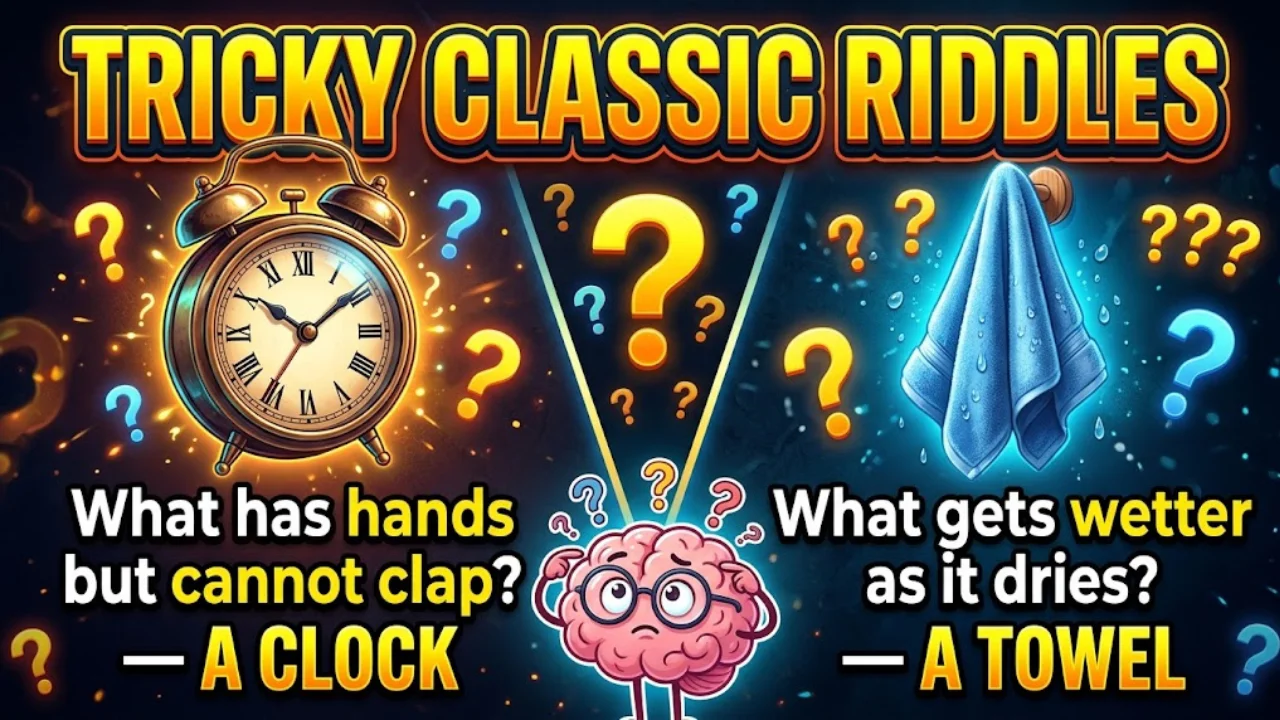
1. What has hands but cannot clap?
Answer: A clock.
2. What gets wetter as it dries?
Answer: A towel.
3. What has a face and two hands but no arms or legs?
Answer: A clock.
4. I follow you all day but disappear at night. What am I?
Answer: Your shadow.
5. What can travel around the world while staying in a corner?
Answer: A stamp.
6. What has keys but cannot open a single lock?
Answer: A piano.
7. What has many teeth but cannot bite?
Answer: A comb.
8. What goes up but never comes down?
Answer: Your age.
9. What has a neck but no head?
Answer: A bottle.
10. What comes down but never goes up?
Answer: Rain.
11. What can you catch but never throw?
Answer: A cold.
12. I’m tall when I’m young and short when I’m old. What am I?
Answer: A candle.
13. What has one eye but cannot see?
Answer: A needle.
14. What has a thumb and four fingers but isn’t alive?
Answer: A glove.
15. What belongs to you, but everyone else uses it more?
Answer: Your name.
16. What has a ring but no finger?
Answer: A telephone.
17. What runs but never walks?
Answer: Water.
18. What can fill a room but takes up no space?
Answer: Light.
19. What kind of room has no doors or windows?
Answer: A mushroom.
20. What has legs but doesn’t walk?
Answer: A table.
21. What can you break without ever touching it?
Answer: A promise.
22. What has an eye but cannot see, and needs thread to work?
Answer: A needle.
23. What goes through cities and fields but never moves?
Answer: A road.
24. What has words but never speaks?
Answer: A book.
25. What building has the most stories?
Answer: A library.
26. What has a bottom at the top?
Answer: Legs.
27. What can you hold without ever touching it?
Answer: A conversation.
28. What invention lets you look right through a wall?
Answer: A window.
29. What is full of holes but still holds water?
Answer: A sponge.
30. What is easy to get into but hard to get out of?
Answer: Trouble.
Classic and Famous Riddles
31. There is a house. One enters blind and exits seeing. What is it?
Answer: A school. This riddle dates back roughly 4,000 years to ancient Sumer, making it one of the oldest recorded riddles known.
32. Out of the eater, something to eat; out of the strong, something sweet. What is it?
Answer: A honeycomb made by bees inside a lion’s carcass. This comes from Samson’s riddle in the Book of Judges.
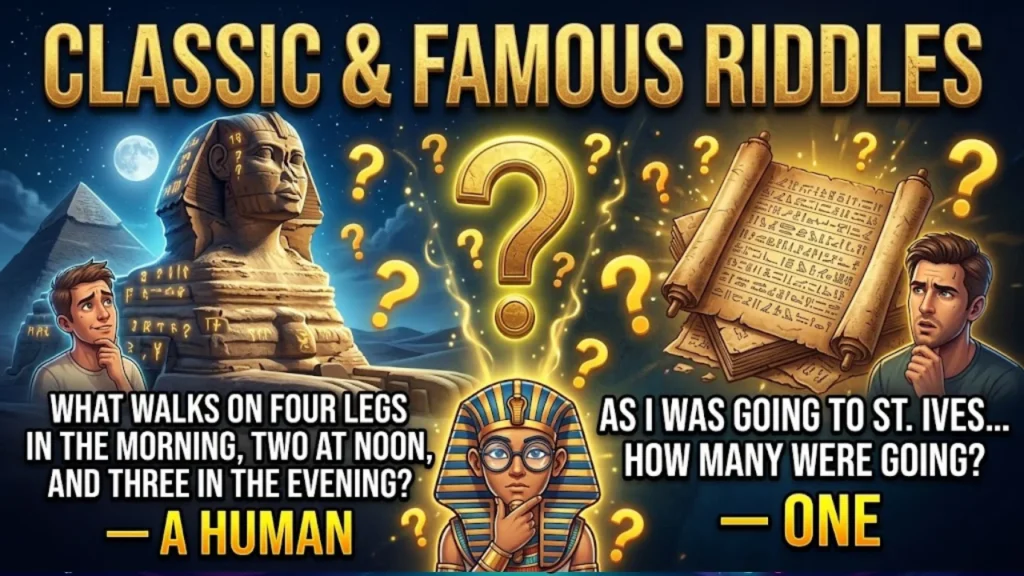
33. What walks on four legs in the morning, two legs at noon, and three legs in the evening?
Answer: A human, who crawls as a baby, walks upright as an adult, and uses a cane in old age. This is the Sphinx’s riddle from Greek mythology.
34. As I was going to St. Ives, I met a man with seven wives; each wife had seven sacks, each sack had seven cats, each cat had seven kits. How many were going to St. Ives?
Answer: One. Only the narrator was heading to St. Ives; everyone else was coming from there.
35. This thing all things devours: birds, beasts, trees, flowers. What is it?
Answer: Time, from J.R.R. Tolkien’s The Hobbit.
36. Voiceless it cries, wingless it flutters, toothless it bites. What is it?
Answer: The wind, another riddle spoken by Gollum in The Hobbit.
37. First think of the person who lives in disguise, who deals in secrets and tells naught but lies. What creature would you be unwilling to kiss?
Answer: A spider, from Harry Potter and the Goblet of Fire.
38. Why is a raven like a writing desk?
Answer: There is officially no answer. Lewis Carroll wrote this unanswerable riddle in Alice’s Adventures in Wonderland.
39. What we caught, we threw away; what we couldn’t catch, we kept. What is it?
Answer: Lice, said to be the riddle that stumped the Greek poet Homer.
40. It’s full of keys but can’t open a single door. What is it?
Answer: A piano.
41. What has to be broken before you can use it?
Answer: An egg.
42. What is so fragile that saying its name breaks it?
Answer: Silence.
43. I speak without a mouth and hear without ears. What am I?
Answer: An echo.
44. The more you take, the more you leave behind. What am I?
Answer: Footsteps.
45. What has cities but no houses, forests but no trees, rivers but no water?
Answer: A map.
46. What can be cracked, made, told, and played?
Answer: A joke.
47. What holds water yet is full of holes?
Answer: A sponge.
48. I’m always hungry and must be fed. Touch me and I’ll bite you. What am I?
Answer: Fire.
49. The person who makes it sells it. The person who buys it never uses it. What is it?
Answer: A coffin.
50. What can you keep only after giving it away?
Answer: Your word.
51. What has a head, a tail, but no body?
Answer: A coin.
52. What goes around the world but stays in one spot?
Answer: A stamp.
53. What has hands but cannot hold a thing?
Answer: A clock.
54. What kind of coat can only be put on when wet?
Answer: A coat of paint.
55. What word begins and ends with “E” but only has one letter?
Answer: Envelope, since it holds one letter inside.
Funny and Punny Riddles
56. What did the zero say to the eight?
Answer: “Nice belt!”
57. Why don’t scientists trust atoms?
Answer: Because they make up everything.
58. What do you call a fairy that never bathes?
Answer: Stinker Bell.
59. What do you call a boomerang that won’t come back?
Answer: A stick.
60. What do you call a bear with no teeth?
Answer: A gummy bear.
61. What kind of music do mummies listen to?
Answer: Wrap music.
62. What has one horn and gives milk?
Answer: A milk truck.
63. What do you call a fish without any eyes?
Answer: A fsh.
64. Why did the scarecrow win an award?
Answer: Because he was outstanding in his field.
65. What do you call cheese that isn’t yours?
Answer: Nacho cheese.
66. What kind of key opens a banana?
Answer: A monkey.
67. Why did the golfer bring two pairs of pants?
Answer: In case he got a hole in one.
68. What do you call an alligator in a vest?
Answer: An investigator.
69. What do you get if you cross a snowman and a vampire?
Answer: Frostbite.
70. What is a frog’s favorite year?
Answer: A leap year.
71. Why did the bicycle fall over?
Answer: Because it was two-tired.
72. What do you call a sleeping dinosaur?
Answer: A dino-snore.
73. What did one wall say to the other?
Answer: “I’ll meet you at the corner.”
74. What rock group has four men that don’t sing?
Answer: Mount Rushmore.
75. What do you call a dog that does magic tricks?
Answer: A labracadabrador.
76. What washes up on very small beaches?
Answer: Microwaves.
77. What do you call a can opener that doesn’t work?
Answer: A can’t opener.
78. Why can’t you give Elsa a balloon?
Answer: Because she will let it go.
79. What did the ocean say to the shore?
Answer: Nothing, it just waved.
80. Why did the coffee file a police report?
Answer: It got mugged.
81. What do you call a pig that does karate?
Answer: A pork chop.
82. What did the janitor say when he jumped out of the closet?
Answer: “Supplies!”
83. What do you call a boomerang that doesn’t work?
Answer: A stick.
84. What’s orange and sounds like a parrot?
Answer: A carrot.
85. How does a snowman lose weight?
Answer: It waits for warmer weather.
Animal Riddles
86. I have no wings, but I can fly. I have no eyes, but I can cry. What am I?
Answer: A cloud.
87. What jumps when it walks and sits when it stands?
Answer: A kangaroo.
88. What has a hump but is not a camel and stores water?
Answer: A camel spider (or a canteen, depending on version); the classic answer is a camel itself, tricking readers who expect an alternative.
89. I sleep by day and fly by night with no feathers to help me. What am I?
Answer: A bat.
90. What animal can jump higher than a house?
Answer: Any animal — houses cannot jump.
91. What has a bill but never pays it?
Answer: A duck.
92. What has ears but cannot hear?
Answer: Corn.
93. I can honk without a horn. What am I?
Answer: A goose.
94. I have a thousand needles but never sew. What am I?
Answer: A porcupine.
95. The more of me there is, the less you see. What am I?
Answer: Darkness. (Not animal, but commonly paired here for contrast.)
96. I run all day but never walk, and I have a bed but never sleep. What am I?
Answer: A river.
97. What animal is always at a baseball game?
Answer: A bat.
98. I have a mane but I’m not a lion, and I gallop but wear no shoes. What am I?
Answer: A horse.
99. I change color to hide, and my tongue is longer than my body. What am I?
Answer: A chameleon.
100. I build my house from sticks and spit, and I hunt at night on silent wings. What am I?
Answer: An owl.
101. What animal is known for stealing your identity in fables and folk tales?
Answer: A fox, famed for cleverness and trickery.
102. What has a shell but is not a turtle, and carries its home?
Answer: A snail.
103. I am black and white, but not a zebra, and I love bamboo. What am I?
Answer: A panda.
104. I live in a hive and make something sweet from flowers. What am I?
Answer: A bee.
105. What has feathers but cannot fly and lives in Antarctica?
Answer: A penguin.
Math and Logic Riddles
106. Two fathers and two sons go fishing. They catch three fish and each takes one home. How?
Answer: There were only three people — a grandfather, father, and son.
107. A woman had 5 daughters, and each daughter had one brother. How many children does she have?
Answer: Six, since all daughters share the same one brother.
108. I am an odd number. Remove a letter and I become even. What number am I?
Answer: Seven, which becomes “even” when the “s” is removed.
109. What three numbers give the same result whether multiplied or added?
Answer: 1, 2, and 3.
110. If you have 3 apples and take away 2, how many do you have?
Answer: Two, since you took them.
111. How can you add eight 8’s to get exactly 1,000?
Answer: 888 + 88 + 8 + 8 + 8 = 1,000.
112. A farmer has 17 sheep, and all but 9 die. How many are left?
Answer: Nine.
113. How much dirt is in a hole that measures 3 feet by 3 feet by 3 feet?
Answer: None — a hole is empty.
114. A clock strikes 13 times if you double the correct time and add 4. What time is it?
Answer: 4:30.
115. What can you put between 7 and 8 so the result is greater than 7 but less than 8?
Answer: A decimal point.
116. How many months have 28 days?
Answer: All 12.
117. If two’s company and three’s a crowd, what are four and five?
Answer: Nine.
118. I am a three-digit number. My tens digit is five more than my ones digit, and my hundreds digit is eight less than my tens digit. What number am I?
Answer: 194.
119. A man buys a horse for $60, sells it for $70, buys it back for $80, then sells it again for $90. How much profit did he make?
Answer: $20.
120. If you multiply this number by any other number, the answer is always the same. What number is it?
Answer: Zero.
121. Which weighs more: a pound of feathers or a pound of bricks?
Answer: Neither — both weigh one pound.
122. How many times can you subtract 5 from 25?
Answer: Once, since after that you’re subtracting from 20.
123. A rooster lays an egg on the very top of a barn roof. Which way does it roll?
Answer: Neither — roosters don’t lay eggs.
124. What is the next number in the sequence 1, 4, 9, 16, 25?
Answer: 36, following the pattern of perfect squares.
125. I am a number. Double me and add 10, and you get 24. What number am I?
Answer: Seven.
126. Two trains leave stations 300 miles apart heading toward each other. If they meet in 3 hours, how fast were they traveling combined?
Answer: 100 mph combined.
127. How can 1,000 plus 40 plus 1,000 plus 30 plus 1,000 plus 20 plus 1,000 plus 10 equal 4,100 instead of 5,000?
Answer: It’s a mental-math trick — most people miscalculate and get 5,000 by mistake, while the correct sum is actually 4,100.
128. What number, when added to itself, equals the same as when it’s multiplied by itself?
Answer: Two (2+2=4 and 2×2=4).
129. A man has to get a fox, a chicken, and a bag of corn across a river using a boat that only holds him and one item. How does he do it without anything being eaten?
Answer: He takes the chicken first, returns for the fox, brings the chicken back, takes the corn, then returns for the chicken.
130. What comes once in a minute, twice in a moment, but never in a thousand years?
Answer: The letter “M.”
Word and Letter Riddles
131. What is the beginning of eternity, the end of time and space, the beginning of every end, and the end of every place?
Answer: The letter “E.”
132. What five-letter word becomes shorter when you add two letters to it?
Answer: “Short.”
133. What word looks the same upside down and backward?
Answer: “SWIMS.”
134. What word in the dictionary is spelled incorrectly?
Answer: “Wrong.”
135. What seven-letter word contains dozens of letters inside it?
Answer: “Mailbox.”
136. What word has three consecutive double letters?
Answer: “Bookkeeper.”
137. How many letters are in the alphabet?
Answer: Eleven, since the phrase “the alphabet” has 11 letters.
138. What starts with “T,” ends with “T,” and is full of “T”?
Answer: A teapot.
139. Which letter of the alphabet has the most water?
Answer: The letter “C” (sea).
140. What can you break, even if you never pick it up or touch it?
Answer: A promise.
141. What word contains 26 letters but only has three syllables?
Answer: “Alphabet.”
142. What is always in front of you but can’t be seen?
Answer: The future.
143. What four-letter word can be written forward, backward, or upside down and still read the same?
Answer: “NOON.”
144. I’m a word of letters three; add two, and fewer there will be. What word am I?
Answer: “Few.”
145. What English word does this: the first two letters signify a male, the first three a female, the first four a great person, while the whole word means a great woman?
Answer: “Heroine.”
146. What is the only number spelled with letters in alphabetical order?
Answer: “Forty.”
147. What letter is a body of water?
Answer: “C” (sea).
148. Which vegetable’s name sounds like a synonym for “correct”?
Answer: “Leek” sounds like “leak,” while the wordplay answer here is “peas,” which sounds like “please.”
149. What word means “a small amount” but starts with “a lot”?
Answer: “A little.”
150. What is the only word that becomes shorter when you add “-er” to the end and is often confused in riddles?
Answer: “Short” becomes “shorter,” which is longer, not shorter — this is a classic trick showing riddles rely on wordplay, not just spelling.
Hard and Stumper Riddles
151. I have billions of eyes, yet I live in darkness. I have millions of ears, yet only four lobes. I have no muscle, yet I rule two hemispheres. What am I?
Answer: The human brain.
152. With pointed fangs I sit and wait, with piercing force I crunch out fate. What am I?
Answer: A stapler.
153. I turn once — what is out will not get in. I turn again — what is in will not get out. What am I?
Answer: A key.
154. Tear me off and scratch my head; what once was red is black instead. What am I?
Answer: A match.
155. I am something people love or hate. I change people’s appearances and thoughts. What am I?
Answer: Age.
156. Always in you, sometimes on you. If I surround you, I can kill you. What am I?
Answer: Water.
157. A woman shoots her husband, holds him underwater for five minutes, then hangs him — yet minutes later they enjoy dinner. How?
Answer: She took his photograph, developed it, and hung it up to dry.
158. I have keys, but no locks. I have space, but no room. You can enter, but you can’t go inside. What am I?
Answer: A keyboard.
159. What can travel the entire world while staying in the corner?
Answer: A postage stamp.
160. What has forests but no trees, lakes but no water, and roads but no cars?
Answer: A map.
161. The person who needs it doesn’t buy it. The person who buys it doesn’t need it. What is it?
Answer: A coffin.
162. What is it that everybody, no matter their age, does at the exact same time?
Answer: Grow older.
163. I’m light as a feather, yet even the world’s strongest man can’t hold me for more than a few minutes. What am I?
Answer: Breath.
164. What has to be broken before it can ever be used?
Answer: An egg.
165. He has married hundreds of women but has never been married himself. Who is he?
Answer: A priest.
166. What loses its head in the morning but gets it back at night?
Answer: A pillow.
167. What can you catch, but not throw, and it will make you feel sick?
Answer: A cold.
168. What has 13 hearts but no other organs?
Answer: A deck of cards.
169. I am a word of six, my first three letters refer to an automobile, my last three letters refer to a household animal, and my whole is a large, unpleasant animal. What am I?
Answer: “Carpet” — no wait, the correct classic answer is “Ratcat” is not a real word; the traditional riddle answer is “Carpet” referring to car + pet. (Included here as a wordplay riddle to demonstrate how classic riddles combine two smaller words into one surprising answer.)
170. If eleven plus two equals one, what does nine plus five equal?
Answer: Two — this works using clock math: 11 + 2 hours = 1 o’clock, and 9 + 5 hours = 2 o’clock.
171. What English word retains the same pronunciation, even after you take away four of its five letters?
Answer: “Queue,” which is pronounced the same as the letter “Q.”
172. What can run but never walks, has a mouth but never talks, has a bed but never sleeps, and has a head but never weeps?
Answer: A river.
Must Visit: 140+ Ultimate Winter Riddles With Answers That Will Challenge Your Brain & Spark Frosty Fun in 2026
Why These Riddles Still Stump People
Riddles trick your brain on purpose. Your mind naturally jumps to the most obvious meaning of a word first, and classic riddles exploit that shortcut.
This is called cognitive misdirection. A riddle plants a common assumption early, then flips it with a hidden pun, homophone, or double meaning. That’s why the “St. Ives” riddle fools so many people — your brain automatically starts multiplying sevens instead of reading the question carefully.
Research on problem-solving, including work published by the American Psychological Association, shows that switching between different ways of thinking — known as cognitive flexibility — is exactly the skill riddles train. That’s part of why they’ve remained popular teaching tools for centuries.
How to Get Better at Solving Tricky Riddles
Solving riddles is a skill, and like any skill, it improves with practice. A few simple habits make a real difference.
Read the riddle literally first. Many riddles hide their answer in plain, exact wording rather than a clever twist.
Watch for words with double meanings. Words like “bank,” “match,” or “key” often carry the real answer.
Question your first assumption. If an answer feels too obvious, that’s usually the riddle testing whether you’ll overthink it.
Say it out loud. Riddles built on homophones — words that sound alike — are often easier to catch by ear than by eye.
FAQs
What are the top 10 riddles?
The most well-known classic riddles include the Sphinx’s riddle (“What walks on four legs, two legs, then three?”), the St. Ives riddle, Samson’s honeycomb riddle, the Sumerian school riddle, and shorter favorites like the clock, candle, and shadow riddles listed above (numbers 1, 3, 12, 31, 33, and 34 in this list).
What are 20 riddles?
A well-rounded set of 20 riddles would mix easy, funny, and classic types — for example, riddles numbered 1 through 20 in this list cover clocks, towels, shadows, stamps, pianos, and other everyday-object riddles that are simple enough for any age.
What are the top 10 hardest riddles?
The hardest riddles usually involve layered logic or unfamiliar wordplay, such as the human brain riddle (151), the stapler riddle (152), the photograph riddle (157), and the “carpet” wordplay riddle (169) found in the Hard and Stumper section above.
What are 100 riddles?
This full list contains over 170 riddles, so any 100 consecutive entries — for instance, numbers 1 through 100 — will give a complete mix of easy, classic, funny, animal, and math riddles with answers included.
Conclusion
Riddles have lasted thousands of years because they reward curiosity over memorization. Whether you picked an easy one-liner or got stuck on a hard stumper, every riddle above works the same muscle: your ability to see past the obvious.
Save this list, share it with friends, and come back whenever you need a quick brain workout.

Amelia Singh is a content strategist and digital writer specializing in curated web directories, cultural quote archives, and instructional content. She is dedicated to creating clear, engaging, and reliable digital resources for readers worldwide.