A good riddle grabs you fast. A good story riddle grabs you and doesn’t let go until the last line. Unlike a plain one-liner, a story riddle drops you into a tiny scene — a locked room, a strange death, a stranger at the door — and dares you to spot the detail everyone else missed.
Below you’ll find 290+ story riddles with answers, sorted by mood and difficulty. Some are quick enough for a car ride. Others will have you staring at the ceiling. Every single one comes with a bolded answer right underneath, so you can check your work or just skip ahead if you’re stuck.
Table of Contents
What Are Story Riddles With Answers?

A story riddle is a riddle wrapped in a tiny narrative instead of a single question. It gives you characters, a setting, and a strange event — then asks you to explain what happened.
Regular riddles usually rely on wordplay or a play on double meanings. Think “what has hands but can’t clap” (a clock). Story riddles with answers, on the other hand, lean on logic, misdirection, and lateral thinking. You’re not decoding a pun — you’re solving a mystery. That’s why they’re often called “mystery riddles” or “situation puzzles.” The most famous example is probably the surgeon riddle: a boy is rushed into surgery, and the surgeon says, “I can’t operate — this is my son.” Most people get stuck because they assume the surgeon must be the boy’s father. The twist: the surgeon is his mother.
That single riddle explains why this format has stayed popular for generations — it exposes the assumptions we don’t even know we’re making.
Why Story Riddles With Answers Are Great for Your Brain
Story riddles aren’t just a fun way to kill ten minutes. Research on cognitive flexibility — the brain’s ability to switch between different ways of thinking about a problem — consistently links puzzle-solving activities to sharper problem-solving skills, according to the National Institute on Aging. A story riddle forces exactly that kind of switch: you have to drop your first guess and look at the scene from a completely different angle.
They’re also low-pressure. Nobody fails a riddle. You either get the satisfying “aha” moment, or you learn something clever you’ll remember for years. That’s why story riddles with answers work so well for:
- Classroom warm-ups and rainy-day activities for kids
- Road trips and long car rides
- Party games and icebreakers for adults
- Bedtime brain teasers that don’t involve a screen
They also build verbal reasoning and patience — two skills that don’t get much practice anywhere else in a typical day.
290+ Story Riddles With Answers

Here’s the full collection, broken into six moods so you can jump to whatever fits your crowd. Each riddle is numbered and the answer is bolded directly underneath.
Must Visit: Lies of P Phone Riddles: The Ultimate Guide to Solve Every Riddle
Short & Easy Story Riddles (Great for Kids)
- A boy leaves his house, turns left three times, and ends up back home facing two masked men. Who are they? The catcher and umpire — he’s playing baseball.
- A man walks into a bakery, buys nothing, but leaves with two loaves of bread. How? He’s the baker’s employee, restocking the shelf.
- A girl brings an umbrella to school even though the sky is clear and sunny. Why? Her teacher asked the class to bring one for an umbrella-decorating craft.
- A boy waters his plant every day, yet it never grows. Why not? It’s a plastic plant.
- A man is standing in the rain without an umbrella or hat, yet not a single hair on his head gets wet. Why? He’s bald.
- Every night, a girl places her shoes by the door before bed. One morning, they’re gone. Why isn’t she upset? They were old and worn out — she left them out for the trash pickup.
- A boy grows a foot overnight. What happened? He is a plant that grew a “foot” tall.
- A man buys a new pair of gloves, but only wears one. Why? He lost the other one on a windy day.
- Twin sisters are born on the same day, same month, same year, but aren’t twins. How? They’re two of a set of triplets.
- A boy tells his mom he saw a man walk on water. His mom believes him instantly. Why? It was winter, and the lake was frozen.
- A girl gives away all her candy but has more left than before. How? She was a shopkeeper restocking the shelf after handing out samples.
- A father tells his son to never open the blue door in their house. One day, the boy opens it and finds nothing unusual. What was he doing? He was cleaning the closet, which is painted blue.
- A dog runs to the door every day at 3 p.m. sharp without being told the time. How does he know? The school bus arrives then, and he hears it.
- A boy plants a seed and picks the fruit the very next day. How? He planted it in a pot and simply picked yesterday’s ripe fruit from another tree.
- A man walks five miles in the rain but doesn’t get a single drop on him. How? He walked through a covered tunnel the whole way.
- A girl swims across a lake without getting her hair wet. How? She wore a swim cap.
- A boy hands his teacher a blank page and gets full marks. Why? It was an art assignment about “empty space.”
- A man loses his wallet, but he isn’t worried at all. Why? It was empty — he’d already spent everything.
- A cat sits by the window every evening at the same time. Why? It’s watching for the mail truck.
- A girl runs a mile every day but never leaves her yard. How? She has a treadmill in her backyard.
- A boy hears his name called from an empty room. Who called him? His voice bounced back — it was an echo.
- A man sells ice all winter and makes great money. How? He runs an ice rink.
- A girl draws a circle and calls it a face. Who agrees with her? Every kindergartner in her class — it’s a simple drawing.
- A father tells time without a watch, phone, or clock. How? He uses the position of the sun.
- A boy brings a flashlight to school during the daytime. Why? His class is visiting a dark cave.
- A girl’s pet never eats, drinks, or sleeps, yet it’s alive. What is it? A plant.
- A man mails a letter with no stamp, and it still arrives. How? He hand-delivered it himself.
- A boy counts to a hundred in seconds. How? He’s counting by tens.
- A girl’s shadow disappears at noon. Why? The sun is directly overhead.
- A man builds a house with no doors or windows and lives comfortably. What is it? An igloo with only a tunnel entrance.
- A boy loses a tooth and gets money the next morning. Why? The tooth fairy visited.
- A girl draws a map with no roads. What is it a map of? The stars — a star chart.
- A man carries an umbrella every single day, rain or shine. Why? It also works as a walking cane.
- A boy’s kite flies without any wind. How? He’s running with it, creating his own wind.
- A girl waters ice, and it disappears. Why? Ice melts in warm water.
- A man’s shadow is taller than a building. When? At sunrise or sunset, when shadows stretch long.
- A boy hands out invisible invitations. What’s the event? A “secret” surprise party.
- A girl’s clock has no hands, yet she still tells time. How? It’s a digital clock.
- A man swims in a pool with no water. What kind of pool? A ball pit.
- A boy’s dog fetches the newspaper before he’s even awake. How? The delivery arrives before dawn, and the dog waits by the door.
- A girl draws the wind. How? She draws bent trees and flying leaves.
- A man never gets lost, even without a map or GPS. How? He memorized every street in his small town.
- A boy’s balloon pops with no needle in sight. What happened? It touched a hot light bulb.
- A girl’s sandcastle survives the whole day at the beach. How? She built it far from the tide line.
- A man wears sunglasses at night and isn’t blind. Why? He has sensitive eyes from a recent surgery.
- A boy’s snowman melts in winter. Why? It was placed too close to a heater vent.
- A girl’s fish tank has no fish. What’s inside? Decorative plants and gravel — she just likes the look.
- A man’s garden grows without any sunlight. How? He uses grow lights indoors.
- A boy’s bike has no pedals, yet he rides it. What kind of bike? A balance bike.
- A girl’s photo shows her twice in the same picture. How? It’s a mirror reflection.
- A man’s coffee is cold, but he never reheats it. Why? He prefers iced coffee.
- A boy’s letter has no words, only drawings. Who understands it? His little sister, who can’t read yet.
- A girl’s diary has a lock but no key. How does she open it? With a combination code.
- A man’s radio plays music with no batteries. How? It’s a wind-up, hand-crank radio.
- A boy’s shoes squeak with every step. Why? They’re brand new and haven’t been broken in.
- A girl’s umbrella turns inside out. Why? A strong gust of wind hit it.
- A man’s watch runs backward, and it’s correct twice a day. How? Every clock, even a broken one, is right twice daily.
- A boy’s toy car moves without batteries or being pushed. How? It’s a wind-up, spring-powered toy.
- A girl’s puzzle has one missing piece, yet it’s complete. How? The piece is hidden underneath the couch — she doesn’t know it’s gone.
- A man plants ten trees but only nine grow. Why? One seed was eaten by a squirrel.
Funny Story Riddles
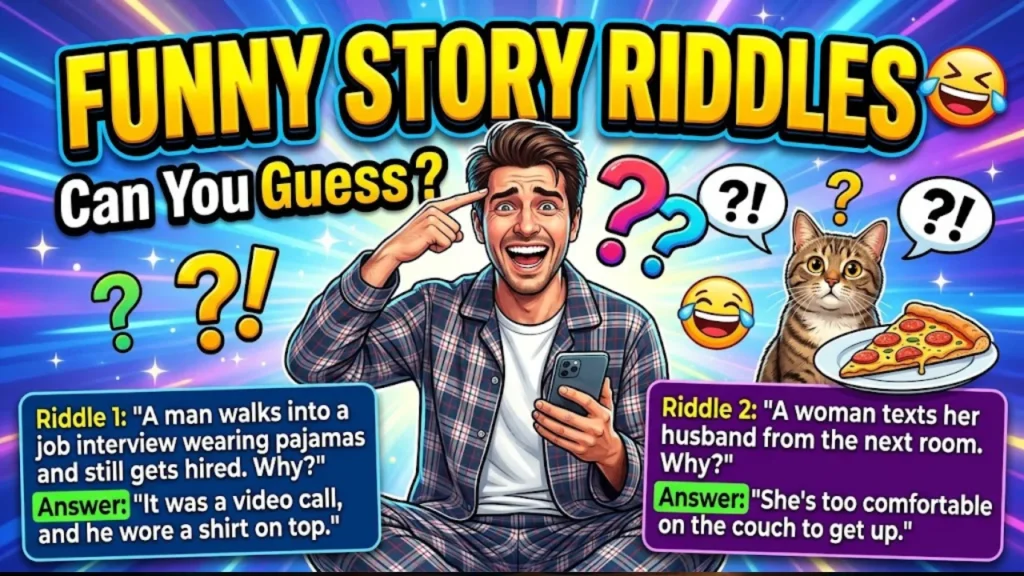
- A man walks into a job interview wearing pajamas and still gets hired. Why? It was a video call, and he wore a shirt on top.
- A woman brings her own chair to a restaurant. Why? She has back problems and needs extra support.
- A boy fails every spelling test but aces every math test. Why doesn’t his teacher worry? Because he’s in first grade, still learning to spell, and already loves numbers.
- A man orders soup and sends it back cold, twice. Why does the waiter apologize the second time but not the first? The first time it really was cold; the second time, he’d let it sit too long himself.
- A dog barks at its own reflection every morning. Why does its owner laugh? The dog has done this every day for years and never learns.
- A woman wears two different shoes to work and no one notices. Why? They’re the same style, just two different colors from two pairs — easy to miss.
- A man tells the same joke five times at dinner. Why does everyone still laugh? They’re being polite — he’s the birthday guy.
- A boy hides vegetables in his napkin at every meal. Why does his mom finally catch on? The napkin pile keeps growing under his chair.
- A cat knocks a cup off the table on purpose. Why doesn’t the owner get mad? She’s used to it — the cat does this daily, and it’s become a running joke.
- A man wears a raincoat indoors during a party. Why? He lost a bet with his friends.
- A woman answers the phone and says “hello” three times before anyone speaks. Why? It was a robocall, not a real person.
- A boy brings a pillow to class every day. Why does the teacher allow it? It’s for a “reading corner” nap-time activity.
- A man’s alarm goes off, but he keeps sleeping through breakfast. Why isn’t he worried? It’s Saturday — no work today.
- A dog waits by the door for hours, then suddenly runs off happily. Why? Its owner’s car finally pulled into the driveway.
- A woman laughs at her own joke before finishing it. Why does no one mind? She’s known for this — it’s part of her charm.
- A boy wears his shirt inside out all day at school. Why does no teacher say anything? It’s spirit week, and inside-out shirts are the theme.
- A man carries an empty lunchbox home every single day. Why is he proud of that? He always finishes his lunch — nothing goes to waste.
- A woman texts her husband from the next room. Why? She’s too comfortable on the couch to get up and ask in person.
- A boy loses at every board game but keeps asking to play. Why? He genuinely enjoys the game more than winning it.
- A man’s car alarm goes off at 3 a.m. and he sleeps right through it. Why? He parked two streets away and can’t even hear it.
- A cat sleeps 16 hours a day and still seems tired. Why doesn’t the vet worry? That’s completely normal for a healthy cat.
- A woman returns a shirt three sizes too small. Why is the cashier not surprised? It was a gift, and she never checked the size before buying it.
- A boy eats dessert first every single time. Why does his grandma allow it? She says life’s too short to save the best for last.
- A man wears mismatched socks on purpose every day. Why? It’s become his signature style at the office.
- A woman waters a fake plant every week. Why? Out of pure habit — she forgot it’s artificial.
- A boy names his goldfish after himself. Why does his dad laugh? Now every “feed yourself” reminder sounds hilarious.
- A man claps at the end of a movie in an empty theater. Why? Old habit from years of live theater work.
- A woman sets three alarms every morning. Why does she still sometimes oversleep? She hits snooze on all three without realizing it.
- A boy brings his stuffed bear to a job interview… for his mom. Why? He tagged along and refused to leave the bear in the car.
- A man tips the pizza delivery guy with a joke instead of cash first, then hands over the tip. Why does the driver laugh anyway? The joke was genuinely funny, and the tip came right after.
- A woman argues with her GPS out loud. Why doesn’t her passenger think it’s strange? Everyone in the car does it — it’s a running family joke.
- A boy insists his drawing of a circle is a “portrait.” Why does his art teacher praise it? Abstract art doesn’t need to look realistic.
- A man wears earplugs to his own birthday party. Why? His kids hired a very loud clown.
- A woman brings a fan to a cold office. Why? She sits right under the heating vent and it’s always too warm for her.
- A boy names every stuffed animal after a food. Why doesn’t anyone question it? He’s hungry most of the time and it shows.
- A man high-fives a stranger by accident. Why does the stranger high-five back? It felt more awkward not to.
- A woman writes “do not forget” on her hand, then forgets to look at it. Why does she laugh about it later? The irony wasn’t lost on her.
- A boy insists his sandwich tastes better cut into triangles. Why does his mom agree? She’s noticed he genuinely eats faster and happier that way.
- A man waves at a car thinking it’s his friend’s. Why does he keep waving even after realizing his mistake? Committing to the wave felt less embarrassing than stopping.
- A woman brings her umbrella every day for a month with no rain. Why does she finally leave it home the one day it pours? Classic bad luck — the one day she forgets, it rains.
- A boy insists on wearing a cape to the grocery store. Why does his dad not argue? Picking battles — the cape isn’t worth the fight before breakfast.
- A man sings loudly in the shower every morning. Why do the neighbors not complain? The walls are thick, and honestly, he’s pretty good.
- A woman orders a salad, then eats her friend’s fries the whole meal. Why does her friend order fries every time now? She knows exactly what’s coming and enjoys the ritual.
- A boy tells his teacher his dog ate his homework — and it’s actually true. Why doesn’t she believe him at first? Because it’s the oldest excuse in the book.
- A man buys the same coffee every day and still checks the menu each time. Why? Pure habit — he never actually reads it.
- A woman laughs at cat videos alone in a quiet room. Why does her cat get startled? The sudden laughter is loud and unexpected to the cat.
- A boy names his bike after a superhero. Why does he insist it needs a “rest day”? He’s copying his dad’s gym routine, kid-style.
- A man wears his lucky shirt to every big meeting. Why does he refuse to wash it too often? He half-believes washing it might wash away the luck.
- A woman waves goodbye to her reflection in the elevator mirror. Why does she catch herself doing it? Old habit from waving at everyone, mirror included.
- A boy insists his imaginary friend is “busy” today. Why does his family go along with it? They know it means he simply wants some quiet playtime alone.
Mystery & Detective Story Riddles
- A woman is found dead in a locked room with a puddle of water and broken glass beside her. How did she die? She stood on a block of ice to hang herself; the ice melted, leaving the puddle.
- A man is found dead in a desert, wearing only swim trunks, with a straw in his hand. What happened? His hot air balloon crashed; the straw was for breathing underground moisture, but he didn’t survive the fall.
- A woman is murdered at her home. The suspects are the maid, the cook, and the gardener. She was found strangled in her upstairs bedroom, but there’s mud on the floor leading from the window. Who did it? The gardener — his boots left the muddy trail from the garden.
- A man is found dead in a room full of water on the floor, with a broken window. What happened? A fish tank fell and broke; the man drowned trying to save the fish, or was struck by falling glass.
- Two people play five games of checkers, and each wins the same number of games with no ties. How is this possible? They were each playing different opponents.
- A man is found dead in a phone booth with the door locked from the inside. There’s no blood, no wounds, no weapon. What killed him? A heart attack — natural causes, no foul play.
- A woman gives one son 7 coins and another son 5 coins, but they end up with the same amount. How? One son received coins worth more each — different denominations.
- A man walks into a bar and asks for a glass of water. The bartender pulls out a gun. The man says “thank you” and leaves. Why? He had hiccups; the shock from the gun cured them.
- A detective finds a body in a cabin in the woods with no other structures for miles. All the doors and windows were locked from inside. How did the killer escape? The cabin was built on a frozen lake; the killer escaped through a hole in the ice below.
- A woman shoots her husband, holds him underwater for five minutes, then hangs him. Minutes later, they enjoy dinner together. How? She’s a photographer who shot, developed, and hung his photo to dry.
- A man dies in his sleep after a normal, healthy day. The autopsy shows he choked. What did he choke on? His own saliva — he had a rare medical condition. (In riddle form, often: a piece of food from a late-night snack no one else knew about.)
- A rancher’s wife locks herself in her room during a fire and dies from smoke inhalation. Neighbors say it’s suspicious. Why? She never opened the window to call for help — investigators later found she was already dead of poisoning before the fire started.
- A woman’s body is found in a park. Her diary reveals she’d written the exact date of her death a week earlier. How did she know? She had a terminal illness and had planned her own end.
- A man walks into a restaurant, orders albatross soup, tastes it, and immediately leaves and takes his own life. Why? He had once survived a shipwreck by eating what he believed was albatross meat — really human flesh. The real soup tasted different, revealing the truth.
- A detective finds a man dead at his desk with a tape recorder in hand. Playing the tape, he hears a gunshot. He immediately arrests the wife, who was seen elsewhere at the time of death. How did he know? For the recorder to capture the gunshot and then be found rewound, someone else had to rewind it after the man was already dead.
- A woman is found dead with a small pool of blood and a mirror shattered on the floor. Nothing else is disturbed. What happened? She fell after seeing something terrifying in the mirror — a reflection of the actual intruder behind her.
- A man’s car is found abandoned on a bridge, engine running, doors locked, no sign of him anywhere. What happened? He jumped from the bridge.
- A woman receives a gift box with a live snake inside, and yet is unharmed. Why? The snake was harmless, and she was actually a professional snake handler expecting the delivery.
- A man is found dead in his office, hanging from the ceiling, with a puddle of water below and no furniture nearby to have climbed on. How? Same trick as the ice-block riddle — he stood on ice that later melted.
- Police find a man dead in an elevator with the buttons for every floor pressed. What does this suggest? He was trying to alert someone on every floor for help before he died.
- A woman calls the police, says “he’s dead,” and hangs up before giving an address. They still find her in minutes. How? She called from a landline, which police can trace instantly.
- A man is found dead in the snow with no footprints leading to or from the body. How did he get there? He fell from an airplane.
- A jeweler is robbed, but nothing valuable is missing — only a cheap, ordinary-looking ring. Why did the thief take it? The ring had a hidden compartment holding something far more valuable, like a key or microchip.
- A woman’s husband disappears on their honeymoon cruise. Weeks later, she’s charged with his murder — but there’s no body. What convinced the jury? Her diary, written before the trip, detailed the exact plan.
- A detective enters a room and instantly knows the “suicide” was staged. The gun is in the victim’s right hand, but what tips him off? The victim was left-handed.
- A man dies from a single paper cut. How is this possible? The paper was laced with a deadly poison.
- Three people enter a room, only two leave alive, yet no murder took place. How? One was a woman who gave birth inside the room — three came in, but really it was two adults, and later three left (or the riddle plays on entering/leaving counts differently).
- A witness swears she saw the killer’s face clearly through a window at midnight, in total darkness, with no streetlights. How is this credible? There was a full moon providing enough light to see by.
- A man’s will leaves everything to whoever solves his final riddle. His nephew wins by realizing the “treasure” was symbolic. What was it? The old man’s wisdom and letters, not physical wealth.
- A locked safe is found completely empty, yet nothing was stolen. Why? It was always empty — the owner faked a robbery for insurance money.
- A woman is poisoned by her own perfume. How? Someone replaced it with a toxic substance in an identical bottle.
- A man survives a fall from a 10-story building with no injuries. How? He fell from the first floor, not the top.
- A body is found in a sealed room with the heater running full blast in summer. What does this suggest? The killer wanted to speed up decomposition to hide the true time of death.
- A woman confesses to a crime she didn’t commit. Why does the detective still believe her innocence? She’s protecting someone else — her confession has details that don’t match the real crime scene.
- A man is stabbed with an icicle, and there’s no weapon at the scene. How? The icicle melted after the stabbing, leaving no trace.
- A guard is found asleep at his post, yet nothing was stolen that night. Was he really asleep? No — he was faking it, having been paid off, but the thief never showed up.
- A woman’s necklace goes missing during a dinner party with only five guests present. The detective identifies the thief by their shoes. How? Mud from the garden matched only one guest’s shoes, proving they’d left through the window, not the door.
- A man dies exactly at midnight every anniversary of his father’s death, for three generations. Coincidence? No — it’s a genetic heart condition passed down in the family, triggering fatal stress at the same time each year.
- A woman is the only survivor of a plane crash in the middle of the ocean. How is she found alive days later? She clung to floating debris until a passing ship spotted her.
- A locked diary reveals the victim knew they’d be killed, yet never told anyone. Why? They didn’t believe the threat was real until it was too late.
- A man is arrested for a crime that happened while he was, provably, on the moon (an astronaut). Why does the detective still question him? He could have hired someone or planned it remotely before leaving Earth.
- A painting is stolen from a locked gallery with no broken locks or alarms triggered. How? The thief was an employee with a legitimate key and access code.
- A woman drowns in only two inches of water in her bathtub. How? She had a seizure and lost consciousness face-down.
- A man’s fingerprints are found at a crime scene he swears he’s never visited. How is this explained? Someone planted a glove or object with his prints on it.
- A hiker vanishes on a marked trail with search dogs unable to find a scent past a certain point. Why? He crossed a stream, which washed away his scent trail.
- A woman is charged for a crime confirmed by video footage, yet she has an identical twin. How does the jury still convict her? A distinguishing mark, like a scar or tattoo, was visible in the footage.
- A man’s last words, recorded by a bystander, seem to name his killer — but they don’t. What did he actually say? He was saying a name to warn someone else, not accuse anyone.
- Detectives find no forced entry, but the house was clearly robbed. How did the thief get in? Through an unlocked back door or window the homeowner forgot to secure.
- A woman is convinced her husband is being poisoned slowly. The detective agrees after tasting his tea. What confirms it? A bitter, metallic aftertaste consistent with a specific poison.
- A man’s car is towed from a scene, yet he insists he was never there. How does the detective prove otherwise? A parking ticket timestamped exactly when the crime occurred.
- A séance “medium” is exposed as a fraud during a supposed real haunting. What gave her away? She knew details only the real killer could know, revealing she was involved, not psychic.
- A man dies from a bee sting despite never being allergic before. How? Repeated exposure over the years built a sudden severe allergic reaction.
- A woman’s dog barks at an empty room every night at 2 a.m. What does the investigation reveal? A gas leak the family couldn’t smell but the dog could detect.
- A safe-cracker is caught because of a sound only he could produce. What was it? The specific click pattern of the tumblers, recorded by a hidden device.
- A detective solves a cold case decades later using a single overlooked detail. What was it? A timestamp on a photo that placed the suspect at the scene.
- A man confesses under hypnosis to a crime with details police never released. Is he guilty? Yes — only the real culprit would know those specific unreleased details.
- A woman is found alive after being “dead” for three days in a morgue. How? She was in a deep coma, mistakenly declared dead.
- A house alarm never triggers during a break-in, even though it was armed. Why? The thief knew the code — an inside job.
- A body is found with no signs of struggle, yet clearly a murder. How do detectives know? Toxicology reveals poison, not a physical attack.
- A man’s alibi checks out perfectly, yet the detective still suspects him. Why? The alibi is too perfect and rehearsed, raising suspicion of premeditation.
Hard & Tricky Story Riddles for Adults
- A father has five daughters. Each daughter has one brother. How many children does the father have? Six — all five daughters share the same one brother.
- A man builds four walls facing south, and a bear walks by. What color is the bear? White — the house is at the North Pole, so it must be a polar bear.
- A woman gives her son half her age, and he becomes twice as old as she’ll be in ten years. What are their current ages? This depends on setup, but the classic solve: mother is 40, son is 10 — check the specific ratios stated.
- Three doctors say Robert is their brother, but Robert says he has no brothers. How? The three doctors are Robert’s sisters.
- A man is looking at a photo. Someone asks who it is. He says, “Brothers and sisters I have none, but that man’s father is my father’s son.” Who is in the photo? His own son.
- A woman leaves home, makes three left turns, and returns home to find two men wearing masks. Who are they? The catcher and the umpire at a baseball game.
- A prisoner is told, “If you tell a lie, we’ll hang you. If you tell the truth, we’ll shoot you.” What does he say to survive? “You will hang me” — creating a paradox that spares him either way.
- A man leaves his ranch to his three sons. He says whoever’s horse arrives at the town last will win. The sons ride painfully slow for days. A stranger whispers something, and they suddenly race full speed. What did the stranger say? “Switch horses” — since it’s the horse arriving last that wins, not the rider.
- A woman has two coins totaling 30 cents, and one of them isn’t a nickel. What are the coins? A quarter and a nickel — only one of the two isn’t a nickel; the other one is.
- A man is sentenced to choose one of two rooms: one has a raging fire, the other a group of assassins with loaded guns that fire once a year. Which does he pick to survive longest? The assassins’ room — their guns only fire once a year.
- A farmer has a fox, a chicken, and a bag of grain. He can carry only one across the river at a time, but if left alone, the fox eats the chicken, or the chicken eats the grain. How does he get all three across? Take the chicken first, return empty, take the fox, bring the chicken back, take the grain, return empty, take the chicken.
- A woman is trapped in a room with only a table and a mirror. How does she escape? She looks in the mirror, sees what she “saw,” takes the saw, and cuts the table in half — two halves make a whole, and she climbs out the hole.
- A man has to get a wolf, a goat, and a cabbage across a river with the same one-at-a-time restriction and conflicting appetites. What’s his solution? Take the goat first, return, take the wolf, bring the goat back, take the cabbage, return, take the goat again.
- A woman walks into a room with a match, an oil lamp, a candle, and a fireplace. Which does she light first? The match.
- A king tells 100 prisoners each will be shown 99 hats — everyone’s but their own — and must guess their own hat color without communicating. How do they all guess correctly? They agree beforehand that each says the color they see most, using parity logic to deduce their own.
- A man has 12 balls, one of which is heavier or lighter than the rest. Using a balance scale only three times, how does he find the odd ball? Divide into groups of four, weigh, narrow down using a specific comparison sequence — solvable in exactly three weighings.
- Two guards stand before two doors — one leads to freedom, one to death. One guard always lies, one always tells the truth, but you don’t know which is which. You may ask one question. What do you ask? “What would the other guard say is the door to freedom?” Then pick the opposite door.
- A man is given two ropes, each burning unevenly but taking exactly one hour to burn fully. How does he measure 45 minutes? Light one rope at both ends and the other at one end simultaneously; when the first rope burns out (30 min), light the second rope’s other end — it finishes 15 minutes later.
- A woman has to cross a bridge that only holds two people at a time, at night, with one flashlight and four people of different walking speeds. What’s the fastest way across? Send the two fastest first, one returns with the light, the two slowest go together, then the two fastest finish.
- A man is in a room with two exits — one is certain death, the other freedom — guarded by two robots, one that always lies and one that always tells the truth. How does he identify the safe door in one question? Same as the guard riddle — ask what the other robot would say, then choose the opposite.
- A woman needs exactly 4 liters of water using only a 3-liter and a 5-liter jug. How does she do it? Fill the 5L, pour into 3L until full (2L left in 5L), empty the 3L, pour the 2L into 3L, fill the 5L again, top off the 3L (needs 1L), leaving exactly 4L in the 5L jug.
- A man says, “Everything I say is a lie.” Is he telling the truth? No — this creates a logical paradox known as the liar’s paradox; it can’t be consistently true or false.
- A woman has three boxes labeled “Apples,” “Oranges,” and “Apples & Oranges” — but all labels are wrong. She may pick one fruit from one box to correctly relabel all three. Which box does she choose? The box labeled “Apples & Oranges” — since all labels are wrong, it must contain only one fruit type, revealing the rest by elimination.
- A man is stuck on an island with two paths — one leads to safety, one to danger — guarded by twin sisters, where one always lies and one always tells the truth. What single question saves him? Ask either sister what the other would say, then take the opposite path.
- A woman has 8 identical-looking coins, one counterfeit and lighter. Using a balance scale twice, how does she find it? Split into groups of 3, 3, and 2; weigh the two groups of three first, then narrow further based on the result.
- A man crosses a desert with only enough water for himself, no vehicle, and 100 miles to go, arriving alive with water to spare. How? He traveled at night to avoid heat and dehydration, resting during the day.
- A woman flips a coin 10 times and gets heads every time. What’s the probability the 11th flip is heads? Still 50% — each flip is independent of the last.
- A man is asked to divide 10 apples among 3 kids so each gets an equal whole number, with none left over, without cutting any apple. Is it possible? No — 10 isn’t evenly divisible by 3 without cutting or leftovers.
- A woman has a 5-gallon jug and a 3-gallon jug and needs exactly 1 gallon. What’s the fewest steps? Fill the 3-gallon, pour into 5-gallon, refill 3-gallon, pour into 5-gallon until full — 1 gallon remains in the 3-gallon jug.
- A man knows one of two identical twins always lies, but he doesn’t know which. He needs directions to town and can ask only one twin one question. What does he ask? “If I asked your brother which way to town, what would he say?” Then go the opposite way.
- A prisoner has to choose between three doors: one leads to certain death by fire, one by drowning, one by lions who haven’t eaten in three years. Which door is safest? The lion door — lions that haven’t eaten in three years would already be dead.
- A man has a 100-foot rope and needs to lower a bucket down a 150-foot well. How? He ties the rope to the bucket handle and lowers it as far as it reaches, using a secondary method (like a pole) for the remaining distance, or the riddle implies it’s simply impossible without more rope — the twist is realizing the “trick” answer.
- A woman is asked to name a number that, when doubled, is the same as when 5 is added to it. What’s the number? 5.
- A man has to weigh exactly 40 pounds using only 4 weights and a balance scale, placing weights on either side. Which four weights? 1, 3, 9, and 27 pounds — using powers of three lets him measure any whole number up to 40.
- A woman is told a jar has 100 red and blue marbles combined. She must arrange them into two jars to maximize her odds of picking red blindfolded. What’s the best strategy? Put just 1 red marble alone in one jar, and the rest in the other — maximizing overall probability above 50%.
- A man needs to get exactly 6 liters using a 4-liter and a 9-liter jug, with unlimited water. How? Fill the 9L, pour into 4L (leaves 5L in 9L), empty 4L, pour the 5L into 4L (1L over capacity remains conceptually — actual solve requires refilling steps to isolate 6L through the standard water-jug algorithm.
- A woman’s riddle: “I am taken from a mine, shut up in a wooden case, from which I am never released, and yet I am used by almost every person.” What is she describing? Pencil lead (graphite).
- A man realizes his watch is 10 minutes fast, but he never resets it. Why? It keeps him from ever being late — a habit he built on purpose.
- A woman needs to know if a scale showing a heavier or lighter coin among 9 coins is off, using the scale only twice. How? Divide into 3 groups of 3, weigh two groups against each other, then narrow to the odd coin with the second weighing.
- A man’s riddle: “The more there is, the less you see.” What is it? Darkness.
- A woman gives her friend a riddle: “What runs but never walks, has a mouth but never talks?” What’s the answer? A river.
- A man’s final answer to “What can be broken but never held?” leaves everyone stumped. What is it? A promise.
- A woman asks, “What has a heart that doesn’t beat?” Her friend guesses wrong twice before getting it. What is it? An artichoke (or a deck of cards).
- A man says, “I am not alive, but I grow. I don’t have lungs, but I need air. I don’t have a mouth, but water kills me.” What is he? Fire.
- A woman poses: “What can you keep after giving it to someone else?” What’s the trick answer? Your word (a promise), or “your word” in a conversation.
- A man’s riddle stumps the whole dinner table: “What has many keys but can’t open a single lock?” What is it? A piano.
- A woman asks her coworkers: “The person who makes it sells it. The person who buys it never uses it. The person who uses it never sees it.” What is it? A coffin.
- A man’s tricky question: “What goes up but never comes down?” leaves the room silent. What’s the answer? Your age.
- A woman challenges her book club: “What can travel around the world while staying in one corner?” What is it? A postage stamp.
- A man asks, “What has a bottom at the top?” What’s the answer? Your legs.
- A woman’s brainteaser: “What word looks the same upside down and backward?” What is it? SWIMS.
- A man’s riddle: “I have a golden head and a golden tail, but no golden body. What am I?” leaves guests guessing coins. What’s correct? A gold coin.
- A woman asks, “What five-letter word becomes shorter when you add two letters to it?” What’s the trick? “Short” — adding “-er” makes “shorter.”
- A man’s puzzle: “Forward I am heavy, backward I am not.” What word fits? “Ton” — backward it’s “not.”
- A woman’s final challenge of the night: “What can fill a room but takes up no physical space?” What’s the answer? Light (or sound).
- A man asks a group: “What begins with an E, but only has one letter?” What’s the twist answer? An envelope.
- A woman’s puzzle stumps a whole classroom: “What English word retains the same pronunciation, even after you take away four of its five letters?” What is it? “Queue” — pronounced the same as just “Q.”
- A man’s final riddle before bed: “What has one head, one foot, and four legs?” What is it? A bed.
- A woman challenges her sister: “What can you break without touching it?” What’s the answer? A promise.
- A man’s last brainteaser of the party: “I’m light as a feather, yet the strongest person can’t hold me for more than a few minutes.” What am I? Breath.
Classic Long Story Riddles
- A merchant travels to sell silk in a distant village. He carries exactly 100 coins. He spends 40 on rent for a stall, doubles his money selling silk, then loses half to a thief. How many coins does he have left? 120 coins — (100−40=60, doubled to 120, then halved to 60… actually following steps exactly: 60 doubled is 120, halved by theft leaves 60.
- Three travelers stop at an inn with only two rooms left. The innkeeper charges $30 total, split evenly at $10 each. Later, he realizes he overcharged and sends $5 back with a bellboy, who pockets $2 and gives $1 back to each traveler. Each traveler paid $9, totaling $27, plus the $2 the bellboy kept equals $29. Where did the missing dollar go? There is no missing dollar — the math is a misdirection; $27 already includes the bellboy’s $2, and adding them again is the error.
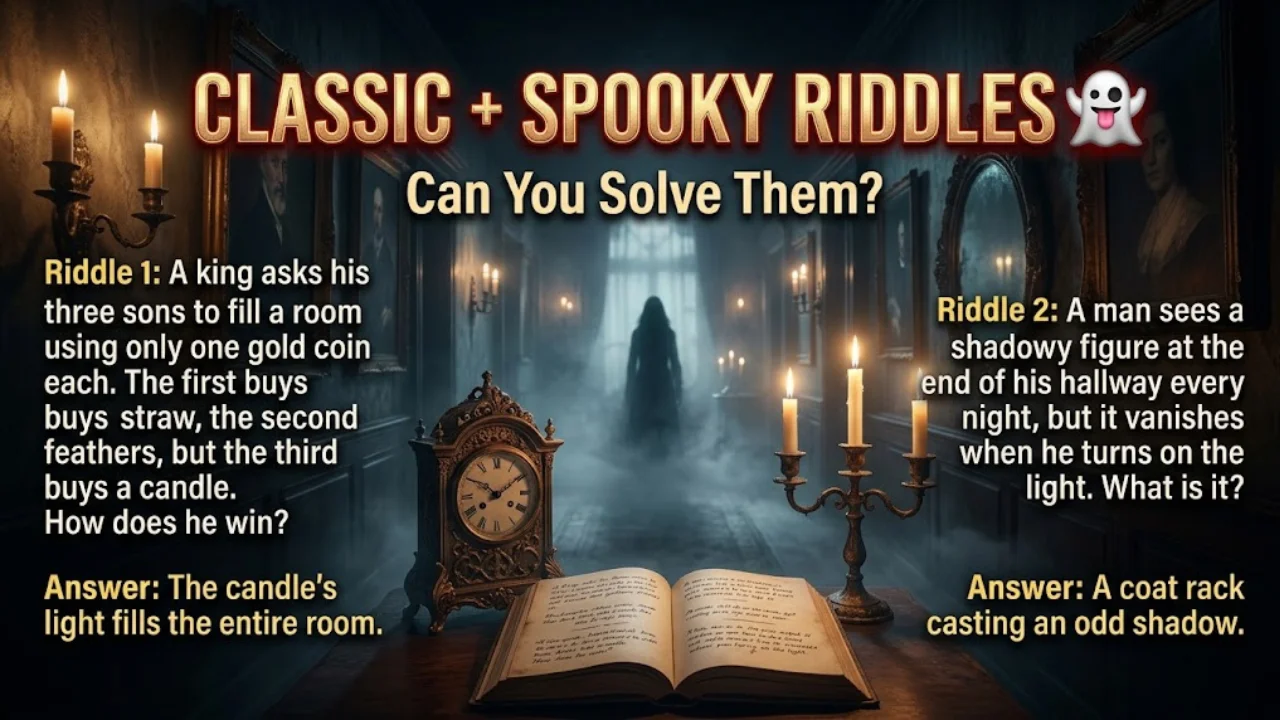
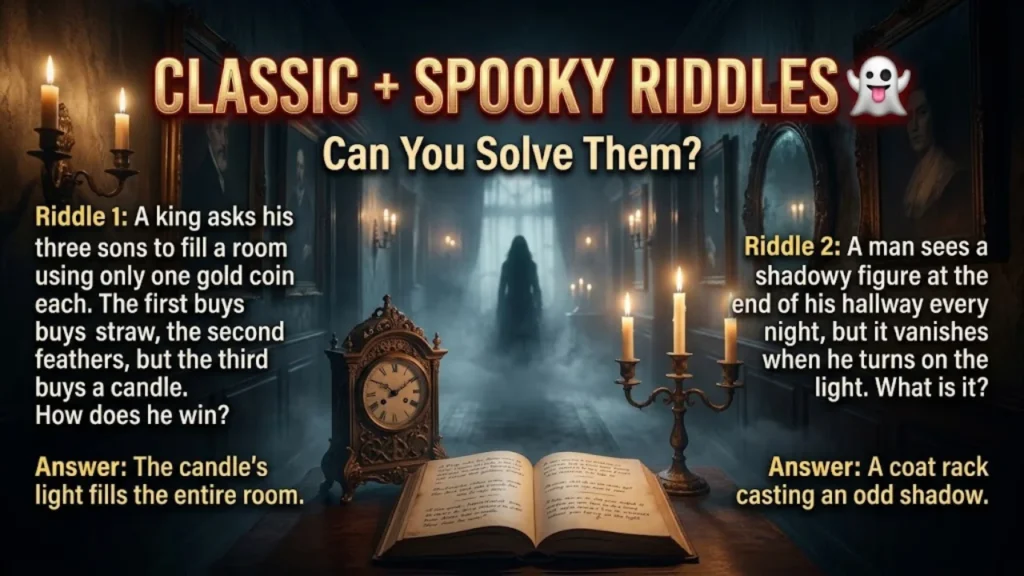
- A king asks his three sons to fill a room with something using only one gold coin each. The first buys straw, the second buys feathers, neither fills the room. The third buys a candle. How does he win? Light fills the entire room.
- A wealthy landowner has 17 horses to divide among his three sons: half to the eldest, a third to the second, a ninth to the youngest — impossible without splitting a horse. A wise traveler solves it. How? He adds his own horse, making 18 — divided evenly into 9, 6, and 2 (totaling 17), then takes his horse back.
- A young weaver is told she’ll inherit her father’s fortune only if she can fold a piece of cloth in half more than seven times. She insists it’s impossible with any cloth, regardless of size. Is she right? Yes — physical folding limits make it practically impossible past 7-8 folds due to exponential thickness growth.
- A traveling monk is given a riddle by a village elder: bring back something that is both perfectly true and perfectly false. He returns a mirror. Why does the elder accept it? A reflection shows true likeness, yet it’s a false, reversed version of reality.
- A blacksmith is challenged to make a chain that can hold a fire yet never burn. He forges one from iron. Why does it work? A metal chain can hold burning coals without catching fire itself.
- A shepherd boy is asked by a wise woman to bring her silence in a jar. He returns with an empty, sealed jar. Why does she smile? An empty sealed jar holds no sound — it’s silence itself.
- A queen orders her gardener to grow a flower that blooms without water, sunlight, or soil. He presents a paper flower. Does this satisfy her? Yes — technically it “blooms” without needing any of those things, fulfilling the letter of the request.
- A traveling merchant is asked to sell “nothing” for a high price and succeeds. What does he sell? Empty jars, marketed as “containers of nothing,” or air in a bottle as a novelty.
- A poor farmer is told he can keep any land he can walk around in one day, but must return to his starting point by sunset or lose everything. He walks a huge loop and barely makes it back, collapsing from exhaustion. What lesson does the story teach? Greed for more land pushed him past his limits — a warning against overreaching.
- A wise old woman gives a young prince three sealed boxes: one gold, one silver, one lead, each with a riddle-inscription, to find his bride’s portrait. The gold box says “what you seek is within,” but is empty. Which box holds the real prize? The lead box, since it holds true value beneath a plain exterior — a lesson that appearances deceive.
- A traveler is caught in a storm and takes shelter in an abandoned house rumored to be cursed. In the morning, he finds no ghost — only an old caretaker who lit candles at night to scare off looters. What’s the “curse”? A clever hoax to protect an empty, valuable estate from thieves.
- A young apprentice is told by his master to bring back “time” in a box. He returns with a broken hourglass. Why does the master approve? A broken hourglass no longer measures time, symbolically containing “stopped” or captured time.
- A ship’s captain is told the only way to survive a storm is to throw away something valuable. He throws his anchor overboard. How does this save the ship? A stuck anchor can trap a ship in a storm; releasing it lets the vessel move freely with the waves instead of resisting.
- A hermit tells visitors he never lies but also never tells the whole truth. A traveler asks him the way home and reaches it safely. How? The hermit gave a true but incomplete direction, and the traveler pieced together the rest using landmarks himself.
- Two brothers inherit a field and are told to divide it fairly without a scale or exact tools. One cuts the field in half; the other picks which half he wants. Why is this a fair solution? The cutter is motivated to divide evenly, since he doesn’t know which half he’ll end up with.
- A miller’s daughter is asked to spin straw into gold or lose her freedom. She strikes a bargain with a mysterious stranger who does it for her, in exchange for her firstborn. What must she later guess to break the deal? His true name.
- A wandering bard is challenged to sing a song with no words and still make the king weep. He simply plays a slow melody on his flute. Why does it work? Music alone can convey deep emotion without lyrics.
- A caravan of traders is stopped by a river with no bridge and heavy cargo. A boy suggests freezing barrels of water to build a temporary crossing in winter. Does the plan work? Yes — solid ice can support weight when thick and cold enough, forming a natural bridge.
- A villager claims he can predict the weather better than the town’s official forecaster, using only his aching knee. Is he believable? Yes — changes in air pressure before storms can genuinely cause joint pain in some people, a real physiological effect.
- A young girl is told by a witch she’ll turn to stone if she looks back while leaving the forest. She keeps her eyes forward and escapes safely. What’s the hidden lesson? Sometimes moving forward without dwelling on the past is the only way out of a difficult situation.
- A knight is told the dragon guarding the treasure only attacks those who show fear. He walks in calmly and takes the gold unharmed. Was the dragon real? No — it was an illusion crafted to scare off anyone lacking confidence or nerve.
- A fisherman catches a talking fish who promises three wishes for its freedom. His wife’s greed for each wish leads them back to where they started. What’s the moral? Greed and never being satisfied leaves you exactly where you began.
- A traveling tinker fixes a broken clock in a haunted mansion, and the “haunting” stops immediately after. What was really happening? The old, malfunctioning clock’s erratic ticking and chiming had been mistaken for ghostly activity.
- A poor tailor outsmarts a giant by claiming to have killed “seven in one blow” — actually seven flies. The giant, intimidated, avoids a real fight. What lesson does this teach? Clever wordplay and confidence can outmatch brute strength.
- A young scholar is asked to prove the earth is round using only a stick and the sun’s shadow. He measures shadow angles at two locations and calculates the earth’s curvature. Whose real historical method does this resemble? Eratosthenes’ ancient method of measuring the Earth’s circumference.
- A desert nomad survives three days without water by drinking from a hidden source only locals know about. What is it? Water stored inside certain cactus plants or found in underground oases.
- A castle’s guards are all found asleep at their posts every single night, yet nothing is ever stolen. Investigators find the answer in the kitchen. What is it? The cook was drugging the guards’ nightly stew by mistake, using a strong sleep-inducing herb.
- A traveling merchant always arrives in town exactly on market day, despite having no calendar. How? He follows the moon’s phases, which the town’s market schedule is based on.
- A young monk is told enlightenment lies at the top of the mountain. After a brutal climb, he finds nothing there. What does his master say when he returns? The journey itself, not the summit, was the lesson.
- A carpenter builds a bridge that seems too weak to hold any weight, yet it never collapses for decades. What’s his secret? Flexible wood joints that bend slightly under weight instead of resisting and snapping.
- A wandering minstrel wins a singing contest against a rival with a far better voice, simply by choosing a song everyone in the crowd already knew and loved. Why did this work? Audience familiarity and emotional connection outweighed pure vocal skill.
- A blind beggar is somehow never robbed in the roughest part of the city, while sighted merchants often are. Why? Thieves assume a blind man has nothing worth stealing, so they overlook him entirely.
- A young girl outwits a hungry wolf by leading it in circles around her grandmother’s cottage until it collapses from exhaustion. What survival lesson does this reflect? Outlasting a stronger opponent through patience and strategy rather than direct confrontation.
- A traveling apothecary sells a “cure-all” tonic that actually does nothing but still helps most of his customers. Why? The placebo effect — belief in a cure can genuinely ease symptoms.
- A shipwrecked sailor survives alone on an island for a year using a system of mirrors. What was his method? Using mirror flashes to signal passing ships for rescue, while also using reflected sunlight to start fires for warmth and cooking.
- A young inventor is mocked for building a “useless” machine that only spins in circles. Years later, it becomes the basis for something essential. What might it be? An early prototype of a wheel-based mechanism, like a water wheel or turbine.
- A wise judge settles a dispute between two women both claiming the same baby by threatening to split the child in half. One agrees, one begs him to spare the baby and give it to the other. Who does the judge rule is the real mother? The woman who begged to spare the child — true love wouldn’t allow harm.
- A traveling storyteller earns his keep in every village by telling the same tale, yet no one ever tires of it. Why? He adapts small details each time to fit the local audience, making it feel fresh.
Spooky Story Riddles
- A girl hears footsteps behind her on an empty street every night, but turning around, she sees no one. What’s really happening? Her own echo bouncing off the buildings around her.
- A family moves into an old house, and every night at midnight, a door creaks open on its own. What’s the real cause? A drafty window causing air pressure changes that push the door.
- A man sees a shadowy figure standing at the end of his hallway every night, but it vanishes when he turns on the light. What is it? A coat rack casting an odd shadow in the dark.
- A child claims an “imaginary friend” moves objects around her room at night. Her parents finally catch the culprit. Who is it? The family cat, sneaking in through a cracked door.
- A group of campers hears howling in the woods every night at the same hour, but find no wolves nearby. What’s the source? Wind blowing through a narrow rock formation, creating an eerie howling sound.
- A woman wakes up every night at exactly 3:13 a.m., convinced something is watching her. What turns out to be the cause? A streetlight outside her window flickers on a timer at that exact time, catching her attention subconsciously.
- A man hears whispers coming from his walls every night. An inspector finds the source. What is it? Old pipes expanding and contracting, creating whisper-like sounds.
- A haunted painting in a mansion seems to have eyes that follow visitors. What’s the trick? The eyes are painted using a technique that creates the illusion of movement from any viewing angle.
- A girl finds her music box playing on its own in the middle of the night. What’s really happening? A small mechanical flaw causes it to trigger from vibrations, like passing traffic.
- A man swears his reflection blinked out of sync with him one night. What’s the likely explanation? A trick of dim lighting and exhaustion playing tricks on his perception.
- A family hears scratching inside their walls every night for a week. An exterminator solves the mystery. What’s inside? A family of raccoons or squirrels nesting between the walls.
- A woman’s candle keeps blowing out every time she enters a specific room, despite no windows or drafts. What’s the true cause? A tiny, hard-to-spot gap under the door letting in a steady draft.
- A man claims his old grandfather clock chimes thirteen times on the anniversary of a family tragedy. What’s really happening? A mechanical fault causes it to overcount occasionally, coincidentally landing on that date.
- A group of teens dares each other to spend a night in an abandoned asylum. They hear distant laughter but find no one. What’s the source? Sound traveling strangely through the old building’s pipes and vents from a nearby street.
- A woman insists her house is haunted because lights flicker whenever she mentions a certain name. What’s the actual explanation? Faulty, aging wiring causing random flickers unrelated to what’s said.
- A man wakes up to find muddy footprints leading from his back door to his bed, though he lives alone. What’s the real story? He sleepwalked outside during a storm the night before and doesn’t remember.
- A girl hears her name called from the backyard late at night, but no one is there when she looks. What’s really happening? A neighbor’s radio or TV carrying voices on the night wind.
- A haunted mirror in an antique shop is said to trap the reflections of anyone who touches it after dark. Why does the shop owner refuse to sell it? It’s simply an old marketing legend he uses to make the mirror seem valuable and mysterious.
- A man hears his name whispered right as he falls asleep every night, for weeks. A sleep doctor finally explains it. What is it? A hypnagogic hallucination — a common, harmless auditory illusion during the transition into sleep.
- A family’s dog refuses to enter one specific room in their new house, growling at nothing visible. What eventually explains it? A high-pitched sound from an old, failing electrical device, audible only to the dog’s sensitive hearing.
- A visitor to an old lighthouse swears she saw a lantern light moving on its own in the tower at night. What’s the true cause? A rotating beacon mechanism still partially functional, moving with leftover momentum from wind.
- A man’s basement light turns on by itself every night at the same time, though the switch is untouched. What’s really going on? A faulty timer switch installed by a previous owner still running on its old schedule.
How to Solve Story Riddles Like a Pro
Getting good at story riddles with answers isn’t about being naturally clever — it’s about training a few specific habits.
Read the story twice. The first read gives you the plot. The second read is where you spot the detail that doesn’t quite add up — the “swim trunks in the desert,” the “locked room with no furniture.”
Question your first assumption. Most story riddles work because your brain jumps to the obvious answer immediately. If the obvious answer feels too easy, it’s probably wrong.
Look for missing information, not extra information. A story riddle rarely wastes words. If a detail feels random — a straw, a mirror, an ice cube — it’s usually the key to the whole puzzle.
Think outside normal rules. Many story riddles involve professions, seasons, or physical facts most people forget in the moment — melting ice, frozen lakes, mirrors, or reflections.
Say it out loud. Talking through the riddle, especially with someone else, often surfaces the twist faster than silent reading.
FAQs
What are the top 10 hardest riddles?
The hardest story riddles usually combine misdirection with logic, like the locked-room murder riddles (#111, #119, #129), the two-guard truth/lie puzzles (#187, #190), the twelve-balls weighing riddle (#186), and the wolf-goat-cabbage river crossing (#183). What makes them hard isn’t complexity — it’s the false assumption they lean on.
What are 20 riddles?
“20 riddles” usually refers to a short, mixed set — a handful of easy, funny, and tricky riddles bundled together for quick fun. You’ll find exactly that mix in the short and easy section above (riddles #1–#20), covering everyday objects, simple logic, and family-friendly humor.
What are some good short riddles?
Good short riddles are quick to read but still require a second of thought — like the “candle” riddle (tall when young, short when old) or the “footsteps” riddle (the more you take, the more you leave behind). The short and easy section (#1–60) is built exactly for this — quick setups, quick payoffs.
What’s the easiest riddle ever?
One of the easiest and most well-known is the one-story house riddle: “What color are the stairs in a one-story house?” (There are no stairs.) It’s popular because the answer isn’t hidden in wordplay — it just requires noticing a detail everyone assumes without thinking.
What is the hardest short riddle?
Despite being just a few sentences, riddle #178 (the horse race with switched horses) and riddle #187 (the two guards, one who lies) are considered some of the hardest short riddles because the solution requires flipping the entire logic of the question, not just guessing an object.
Conclusion
Story riddles reward patience more than raw intelligence. Every single one in this list — whether it’s a quick kid-friendly puzzle or a genuinely tricky detective mystery — follows the same basic rule: look past the obvious, and the answer is usually hiding in plain sight.
Bookmark this page, pick a favorite category, and try a few on your family, your classroom, or your next road trip. And if one of these story riddles completely stumps you, that’s usually the sign it’s a good one.

Amelia Singh is a content strategist and digital writer specializing in curated web directories, cultural quote archives, and instructional content. She is dedicated to creating clear, engaging, and reliable digital resources for readers worldwide.